
Riparian Management Challenges in Wodonga
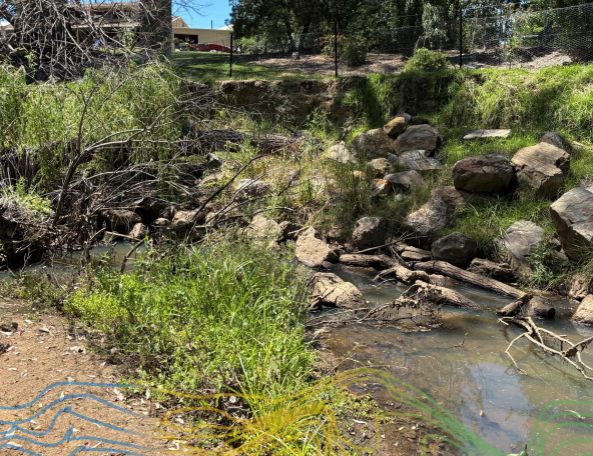
The release of the House Creek Remediation Plan by the North East Catchment Management Authority (NECMA) in Wodonga marks a significant pivot in how riparian corridors are managed and restored in Victoria. Historically, severe streambank erosion in urban and peri-urban interfaces has been treated primarily as a hydraulic civil engineering challenge. The default response of municipal authorities and land developers was often the installation of hard, rigid infrastructure, such as concrete channelisation or heavy rock armouring, to rapidly convey floodwaters and lock banks in place. This project, however, establishes a new benchmark by treating erosion control and ecological restoration as a single, integrated objective.
As a key milestone for the statewide Platy Patch project, this remediation plan is supported by collaborative funding from the Australian Federal Government, the Victorian State Government, and the Ross Trust. The initiative represents a strategic shift away from the expensive and ecologically sterile civil works of the past, focusing instead on dynamic, soft-engineered interventions. For environmental professionals, planners, land developers, and legal advisors, this plan demonstrates how riparian management can satisfy both structural stabilisation mandates and stringent biodiversity recovery requirements.
In the context of rapid regional expansion, particularly in corridors like Wodonga, the historical neglect of natural catchments has led to accelerated erosion, channel incision, and the degradation of critical aquatic habitats. The House Creek Remediation Plan addresses these challenges head-on by targeting the specific microhabitat requirements of the platypus (Ornithorhynchus anatinus) and other threatened aquatic species. By implementing these measures, the plan showcases a repeatable framework for restoring geomorphic stability while actively enhancing ecological value.
Soft-Engineered Solutions for Platypus Habitat
At the core of the House Creek Remediation Plan is a transition from static, hard-engineered stabilisation to dynamic, bio-engineered soft engineering. Traditional civil engineering relies on materials like concrete, steel, and imported rock to resist the hydraulic forces of flowing water. In contrast, soft engineering works with the natural geomorphic processes of the waterway, using organic materials and living vegetation to dissipate energy and bind soils. The plan specifies the installation of locally sourced hardwood structures, such as root wads, log deflectors, and large woody debris, which are strategically anchored into the streambanks. These timber structures are engineered to increase the hydraulic roughness of the channel boundary, which directly reduces the velocity of the water and lowers the shear stress exerted on vulnerable bank soils during high-flow storm events.
By slowing the flow of water, these hardwood installations encourage the natural deposition of suspended sediment, allowing the creek banks to naturally rebuild and stabilise over time. This process not only mitigates ongoing erosion but also restores the natural geomorphic diversity of the stream channel, creating a mosaic of pools, riffles, and runs. The placement of large woody debris is carefully calibrated to create localised scour holes and deep pools, which serve as essential thermal refuges for aquatic species during the hot summer months when water temperatures in shallow, unshaded channels can reach lethal limits.
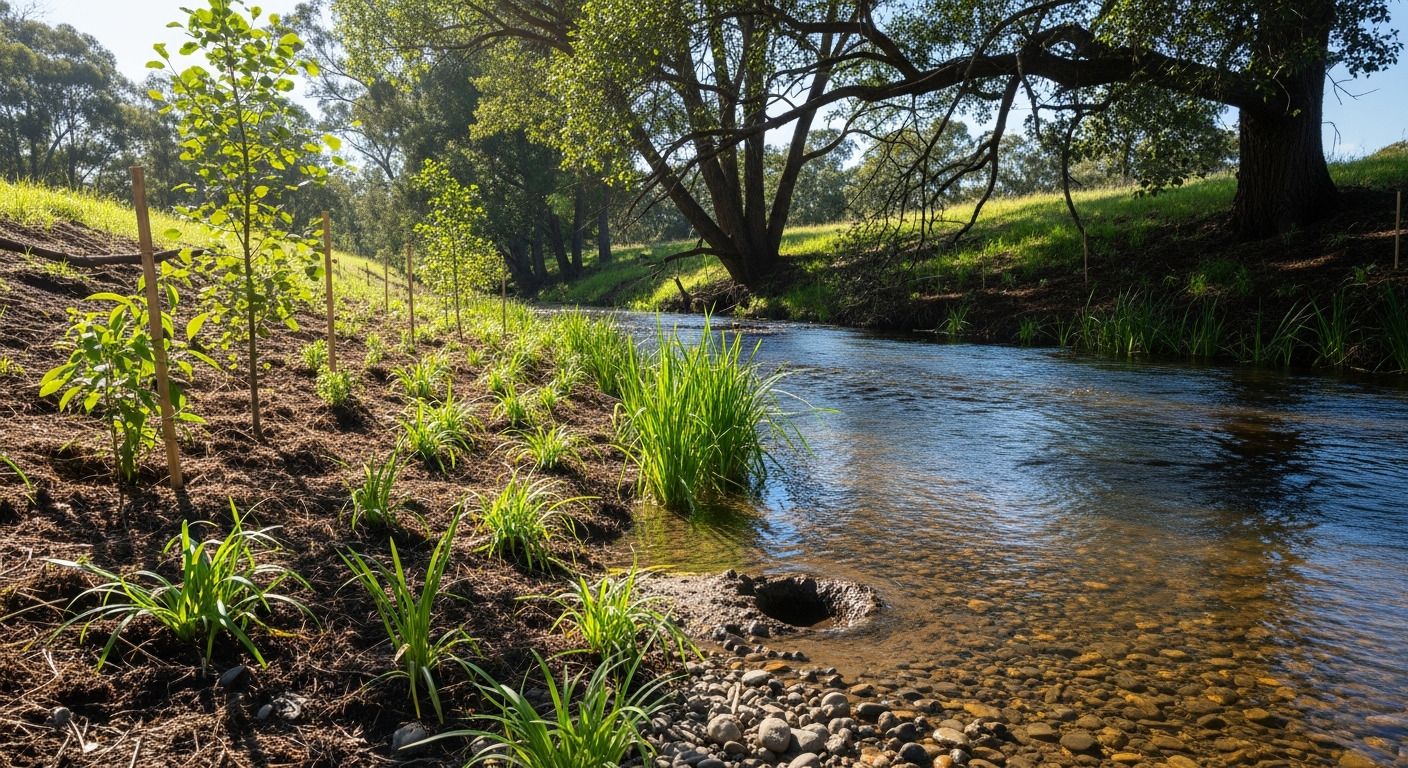
The biological design parameters of the plan are specifically tailored to the life-history requirements of the platypus. Platypuses require stable, cohesive earthen banks that are free from rigid rock armouring or concrete linings, as these artificial materials prevent them from excavating their complex nesting and resting burrows. The House Creek plan achieves bank stability without compromising burrowing habitat by combining timber structures with dense, progressive bio-engineering techniques. This involves planting indigenous vegetation species with high root-tensile strength, such as Carex fascicularis, Melaleuca ericifolia, and Eucalyptus camaldulensis (River Red Gum), directly into the bank matrix. As these plants grow, their root systems interweave to form a living, self-healing reinforcement structure that binds the soil far more effectively than synthetic geotextiles.
Additionally, the plan addresses the critical food web dynamics of the creek. Platypuses are opportunistic carnivores that feed almost exclusively on benthic macroinvertebrates, including caddisfly, mayfly, and stonefly larvae. These insect species require clean, well-aerated gravel substrates and complex organic matter, such as submerged logs and leaf litter, to thrive. By replacing sterile concrete or rock surfaces with complex hardwood structures and diverse native vegetation, the remediation plan actively promotes the colonisation of these key prey species. This integrated approach ensures that the physical restoration of the creek channel directly translates into a functional, self-sustaining ecosystem capable of supporting viable platypus populations over the long term.
Victorian Regulatory Frameworks for Catchment Protection
The implementation of the House Creek Remediation Plan must be viewed within the context of Australia’s evolving environmental regulatory landscape. Historically, riparian management in Victoria was dictated by the Catchment and Land Protection Act 1994 (Vic), which focused primarily on preventing soil erosion and land degradation to protect agricultural productivity and water resources. While these goals remain critical, modern practitioners must now navigate a much more complex web of legislation that places equal emphasis on biodiversity conservation, ecological health, and risk prevention. This includes the Victorian Flora and Fauna Guarantee Act 1988 (Vic), under which the platypus was formally listed as a threatened species in Victoria in 2021.
References and related sources
- Primary source: www.necma.vic.gov.au
- NEPM Assessment of Site Contamination
- EPBC Act
How iEnvi can help
iEnvi provides specialist consulting services relevant to this topic. Our team includes CEnvP Site Contamination Specialists with experience across contaminated land, groundwater, remediation, ecology, and regulatory compliance.
- iEnvi remediation services
- iEnvi contaminated land investigation services
- iEnvi expert services and independent review services
This is an iEnvi Machete news summary. Prepared by iEnvi to summarise the source article for contaminated land, groundwater, remediation, approvals and site risk professionals.
Published: 17 Jun 2026
Need advice on this topic? Speak to an iEnvi expert at info@ienvi.com.au or 1300 043 684, or contact us online.
Need advice on this issue? iEnvi provides practical, senior-led environmental consulting across contaminated land, remediation, ecology and environmental risk.
Team credentials Flora and fauna assessment Contaminated land services Remediation services Talk to iEnvi