
Overview
On 10 June 2025, German cognitive robotics company NEURA Robotics announced the close of a Series C funding round of up to USD 1.4 billion, making it the largest capital raise ever recorded for a full-stack robotics company. The round was led by Tether, the stablecoin issuer, and supported by a consortium that includes NVIDIA, Amazon, Qualcomm Technologies, Bosch, Schaeffler, imec.xpand, and the European Investment Bank. The announcement marks a clear inflection point in the global technology landscape, signalling that the next major wave of investment is moving beyond software-based artificial intelligence toward what the industry is calling Physical AI, where digital reasoning is embedded in machines capable of operating in unstructured, real-world environments.
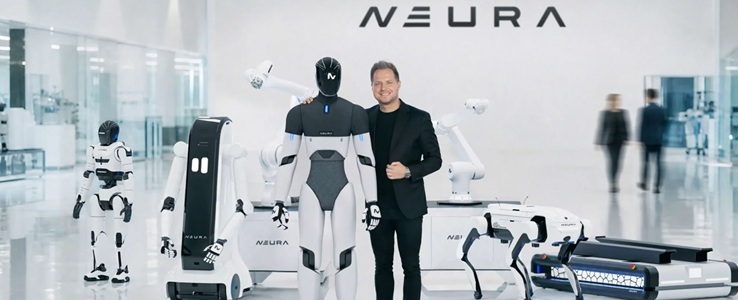
NEURA Robotics is headquartered in Metzingen, Germany, and has developed a portfolio of cognitive humanoid robots, including its flagship 4NE1 platform. The company reports an existing order backlog exceeding EUR 1 billion, backed by substantial commitments from its industrial partners. The capital raised in this round will be directed toward scaling serial production to several million robot units by 2030 and financing the global rollout of NEURA Gyms, large-scale real-world training facilities purpose-built to generate the movement and sensory data required to train physical AI models at scale.
For professionals operating in industries that depend on physical labour, site management, logistics, and asset inspection, this development is not an abstract technology story. The convergence of advanced edge computing, multi-modal sensing, and fleet-scale learning networks is compressing the timeline between laboratory concept and industrial deployment. Businesses and professional services firms that have treated humanoid robotics as a distant horizon need to reconsider that assumption.
Key details of the NEURA Robotics Series C raise and physical AI platform
The Series C round totals up to USD 1.4 billion and represents a consortium of strategic investors spanning technology, semiconductor, industrial manufacturing, and financial sectors. The lead investor, Tether, is the issuer of the USDT stablecoin and has been expanding its investment portfolio into deep technology. Co-investors include NVIDIA, whose Jetson Thor onboard compute platform is integrated into NEURA’s hardware architecture, and Qualcomm Technologies, whose Dragonwing robotics processors form part of the system’s edge computing backbone. Amazon and Bosch bring logistics and industrial manufacturing perspectives, while the European Investment Bank participation adds a layer of institutional and strategic significance for European technology sovereignty.
The Neuraverse is the shared learning ecosystem at the core of NEURA’s platform differentiation. Unlike conventional industrial automation, where each robotic unit is programmed in isolation for a defined set of tasks, the Neuraverse connects deployed robots across a unified network. When any individual unit within the fleet optimises a physical movement sequence, identifies a safety hazard, or refines a motor skill, that learning is distributed in real time to the entire fleet. The practical implication is that the system improves continuously and collectively, rather than requiring individual reprogramming or manual software updates at each unit. This architecture fundamentally changes the operational economics of scaling a robot deployment.
From a hardware perspective, the onboard compute integrates Qualcomm’s Dragonwing robotics processors with NVIDIA’s Jetson Thor platform, enabling complex spatial reasoning and real-time path planning to occur at the edge, without dependence on cloud connectivity or the latency that comes with it. The sensing suite combines multi-modal sensors with three-dimensional perception, which is the technical basis for fenceless industrial safety. Traditional heavy industrial robots require physical safety cages and exclusion zones to protect human workers. NEURA’s cognitive systems are designed to perceive and respond to the presence of people dynamically, operating alongside humans without fixed physical barriers. This is a material shift in how industrial workplaces can be designed and operated.
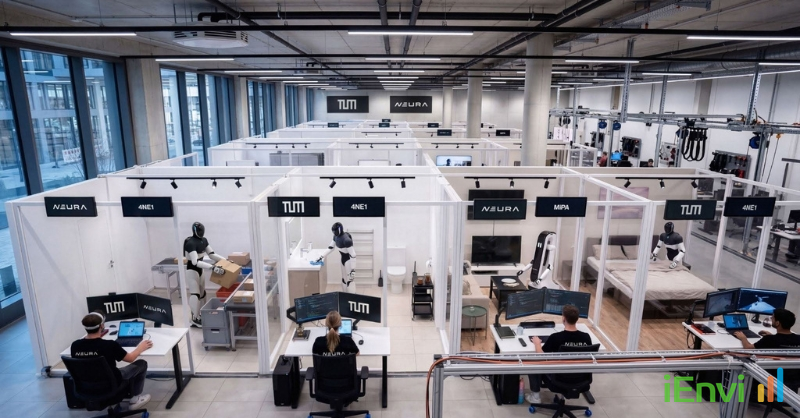
The NEURA Gyms are a significant infrastructure commitment. Real-world interaction data has been the primary bottleneck for physical AI development. Whereas generative AI models were trained on the existing corpus of internet text and images, physical AI requires robots to physically interact with real environments to generate the sensory and movement data needed for model training. NEURA Gyms are large-scale facilities built specifically to accelerate this data generation pipeline. The company’s target of reaching several million robot units in serial production by 2030 is contingent on resolving this data bottleneck at scale, and the Gyms represent the mechanism for doing so.
Australian context: physical AI implications for professional services and asset-intensive industries
Australia’s industrial landscape, characterised by geographically dispersed assets, persistent skilled labour shortages, and high operational costs in sectors including mining, resources, construction, and infrastructure, creates a particular set of conditions where cognitive robotics could be adopted at scale. The nation already leads globally in certain categories of autonomous industrial equipment, most notably in autonomous haulage systems deployed in the Pilbara iron ore operations. That precedent demonstrates both the appetite and the commercial logic for replacing or augmenting human labour with autonomous systems in environments that are physically demanding, hazardous, or remote. Humanoid cognitive robots represent the next step in that trajectory, extending automation potential into environments that require more adaptable, dexterous capability than conventional fixed or wheeled autonomous systems can provide.
References and related sources
- Primary source: www.roboticstomorrow.com
- techfundingnews.com
- trendingtopics.eu
- evertiq.com
- roboticstomorrow.com
How iEnvi can help
iEnvi integrates technology and data-driven approaches into environmental consulting. We monitor AI and technology developments that affect how environmental professionals deliver services to clients.
This is an iEnvi Machete news summary. Prepared by iEnvi to summarise the source article for environmental professionals tracking AI, data, and technology developments that affect consulting and project delivery.
Published: 14 Jun 2026
Need advice on this topic? Speak to an iEnvi expert at info@ienvi.com.au or 1300 043 684, or contact us online.