
Overview
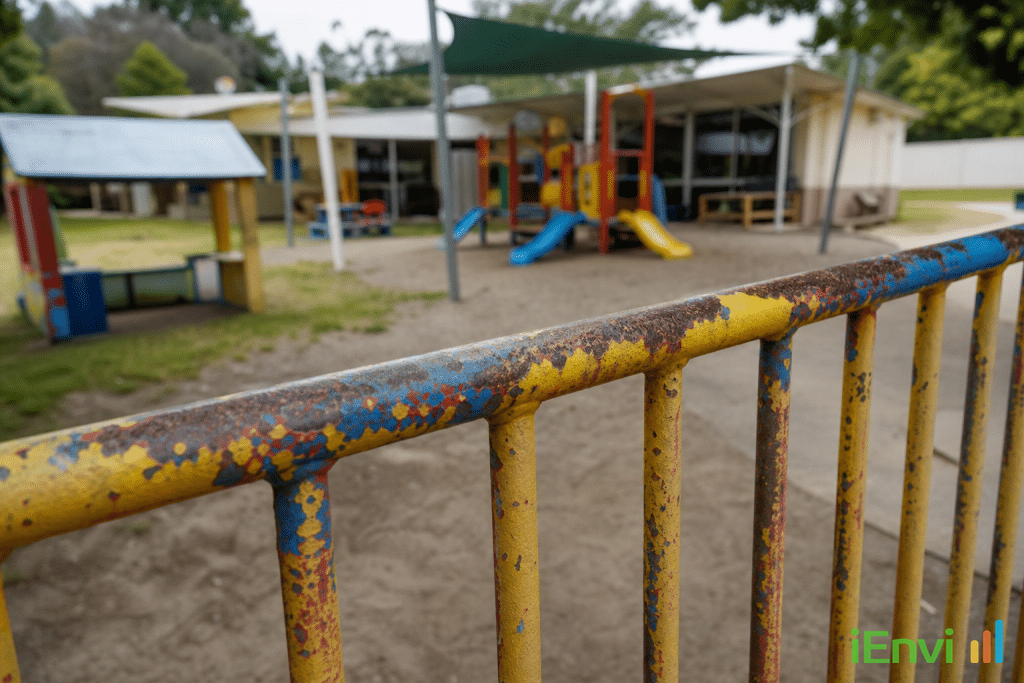
NSW Environment Protection Authority (EPA) soil sampling at the relocated Captains Flat preschool has detected lead at up to 2,526 mg/kg, more than eight times the national Health Investigation Level for residential land with accessible soil and childcare centres (HIL A, 300 mg/kg). The peak was recorded in a garden area. Samples taken directly beneath playground equipment returned between 202 mg/kg and 676 mg/kg. The sampling was carried out in late October 2026, the EPA confirmed the results on 5 November 2026, and they were reported publicly on 6 November 2026. The preschool’s outdoor grounds and play areas were closed to children as a precaution, and remediation contractors were engaged to excavate and replace affected surface soil and mulch.
This is the second time the Captains Flat preschool has been affected by lead. It moved to its current site in 2021 after historical mining tailings and fill contaminated its original location. A relocated sensitive land use returning HIL A exceedances within five years is an important case study for anyone working on legacy mining land. It shows that moving a receptor within a known contamination footprint does not, on its own, remove the exposure pathway.
The results come as the NSW Government opens expressions of interest for the $1.0 million Captains Flat Lead Program, administered by the NSW EPA. The program offers eligible residents free systematic surface soil sampling and funds remediation such as clean soil capping, re-turfing and excavation of heavily impacted soil. The contamination comes from the former Lake George Mine, which operated until 1962. For developers, property lawyers, councils and site owners in historical mining towns, the case raises practical questions about sampling design, validation after relocation or redevelopment, and the long-term performance of capping-based remediation.
Key details
The lead HIL A of 300 mg/kg comes from the National Environment Protection (Assessment of Site Contamination) Measure 1999, as amended in 2013 (ASC NEPM), Schedule B1 Guideline on Investigation Levels for Soil and Groundwater. HIL A applies to residential land with garden or accessible soil and explicitly covers children’s day care centres, preschools and primary schools. Young children are the most sensitive receptor group in the NEPM framework because hand-to-mouth behaviour and close contact with soil result in higher incidental ingestion and dermal exposure. The garden result of 2,526 mg/kg exceeds HIL A by a factor of about 8.4. It also exceeds the commercial/industrial HIL D for lead of 1,500 mg/kg, so the concentration would trigger further assessment even on a non-sensitive site.
The results beneath playground equipment, 202 mg/kg to 676 mg/kg, straddle the HIL A. Some sample locations under the play equipment fall below the investigation level and others are more than double it. That variability matters. A spread of this kind can reflect patchy surface impact from imported fill, landscaping materials such as mulch, or deposited dust, rather than a single source or hotspot. The published results do not establish which mechanism applies at this site, and the data released publicly do not include sampling density, depth intervals or statistical summaries. What the spread does show is that a small number of samples, or an average across a play area, could easily understate the maximum exposure a child might encounter.
The immediate response follows a standard exposure mitigation sequence for a sensitive receptor: close off the exposure pathway by restricting access to outdoor areas, then remove and replace the affected surface soil and mulch. Excavating and replacing the surface layer targets the zone children actually contact. Whether this is a durable fix depends on what lies beneath the replaced layer and on whether lead-bearing material continues to arrive at the surface through dust deposition or disturbance from surrounding land.
The Captains Flat Lead Program has a budget of $1.0 million and is now taking expressions of interest from residents. It offers free systematic surface soil sampling across the town for eligible properties and funds remediation works including:
- clean soil capping over impacted areas;
- re-turfing to restore a vegetated barrier to direct soil contact; and
- excavation and removal of heavily impacted soil where capping alone is not suitable.
The program targets surface soil, which reflects the main exposure pathway in a residential setting with gardens and children. Its funded options rely mainly on barriers between people and contaminated soil rather than full removal of the source.
Australian context
In NSW, the lead results sit within a layered regulatory framework. The Contaminated Land Management Act 1997 (NSW) (CLM Act) governs significantly contaminated land, and Part 3 allows the EPA to declare land significantly contaminated and to issue management orders. Section 60 of the CLM Act places a duty on owners and on persons whose activities caused contamination to notify the EPA in specified circumstances. Whether that duty is triggered is assessed against the EPA’s Guidelines on the Duty to Report Contamination, which consider factors such as contaminant concentrations relative to investigation levels, the current or approved land use and the likelihood of exposure. The Protection of the Environment Operations Act 1997 (NSW) (POEO Act) adds the EPA’s general pollution and clean-up notice powers.
Planning controls also apply. Chapter 4 of State Environmental Planning Policy (Resilience and Hazards) 2021 requires a consent authority to consider whether land is contaminated, and whether it is or can be made suitable, before approving development. Childcare centres and schools are sensitive uses that attract close scrutiny under that test. Councils record contamination information on planning certificates issued under section 10.7 of the Environmental Planning and Assessment Act 1979 (NSW). These certificates must disclose matters such as whether land has been declared significantly contaminated or is subject to a management order under the CLM Act, and councils may also include advice on other relevant matters affecting the land that they are aware of. For buyers, lenders and their advisers in Captains Flat, planning certificates should be read alongside any soil sampling results obtained for the property.
References and related sources
- Primary source: region.com.au
- ozarab.media
- nsw.gov.au
- nsw.gov.au
- nsw.gov.au
- NEPM Assessment of Site Contamination
- NSW EPA
How iEnvi can help
iEnvi provides specialist consulting services relevant to this topic. Our team includes CEnvP Site Contamination Specialists with experience across contaminated land, groundwater, remediation, ecology, and regulatory compliance.
- iEnvi contaminated land services
- iEnvi remediation services
- iEnvi expert services and independent review services
This is an iEnvi Machete news summary. Prepared by iEnvi to summarise the source article for contaminated land, groundwater, remediation, approvals and site risk professionals.
Published: 10 Nov 2026
Need advice on this topic? Speak to an iEnvi expert at info@ienvi.com.au or 1300 043 684, or contact us online.
Need advice on this issue? iEnvi provides practical, senior-led environmental consulting across contaminated land, remediation, ecology and environmental risk.
Team credentials Contaminated land services Remediation services Groundwater services Talk to iEnvi