
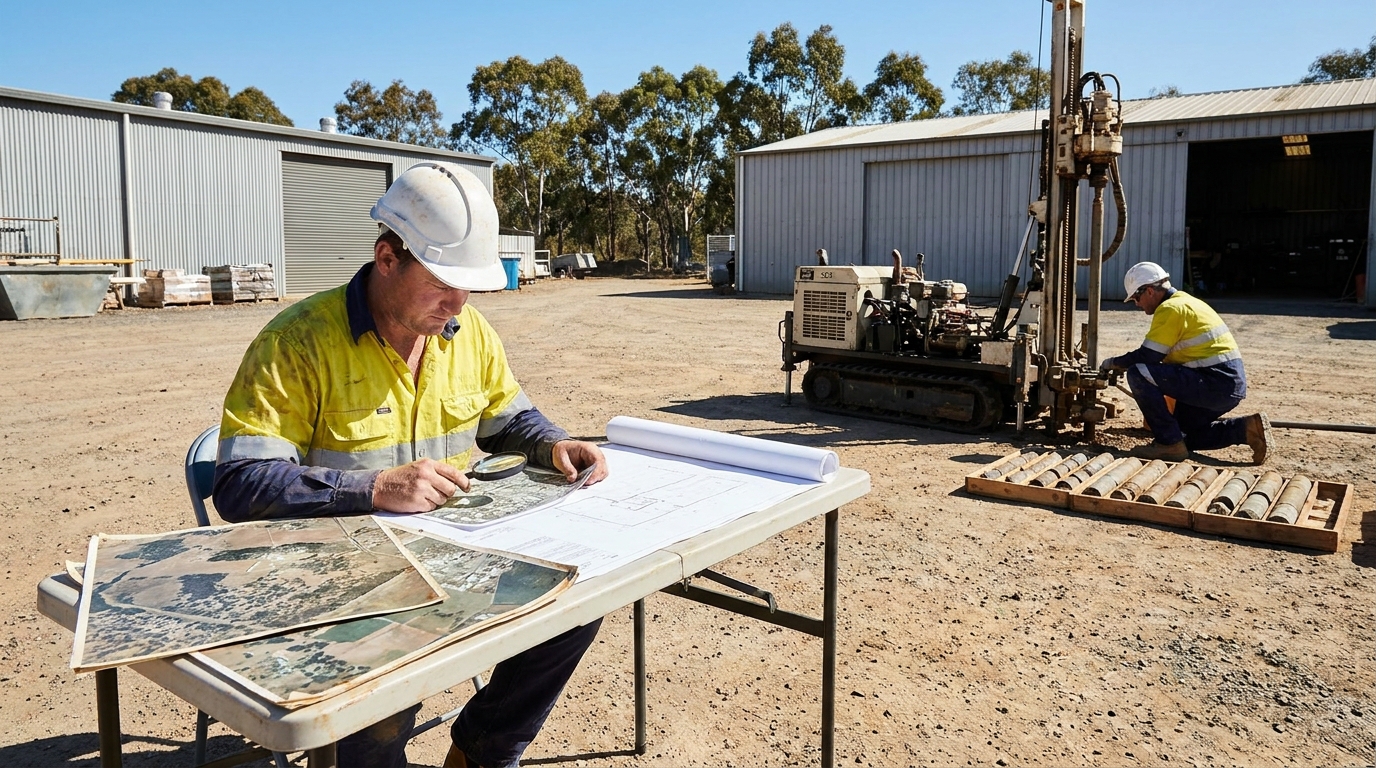
What is the difference between a Phase 1 and a Phase 2 environmental assessment in an M&A deal?
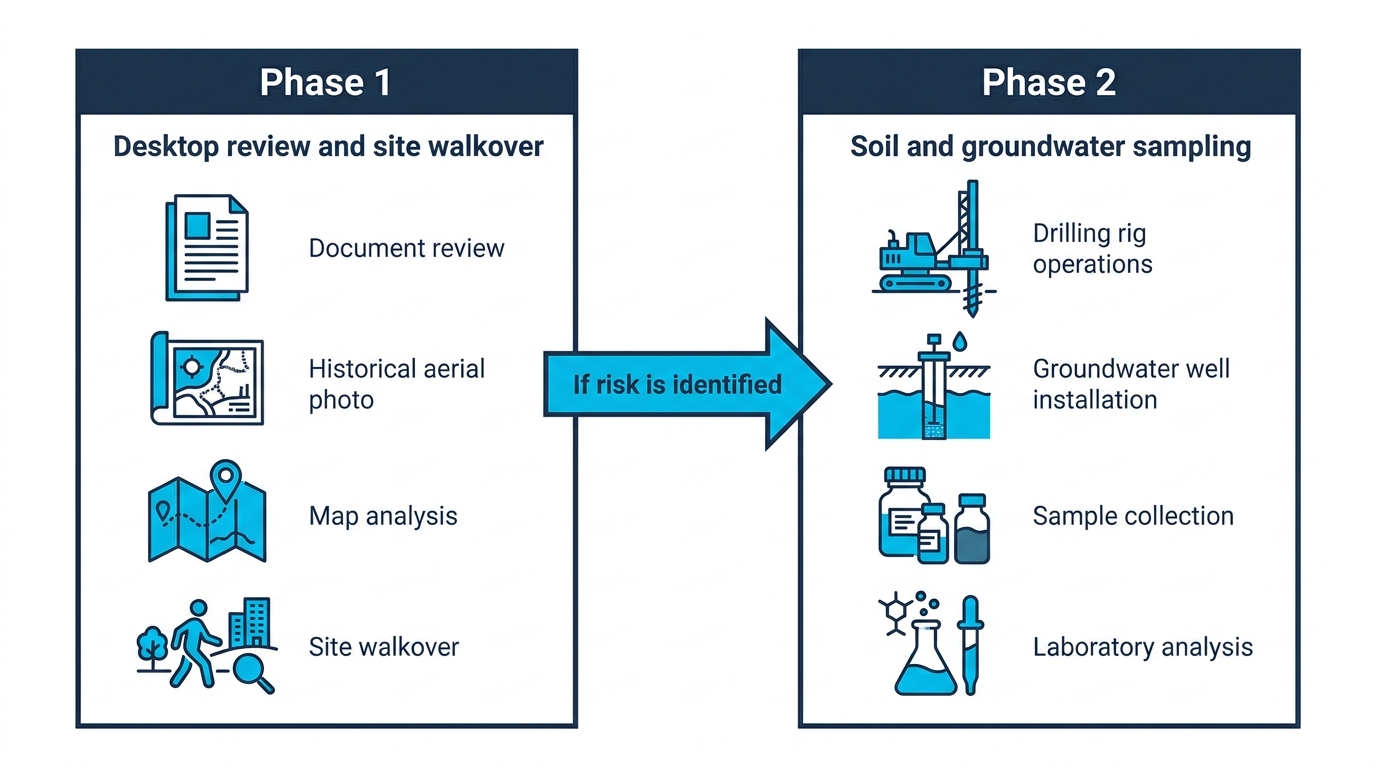
A Phase 1 is a desktop review and site walkover, broadly the preliminary site investigation (PSI) in the ASC NEPM, that asks whether contamination is likely and where. A Phase 2 is an intrusive investigation, broadly the detailed site investigation (DSI), that samples soil, groundwater and sometimes soil gas to measure what is there and whether it poses a risk. A Phase 1 is quicker and cheaper and screens the deal. A Phase 2 takes longer and costs more, but it narrows the uncertainty enough to support negotiations on price, indemnities and retentions. Both should be carried out in line with the ASC NEPM (1999, as amended 2013) and state guidance.
When a buyer, seller or lender asks for environmental due diligence, the first question is usually “Do we need a Phase 1 or a Phase 2?” Comparing a Phase 1 vs Phase 2 environmental assessment shows they do different jobs. The right choice depends on the site’s history, the deal structure, the timetable and how much certainty the parties need before they sign.
This is the second article in our series on environmental due diligence for M&A in Australia. The first article covered why EDD matters. This one explains the two main stages, what each can and cannot tell you, and how to use them on either side of the table.
Phase 1: the desktop review and site walkover
“Phase 1” and “Phase 2” are market terms rather than ASC NEPM terms. A Phase 1 broadly corresponds to a preliminary site investigation (PSI). In a transaction it is usually desktop research and a walkover with no drilling, although the ASC NEPM allows a PSI to include limited sampling, so check what a proposal includes.
A good Phase 1 for a transaction normally includes:
- Historical review: aerial photographs, title and ownership records, council and planning files and past land use, to find activities such as fuel storage, manufacturing, metal finishing, dry cleaning, landfilling or agriculture.
- Regulatory searches: the NSW EPA record of notices, the EPA Victoria Priority Sites Register and audit records, the Queensland Environmental Management Register and Contaminated Land Register, the WA Contaminated Sites Database and the SA EPA public register, plus planning certificates, licences and dangerous goods records. Registers only hold what has been reported, so a clear search is not a clean site.
- Site walkover: tanks, bunds, drains, staining, stockpiles, fill, building materials, vegetation stress and neighbouring uses.
- Interviews and document review: site staff, previous reports, tank and leak detection records and incident logs.
- A conceptual site model: where contamination could be, what it could be, how it could move and who could be exposed.
The output is a report that says whether contamination is unlikely, possible or probable, and what further work is justified. A Phase 1 is usually measured in weeks rather than months. Council and government searches often set the pace, so order them on day one.
What a Phase 1 can do for a deal
For a buyer, a Phase 1 is a screening tool. It clears low-risk sites, flags high-risk sites before more money is spent and gives the deal team a short list of questions for the vendor. For a seller, an early Phase 1 shows the site has been looked at properly.
What a Phase 1 cannot do
A Phase 1 cannot confirm that a site is clean. It reports likelihood, not concentrations. A site with no recorded incidents can still be contaminated, and a site with a worrying history can turn out to be fine. If the deal depends on a site, or the Phase 1 finds a credible source, a desktop report rarely gives enough certainty to price the risk.
Phase 2: intrusive investigation
A Phase 2 broadly corresponds to a detailed site investigation (DSI). It tests the Phase 1 hypotheses by sampling. The plan should follow the ASC NEPM data quality objectives process and the conceptual site model: targeted sampling at each area of concern, plus systematic sampling where site-wide coverage is needed, such as across fill.
Depending on the site, a Phase 2 may include:
- Soil sampling from test pits, hand augers or drill rigs, at depths linked to the likely source.
- Installation of monitoring wells and groundwater sampling, including flow direction.
- Soil gas or vapour sampling where volatile compounds could affect buildings or workers.
- Asbestos testing in fill or soil where demolition or imported material is a concern, using the asbestos-specific ASC NEPM approach (see asbestos in soil assessment).
- Tank and pipework investigations where underground petroleum storage is present or suspected. In NSW the Protection of the Environment Operations (Underground Petroleum Storage Systems) Regulation 2019 sets leak detection, monitoring, record and decommissioning requirements, and gaps in those records are a warning sign.
- Where firefighting foam or other PFAS sources are suspected, sampling and assessment in line with the PFAS National Environmental Management Plan Version 3.1 (PFAS NEMP 3.1).
- Analysis by laboratories NATA accredited for the methods used, with chain of custody and quality control samples.
- Comparison against ASC NEPM and state screening levels. An exceedance triggers closer assessment, not automatic failure, and a site-specific risk assessment may follow.
The report states what was found, where, at what concentrations and whether it poses an unacceptable risk for the current or intended use. Where remediation is likely, a remedial options and cost estimate gives the deal team a range to work with. Together they move the conversation from “there might be a problem” to “this is the problem, and this is the likely range of cost”.
What a Phase 2 cannot do
A Phase 2 is still a set of samples. Contamination between locations can be missed, groundwater changes over time and access limits can leave areas untested. A good report states its data gaps, and the deal documents should reflect them.
Time, cost and access
A Phase 2 takes longer because it involves drillers, laboratory turnaround and interpretation. Groundwater work adds time because wells must be installed and developed before sampling, and some programs need more than one round. Cost scales with site size, areas of concern, depth to groundwater and the contaminants involved.
Access is often the real constraint in M&A. Intrusive work needs the owner’s or tenant’s permission, and a vendor may resist drilling before the deal is certain, partly because confirmed contamination can trigger reporting duties. An access agreement should cover insurance, reinstatement, confidentiality, who receives results and who reports. Raise this early, ideally before exclusivity starts the clock.
Phase 1 vs Phase 2 environmental assessment at a glance
| Question | Phase 1 (broadly PSI) | Phase 2 (broadly DSI) |
|---|---|---|
| What it answers | Is contamination likely, and where? | Is contamination present, how much and is it a risk? |
| Method | Records, searches, walkover, interviews | Soil, groundwater and gas sampling with NATA accredited lab analysis |
| Typical timing | Usually weeks, often set by search turnaround | Several weeks or more, longer with groundwater |
| Relative cost | Lower | Higher, scales with complexity |
| Level of certainty | Qualitative, based on likelihood | Quantitative, but limited to what was sampled |
| Best used to | Screen sites and scope further work | Price risk and negotiate terms |
How to decide which one a deal needs
There is no single rule, but a few questions usually settle it.
- What has the site been used for? Offices and retail with no earlier industrial use may need only a Phase 1. Service stations, depots, workshops, manufacturing, chemical storage, landfills and sites that used firefighting foam are strong candidates for a Phase 2.
- Is it an asset sale or a share sale? In an asset sale the buyer, as new owner or occupier, can become responsible under state law for contamination already there. In a share sale the buyer inherits the company and its liabilities, potentially including sites it occupied or polluted in the past.
- How important is the site to the deal value? If the land is minor to the deal, a Phase 1 may be proportionate. If it is the main asset, more certainty is justified.
- What does the Phase 1 find? A credible source, a regulator record or visible evidence of a spill usually justifies moving to Phase 2.
- What are the parties planning to do with the land? A change to a sensitive use, such as residential or child care, raises the bar and may trigger planning requirements for further investigation or an audit, such as under a Victorian Environmental Audit Overlay.
- Who needs the report? Lenders and insurers have their own requirements, and some will not rely on a desktop report alone.
Many transactions use both: a Phase 1 on every site, then targeted Phase 2 work where it matters most.
Using the findings as risk mitigation
For a buyer, the point is to avoid inheriting an unpriced liability. The findings feed into the deal in several ways:
- Walk away or re-scope: if remediation costs could exceed the value of the site, you want to know before signing.
- Price adjustment: Phase 2 data and a remediation cost estimate give a defensible basis for a price reduction.
- Specific indemnities rather than warranties: warranties are usually qualified by disclosure, so a disclosed issue generally cannot be claimed under a warranty. Known issues belong in the price or a specific indemnity, and an indemnity is only as good as the seller’s covenant, so consider a guarantee or retention. Our article on using environmental due diligence findings to negotiate price, warranties, indemnities and escrow covers this in detail.
- Retentions, escrow and conditions precedent: a retention sized against estimated remediation cost should release on an objective trigger, such as a validation report or site audit statement, not regulator “sign-off”, which is rarely given. A condition precedent can require agreed investigation or remediation before completion.
- W&I insurance: policies generally exclude known matters and often exclude pollution altogether.
- Post-completion planning: a baseline at acquisition separates historic contamination from anything on your watch.
Reporting duties once contamination is known
A Phase 2 can create obligations as well as information. In NSW, section 60 of the Contaminated Land Management Act 1997 requires owners and polluters to notify the EPA of contamination that meets its reporting guidelines. In Victoria, the Environment Protection Act 2017 requires the person in management or control of land to notify EPA of notifiable contamination. In WA, the Contaminated Sites Act 2003 requires owners, occupiers and polluters to report known contamination within 21 days and suspected contamination as soon as reasonably practicable. In SA, section 83A of the Environment Protection Act 1993 requires owners, occupiers and site contamination consultants to notify the EPA of site contamination that affects or threatens groundwater. Legal privilege does not override these duties, so agree up front who receives results and who reports.
Using the findings as sale-price leverage
Sellers sometimes avoid investigating for fear of what they might find. In practice, a buyer who finds an unexplained gap will usually price in the worst case or ask for broad indemnities and large retentions. A seller with a clear Phase 1, and a Phase 2 where warranted, can show the issue is known, bounded and manageable.
That has several benefits for a vendor:
- It shortens the buyer’s due diligence and the window for late renegotiation.
- It replaces vague risk with a better-defined estimate, narrowing the discount a buyer can justify.
- Minor issues, such as a small area of impacted fill or a redundant tank, can be removed and validated before the sale.
- It defines the seller’s warranty exposure, because disclosed matters can be dealt with specifically.
The trade-off is that adverse data may trigger reporting duties and must be disclosed, so take legal advice first. Our environmental due diligence for property transactions and M&A page covers vendor-side assessments.
Standards and quality matter
Both phases should be carried out under the National Environment Protection (Assessment of Site Contamination) Measure 1999, as amended in 2013 (the ASC NEPM), and state guidance. It sets the staged approach, data quality objectives, sampling principles and the health and ecological investigation and screening levels.
A report that does not follow the framework may be rejected by a regulator, lender, insurer or the other side’s advisers. Regulators increasingly expect work by certified practitioners, such as a CEnvP Site Contamination Specialist, and reports should state who may rely on them and for what purpose.
Each main state also has independent auditors (site auditors in NSW, environmental auditors in Victoria, approved auditors in Queensland, contaminated sites auditors in WA and site contamination auditors in SA). An audit statement is often the clearest evidence of suitability for a use, so it makes a good release trigger. If a site is already regulated, see how EPA clean-up notices and orders work.
Common mistakes in transactions
- Treating a Phase 1 as a clean bill of health. It is a screen. It says what is likely, not what is there.
- Starting too late. Phase 2 work needs weeks. Leaving it late forces compromises on scope or signing with gaps.
- Sampling without a plan. Sampling not tied to the conceptual site model can miss the source.
- Ignoring groundwater. Soil results alone can understate a problem, particularly with fuels and solvents.
- Not agreeing access early. Drilling restrictions limit the data and should be recorded.
- Assuming insurance will respond. Known contamination is rarely covered by W&I insurance.
- Overlooking portfolio effects. A single problem site can affect lender appetite and insurance terms for the whole group.
Why iEnvi specialises in this work
Transaction work runs to a deal timetable, is read by lawyers, lenders and executives, and must be expressed in terms that can be priced. iEnvi focuses on contaminated land, so our teams scope staged programs quickly, explain results plainly and work alongside deal advisers on either side.
We act for buyers who want to understand what they are acquiring and for sellers who want to present their site with confidence. Our site assessment work spans contaminated land investigation, detailed assessment and regulator liaison, and you can read about our team and credentials. For examples of how this has been applied across regions, see our work on baseline due diligence for an industrial manufacturing site in Western Adelaide and a baseline site investigation for an industrial lease in southern Brisbane.
Next steps
If you are weighing up a purchase or sale, start with a short conversation about the site’s history, the deal timetable and what the other side has asked for. We can then recommend whether a Phase 1 is enough and whether Phase 2 work should run in parallel.
Talk to iEnvi about environmental due diligence for your transaction. Call us on 1300 043 684 or contact our team for a scoping discussion, and we will tell you what is needed, what is not and how long it will take.
This article is general information, not legal or technical advice for a specific site. Requirements differ between states and territories.
Need advice on this issue? iEnvi provides practical, senior-led environmental consulting across contaminated land, remediation, ecology and environmental risk.
PSI services DSI services Team credentials Environmental management plans Talk to iEnvi