

What is the Sutherland-Kirrawee Groundwater Pilot?
The New South Wales Government announced on 23 July 2024 the launch of the Sutherland-Kirrawee Groundwater Investigation Pilot, a $472,000 initiative jointly led by the Department of Climate Change, Energy, the Environment and Water (DCCEEW) and funded by the Department of Planning, Housing and Infrastructure (DPHI). The pilot targets one of the most persistent pre-construction bottlenecks in Sydney’s residential development pipeline: the requirement for developers to install their own groundwater monitoring bores and collect up to three months of baseline data before they can lodge a Development Application (DA) for any project involving basement excavation and construction dewatering. By replacing this fragmented, site-by-site obligation with a shared regional dataset, the NSW Government is directly intervening in the hydrogeological assessment process at the pre-DA stage.
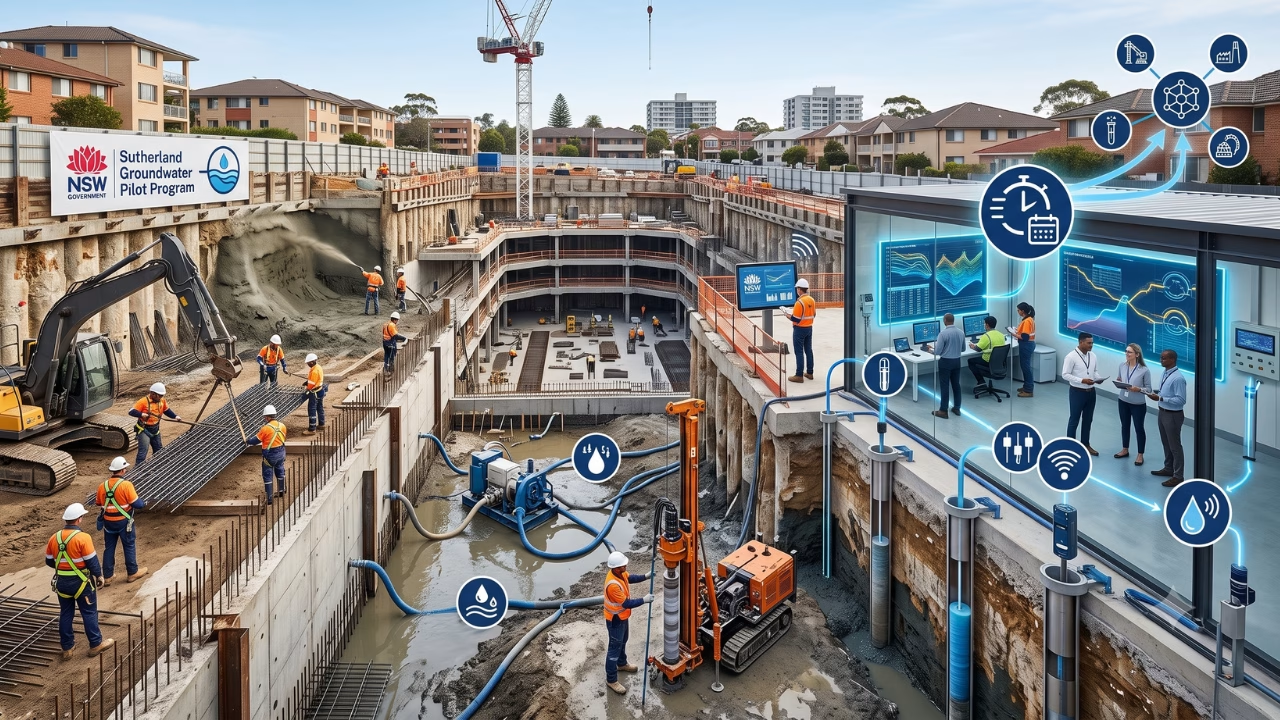
The pilot will establish a network of 20 to 30 groundwater monitoring bores across the Sutherland and Kirrawee area in southern Sydney, a corridor characterised by shallow, responsive watertable conditions that have long complicated basement construction feasibility and approval timelines. The monitoring network will operate for up to three years, generating a publicly available technical dataset that developers, builders, and their environmental consultants can draw upon immediately when scoping dewatering assessments and preparing DA documentation. This is a deliberate shift from the current model, in which each development site carries the full burden of establishing its own hydrological baseline in isolation from adjacent projects.
For environmental consultants, hydrogeologists, property developers, planning lawyers, and local councils, this initiative has direct practical consequences. It changes the information architecture that underpins pre-DA groundwater assessments, alters the cost and timeline profile of development feasibility studies, and raises important questions about how site-specific obligations interact with regionalised baseline data. If the pilot delivers the efficiencies intended, it also establishes a replicable model for other high-density, high-water-table urban corridors across New South Wales and potentially other Australian jurisdictions.
Key details of the Sutherland-Kirrawee Groundwater Pilot programme
The pilot programme will install between 20 and 30 groundwater monitoring bores across the Sutherland and Kirrawee precinct in Sydney’s south. These bores will form a coordinated regional network rather than a collection of disconnected site instruments, enabling the dataset to characterise aquifer behaviour at a spatial scale that individual site investigations cannot achieve. The monitoring period extends to three years, which is sufficient to capture seasonal variability in watertable depth, recharge responses to rainfall events, and longer-term trends that are essential inputs for dewatering impact assessments. The total programme budget is $472,000, with DPHI providing the funding as part of the NSW Government’s broader planning reform agenda.
Under current practice, a developer seeking DA approval for a basement excavation in this area must engage a hydrogeologist to install monitoring bores, collect groundwater level and quality data over a minimum period of approximately three months, and use that data to assess the likely dewatering volumes, drawdown extents, and potential impacts on adjacent structures and infrastructure. This baseline data collection phase occurs before the DA can be lodged, meaning holding costs, financing charges, and project delays accumulate during a period when no substantive planning progress can be made. The pilot dataset is intended to substitute for this site-level baseline requirement, allowing practitioners to move directly to the dewatering assessment and DA preparation stages using the regionalised data.
The legal framework governing construction dewatering in NSW is primarily the Water Management Act 2000, which requires proponents to obtain a Water Supply Works Approval for bores and associated infrastructure used during construction dewatering and to hold a Water Access Licence where water is taken from an aquifer above certain volume thresholds. The Environmental Planning and Assessment Act 1979 (EP&A Act) governs the DA process itself, with groundwater impacts assessed under the Section 4.15 evaluation criteria, which require consent authorities to consider impacts on the natural environment including water resources. Technical guidance is provided through DCCEEW’s NSW Aquifer Interference Policy (2012) and the NSW Groundwater Assessment Toolkit, which applies to State Significant Development and State Significant Infrastructure projects and sets out the methodology for groundwater impact assessment submissions.
It is important to note what the pilot does not eliminate. Site-specific Water Supply Works Approvals under the Water Management Act 2000 remain mandatory for actual construction-phase dewatering operations. Developers will still be required to design site-specific dewatering systems, assess the risk of ground settlement in adjacent structures caused by groundwater drawdown, implement real-time compliance monitoring during construction, and manage discharge of extracted groundwater in accordance with any licence conditions or EPA requirements. The regional dataset reduces the pre-DA baseline data collection burden but does not transfer any statutory responsibility away from the individual site proponent. Practitioners must be precise about this distinction when advising clients on what the pilot actually changes and what remains their obligation.
References and related sources
- Primary source: www.nsw.gov.au
- buildaustralia.com.au
- thegoodbuilder.com.au
- newspapers.directory
- miragenews.com
How iEnvi can help
iEnvi provides specialist consulting services relevant to this topic. Our team includes CEnvP Site Contamination Specialists with experience across contaminated land, groundwater, remediation, ecology, and regulatory compliance.
- iEnvi groundwater services
- iEnvi remediation and validation services
- iEnvi expert services and independent review services
This is an iEnvi Machete news summary. Prepared by iEnvi to summarise the source article for contaminated land, groundwater, remediation, approvals and site risk professionals.
Published: 25 Jul 2026
Need advice on this topic? Speak to an iEnvi expert at info@ienvi.com.au or 1300 043 684, or contact us online.
Need advice on this issue? iEnvi provides practical, senior-led environmental consulting across contaminated land, remediation, ecology and environmental risk.
Team credentials Contaminated land services Remediation services Groundwater services Talk to iEnvi