

Overview
In June 2026, the Taskforce on Nature-related Financial Disclosures (TNFD) released additional sector guidance specifically targeting the alternative fuels industry, covering bioenergy and synthetic fuels including hydrogen. On 24 July 2026, Clayton Utz published a detailed analysis of this guidance, drawing out its practical implications for Australian organisations operating across transport, energy, and fuel supply chains. The guidance establishes a defined expectation that companies must disclose how their alternative fuel pathways interact with land, freshwater, biodiversity, and broader ecosystem assets. Critically, this obligation extends beyond facility operators to include any organisation that purchases or uses these fuels, regardless of whether they hold operational control over production.
The significance of this development cannot be overstated for Australian environmental and sustainability professionals. Australia’s mandatory climate-related financial reporting regime, which commenced for Group 2 entities on 1 July 2026 under the Treasury Laws Amendment (Financial Market Infrastructure and Other Measures) Act 2024 (Cth), has fundamentally changed the reporting landscape. Voluntary alignment with the TNFD framework now sits directly alongside those mandatory obligations. Together, they create a combined disclosure environment where carbon performance alone is no longer a sufficient basis for sustainability claims. Nature performance, covering upstream biodiversity, water use, land conversion, and soil impacts, has become an additional and independently assessed dimension of corporate environmental credibility.
For environmental practitioners advising developers, transport operators, energy companies, and financiers in Australia, this guidance reshapes the scope of environmental due diligence, feasibility assessment, and supply chain risk management. The shift from site-level impact assessment to full supply chain ecosystem evaluation represents a material change in what is required of environmental consultants, ESG advisors, legal counsel, and their clients. Understanding what the TNFD alternative fuels guidance requires in specific, technical terms is the essential starting point.
Key details of the TNFD alternative fuels sector guidance released June 2026
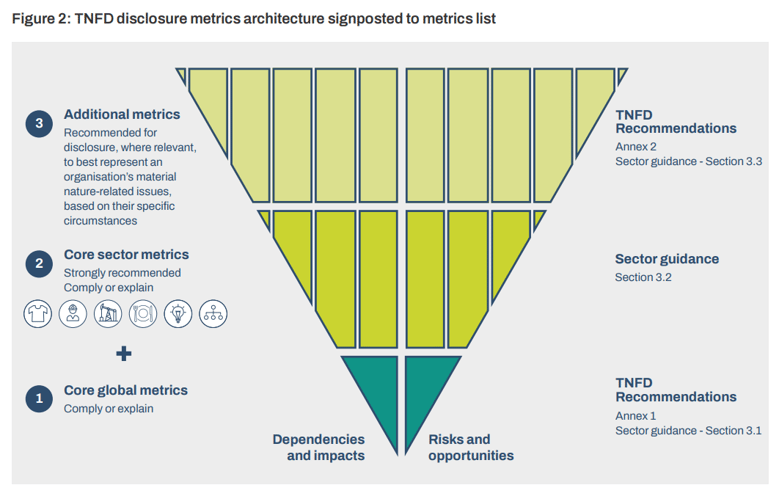
The TNFD additional sector guidance for alternative fuels introduces a suite of “core sector metrics” that organisations must report against when disclosing nature-related risks and opportunities associated with their fuel procurement or production activities. For bioenergy pathways, the mandatory metrics include traceability of primary biomass feedstocks, confirmation of deforestation and land conversion-free sourcing, and assessment of whether waste-derived feedstocks have been evaluated against higher-value uses before being directed to fuel production. These requirements reflect longstanding international concerns about the indirect land-use change consequences of large-scale bioenergy expansion, particularly where agricultural residues or purpose-grown energy crops are involved.
For synthetic fuel and hydrogen production pathways, the guidance introduces specific metrics addressing water consumption and, where applicable, brine disposal management. Electrolysis-based hydrogen production, for example, draws significant volumes of water depending on the feedstock source and can generate concentrated brine as a byproduct in desalination-integrated systems. The TNFD guidance requires organisations to disclose whether their hydrogen or synthetic fuel supply chains source water from areas of water scarcity, a metric with direct relevance to arid and semi-arid regions of Australia where water resource competition is already acute. Brine disposal management is flagged as a critical disclosure item because improper disposal carries material risks to soil salinity, aquifer integrity, and coastal marine environments.
The TNFD’s four-phase LEAP approach, standing for Locate, Evaluate, Assess, and Prepare, provides the methodological framework organisations are expected to apply when identifying and managing nature-related dependencies and impacts. The Locate phase requires organisations to map where in the supply chain their activities interface with natural ecosystems. The Evaluate phase involves assessing the dependencies and impacts identified at those interface points. The Assess phase involves determining the materiality of nature-related risks and opportunities arising from those impacts and dependencies. The Prepare phase involves developing responses, disclosures, and governance arrangements. For environmental consultants, integrating this four-phase methodology into site feasibility work and environmental impact assessments introduces requirements that go substantially beyond the scope of a conventional Phase 1 or Phase 2 Environmental Site Assessment.
The obligation to disclose nature-related metrics extends to organisations that are fuel buyers or end users with no direct operational role in production. An airline using sustainable aviation fuel, a logistics company running a fleet on biodiesel, or a utility using biomass for electricity generation would each be expected to report core sector metrics for the upstream nature-related impacts associated with the fuels they procure. This is not a speculative interpretation. The Clayton Utz analysis published on 24 July 2026 confirms that the guidance explicitly addresses this scenario and places affirmative disclosure expectations on purchasers. This upstream accountability model is consistent with the broader direction of international sustainability disclosure frameworks, including the International Sustainability Standards Board’s approach to Scope 3 value chain emissions reporting.
Australian context: TNFD nature disclosure and its intersection with Australian regulatory frameworks
This section of the article was not received and could not be published. Please contact the editorial team if you believe this content was submitted in full.
References and related sources
- Primary source: www.claytonutz.com
- listcorp.com
- claytonutz.com
- minterellison.com
- EPBC Act
How iEnvi can help
iEnvi provides specialist consulting services relevant to this topic. Our team includes CEnvP Site Contamination Specialists with experience across contaminated land, groundwater, remediation, ecology, and regulatory compliance.
- iEnvi site assessment services
- iEnvi remediation and validation services
- iEnvi expert services and independent review services
This is an iEnvi Machete news summary. Prepared by iEnvi to summarise the source article for contaminated land, groundwater, remediation, approvals and site risk professionals.
Published: 25 Jul 2026
Need advice on this topic? Speak to an iEnvi expert at info@ienvi.com.au or 1300 043 684, or contact us online.
Need advice on this issue? iEnvi provides practical, senior-led environmental consulting across contaminated land, remediation, ecology and environmental risk.
Team credentials Contaminated land services Remediation services Groundwater services Talk to iEnvi