
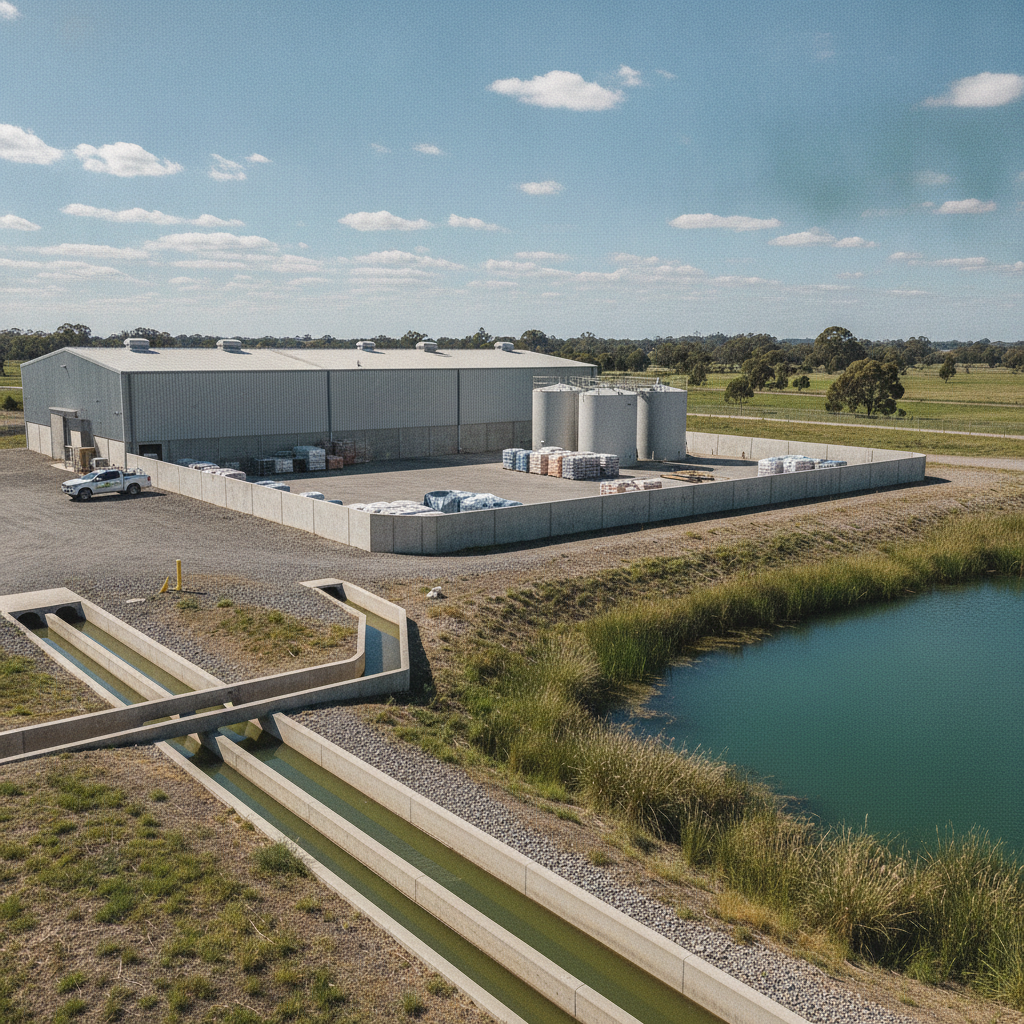
Why does a food manufacturing site need an Operational Environmental Management Plan?
An OEMP turns your obligations under the General Environmental Duty in Victoria’s Environment Protection Act into site-specific controls for trade waste, stormwater, chemicals, odour and waste, so spills, washdown and deliveries do not become problems with the EPA, council or your water authority.
iEnvi prepared an Operational Environmental Management Plan (OEMP) for a food ingredients plant in Dandenong South, one of Melbourne’s largest industrial precincts. The site handles bulk food ingredients and liquids typical of a food manufacturing plant, and it needed a plan that matched real operations, not a generic template.
Why a food manufacturing plant needs an OEMP
Food ingredients plants receive and dispatch bulk liquids, dose clean-in-place (CIP) cleaning chemicals, and run refrigerated stores, forklifts and extended delivery hours. One hose failure at the dock, one wet clean that skips the dry-clean-first step, or one putrescible waste bin left too long in summer, and the site can be facing discharges with high biochemical oxygen demand (BOD), stormwater pollution, odour complaints or a breach of its trade waste consent.
Under Victoria’s Environment Protection Act, the General Environmental Duty is a legal duty, not a guideline. A site must take reasonably practicable steps to eliminate or reduce risks of harm from its activities, and a well-built environmental management plan is how a busy plant shows what those steps are and keeps them running.
What the Dandenong South OEMP covered
iEnvi mapped the full process chain: inbound bulk liquid transfers, chemical storage and CIP dosing, processing and packaging, washdown, outbound logistics, organic waste, and the food oil interceptor (FOI) that captures fats and oils before wastewater leaves the site.
The OEMP sits under the duties in Victoria’s Environment Protection Act, including the General Environmental Duty, with linked action plans for water quality and trade waste, stormwater, solid and organic waste, noise and amenity, and chemicals and odour. An aspects and impacts register scored the unmitigated risks, including a catastrophic bulk liquid release to stormwater, CIP concentrate spills, FOI overload from poor dry-cleaning practice, and odour from putrescible waste.
Site controls that bring residual risk down
The register drives a practical set of controls. The main ones:
- Sealed hardstand areas for bulk liquid transfers
- Supervised unloading of bulk deliveries
- Drain seals and spill kits at transfer points
- Internal washdown only, with dry cleaning before any wet clean
- Scheduled FOI maintenance and pump-outs
- EPA Waste Tracker records for priority waste sludge
- Sealed, high-frequency waste collections
- Noise controls for early morning and evening truck movements
How the OEMP is used on the floor
An OEMP only works if people use it. Training, quarterly inspection checklists, emergency contacts and monitoring and review loops were built in so the plan lives on the floor rather than in a drawer. High-risk moments, such as bulk transfers, CIP chemistry, FOI pump-outs and firewater, have written responses and marked equipment locations.
The result is a control system aligned to Environment Protection Act duties and South East Water trade waste requirements. It reduces the chance of high-BOD stormwater discharges, pollution incidents in receiving waters, consent breaches and neighbour complaints, and it gives managers a clear audit trail for inductions and inspections. Done properly, an OEMP is a practical operating system for the site: fewer surprises when the EPA, council or the water authority ask how you manage trade waste, stormwater and waste. It also sits naturally alongside broader environmental management support.
Need an OEMP for a food manufacturing site in Victoria?
iEnvi prepares Operational Environmental Management Plans for food manufacturers and other industrial sites across Victoria. If your plant needs a plan that stands up to the EPA, council and your water authority, talk to iEnvi.
Related services for this project. iEnvi links delivered project work back to the service pathways clients use for similar sites — investigation, remediation, ecology and environmental management.
Environmental management plans Environmental management Talk to iEnvi