
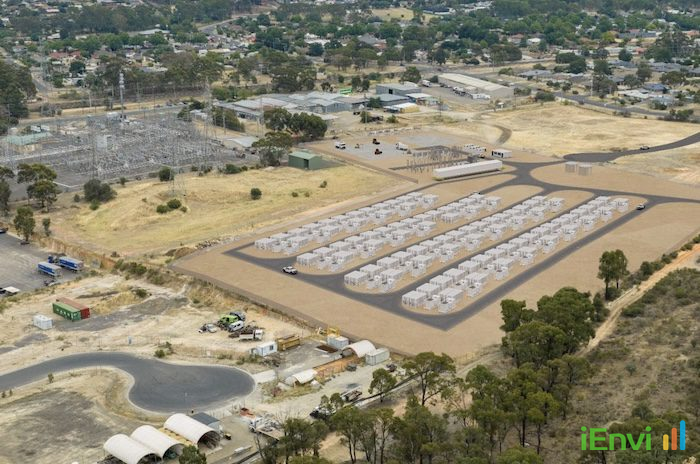
Pacific Blue 201 MW Bendigo battery referred under the EPBC Act
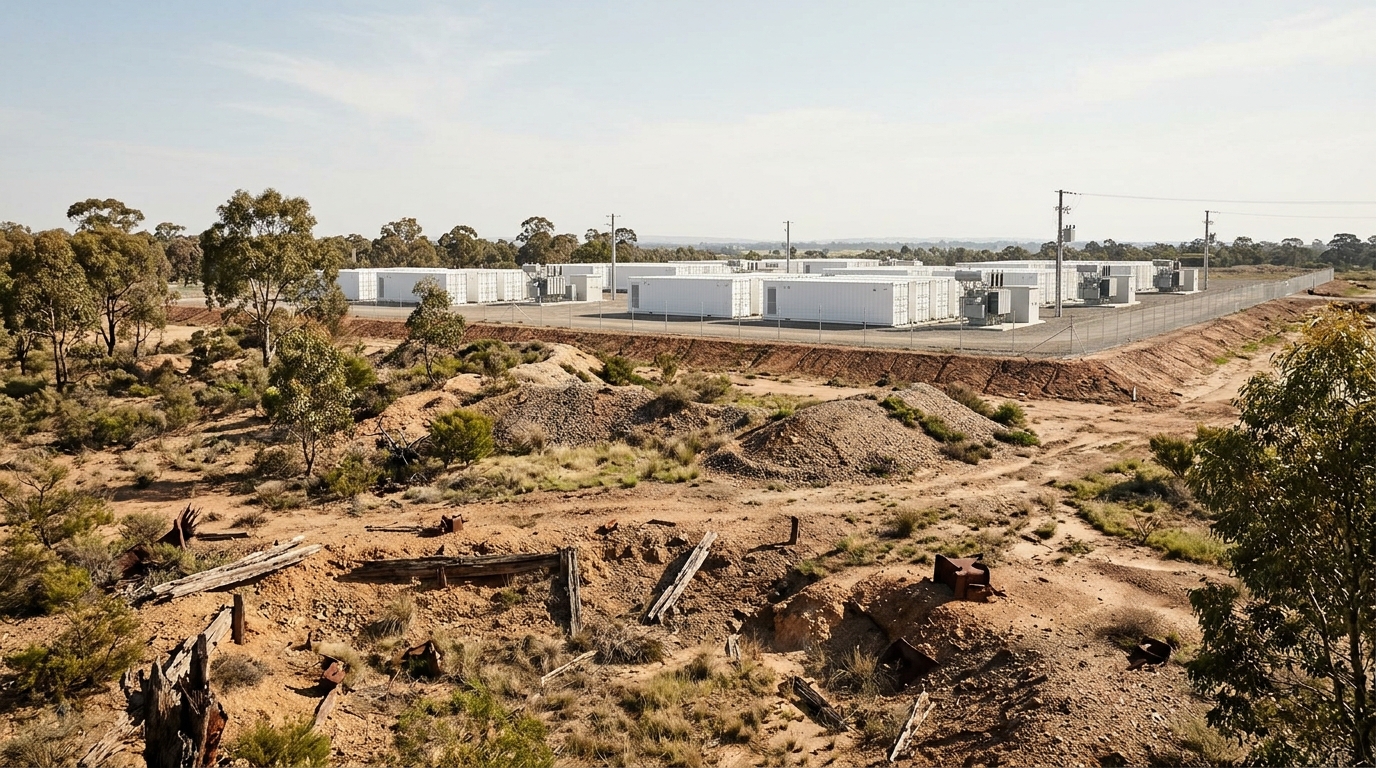
Pacific Blue has referred a proposed 201 MW / 855 MWh battery energy storage system (BESS) at Golden Square in Bendigo, Victoria, for assessment under the Environment Protection and Biodiversity Conservation Act 1999 (Cth) (EPBC Act). RenewEconomy reported the referral on 10 November 2026. The four-hour battery would sit on a 7 hectare industrial site directly next to Bendigo’s primary substation. Planning documents and permit registers show that the land is heavily undermined, with dozens of historical gold-rush mine shafts across the site. Pacific Blue has committed in its planning documents to identify, secure and stabilise these shafts so that the site is structurally safe for battery installation and operation.
The project reflects a wider pattern in grid-scale storage. Connection capacity is constrained across the National Electricity Market (NEM), so developers are looking for land beside existing substations, where they can avoid building long overhead transmission lines. In regional Victoria, much of that land is industrial or former mining ground. A brownfield site removes much of the ecological clearance risk that comes with greenfield sites. In its place, the developer takes on subsurface voids, mineralised soils and processing residues that have sat in the ground for well over a century.
Developers, in-house counsel, financiers and council planners need to understand that an EPBC referral answers one narrow question: whether the action is likely to have a significant impact on a Matter of National Environmental Significance (MNES). It does not assess ground stability, soil contamination or the classification of excavated material. In Victoria, those questions fall under the Environment Protection Act 2017 (Vic) and the Planning and Environment Act 1987 (Vic). They need their own technical work, with its own timing and its own budget.
Golden Square BESS capacity, mine shaft risk and NEPM screening levels
The Golden Square BESS is rated at 201 MW of power and 855 MWh of energy storage. At full output that is about 4.25 hours of discharge, which puts it in the four-hour class now common in NEM storage projects. The proposed footprint is 7 hectares of industrial land adjacent to Bendigo’s main substation. Pacific Blue’s EPBC referral runs to 48 pages. It relies on the site’s industrial zoning and history of disturbance to argue that impacts on threatened species, ecological communities and native vegetation will be limited. That argument leaves ground conditions, fire safety and site civil engineering as the main risks for the project.
Containerised BESS installations place heavy, concentrated loads on their foundations, and transformers and inverter stations add further point loads. Historical shafts that are unmapped, partly backfilled or capped with timber or loose fill can subside or collapse under those loads. The risk is greater where surface water or service trenches change drainage around old workings. Pacific Blue has accepted responsibility for finding and treating the shafts. Doing this well normally means a non-destructive geophysical survey across the whole footprint, followed by intrusive investigation to confirm anomalies. Each confirmed shaft then needs a structural treatment designed for the loads it will carry, such as grouting, capping or excavation and backfill. Archival mining records are a starting point, but on the Victorian goldfields they are rarely complete enough to rely on alone.
Ground stability is only part of the subsurface risk. Victorian goldfield sites often contain elevated arsenic, and may also contain lead and mercury. These come from natural mineralisation and from historical stamp battery crushing, roasting and mercury amalgamation. Arsenic in Bendigo soils and mine spoil can be naturally high. That makes it harder to tell background concentrations apart from contamination caused by ore processing, and the distinction affects both risk assessment and waste classification. For a commercial or industrial land use, Tier 1 human health screening under the National Environment Protection (Assessment of Site Contamination) Measure 1999 (as amended 2013) (NEPM 2013) uses the Schedule B1 Health Investigation Level D (HIL D) values. These include 3,000 mg/kg for arsenic, 1,500 mg/kg for lead and 730 mg/kg for inorganic mercury. Ecological investigation levels may also apply where soils will support landscaping or drainage features.
Off-site disposal of soil is a separate test from on-site human health screening. In Victoria, excavated soil leaving a site must be classified under the Environment Protection Regulations 2021 and EPA Victoria’s waste classification guidance. Fill material thresholds are set far below the HIL D values. A soil that is acceptable for continued industrial use can therefore still be a priority waste once it is excavated and transported. Shaft stabilisation also creates its own waste streams. Grouting can displace mine water held in old workings, and that water may carry dissolved metals. Drilling and excavation around shaft collars produce spoil that may be more mineralised than the surrounding topsoil.
Victorian contaminated land duties for the Bendigo battery project
In Victoria, the main contaminated land obligations for a project like this come from the Environment Protection Act 2017 (Vic). The General Environmental Duty in section 25 requires anyone carrying on an activity that may pose a risk of harm to human health or the environment from pollution or waste to minimise those risks so far as reasonably practicable. That duty applies to the investigation, shaft treatment, construction and operation of the battery. Section 39 places a separate duty on a person in management or control of contaminated land to minimise risks of harm from that land, again so far as reasonably practicable. Under section 40, some contamination must be notified to EPA Victoria where it meets the thresholds in the Environment Protection Regulations 2021. The notification duty sits with the person in management or control of the land and applies as soon as practicable after they become aware of notifiable contamination.
Not every result above a screening level is notifiable. Notification depends on the criteria in the regulations, not on a comparison with HIL D values alone. Investigation data from the shaft program and any soil sampling should be checked against those criteria as results come in, rather than at the end of the project.
The planning system adds another layer. Under the Planning and Environment Act 1987 (Vic), the responsible authority can attach conditions to a planning permit that require site investigation, a construction environmental management plan or a soil and spoil management plan. A battery is not a sensitive land use, so an environmental audit under Part 8.3 of the Environment Protection Act 2017 (Vic) is not automatically required. It may still be triggered if an Environmental Audit Overlay applies to the land or if the responsible authority imposes it through permit conditions. Developers should check the planning scheme maps and any existing permit conditions early.
Fire safety is assessed separately again. Country Fire Authority guidance for renewable energy facilities sets expectations for separation distances, water supply and emergency access at battery sites. On undermined ground, those requirements interact with shaft locations, because access roads, fire water tanks and container layouts all need to sit on stable foundations.
What this means for developers and planners
An EPBC referral that clears ecological risk does not clear a site for construction. On former goldfield land, the critical path often runs through geotechnical and contamination work rather than federal environmental approval. Project teams should plan for:
- a geophysical survey and intrusive investigation of the full footprint, with shaft treatments designed for BESS, transformer and inverter loads
- soil sampling that separates natural arsenic background from processing residues, so that both risk assessment and waste classification rest on sound data
- early waste classification of any soil, spoil or mine water likely to leave the site, with disposal costs built into the budget
- a check of section 40 notification criteria as investigation results arrive
- confirmation of any Environmental Audit Overlay or permit conditions that could require an audit or further assessment
Financiers and lenders will expect this work to be scoped before financial close. Late discovery of an unmapped shaft or a priority waste stream can add months and significant cost to a construction program. Golden Square is unlikely to be the last battery proposed on undermined ground beside a regional Victorian substation, and the same sequence of investigations will apply to the next one.
References and related sources
- Primary source: reneweconomy.com.au
- reneweconomy.com.au
- NEPM Assessment of Site Contamination
- EPA Victoria
- EPBC Act
How iEnvi can help
iEnvi provides specialist consulting services relevant to this topic. Our team includes CEnvP Site Contamination Specialists with experience across contaminated land, groundwater, remediation, ecology, and regulatory compliance.
- iEnvi contaminated land services
- iEnvi remediation and validation services
- iEnvi expert services and independent review services
This is an iEnvi Machete news summary. Prepared by iEnvi to summarise the source article for contaminated land, groundwater, remediation, approvals and site risk professionals.
Published: 12 Nov 2026
Need advice on this topic? Speak to an iEnvi expert at info@ienvi.com.au or 1300 043 684, or contact us online.
Need advice on this issue? iEnvi provides practical, senior-led environmental consulting across contaminated land, remediation, ecology and environmental risk.
Team credentials Environmental management plans Contaminated land services Remediation services Talk to iEnvi