
Overview
On 28 May 2024, the Australian and New South Wales Governments jointly announced highly promising preliminary results from a $26.2 million trial of a bubble plume destratification system installed at Pindari Dam on the Severn River in northern New South Wales. The trial, led by WaterNSW in partnership with the NSW Department of Primary Industries and Regional Development (DPIRD), recorded a bottom-of-dam water temperature rise of more than 6 degrees Celsius within just one month of operation. The system is the largest bubble plume destratification installation ever deployed in Australia, and its early performance marks a practical breakthrough in the long-standing effort to manage cold water pollution (CWP) below major reservoirs.
Cold water pollution is one of the most ecologically damaging but least publicly understood consequences of large dam infrastructure in Australia. When a stratified reservoir releases water from its deep, cold hypolimnion layer, the downstream river can experience dramatic artificial temperature suppression. In Australian river systems, scientific literature documents thermal drops of up to 16 degrees Celsius below major dams. These conditions are hostile to native fish species that depend on precise thermal cues for spawning and growth. Half of all expected native fish species are absent from river reaches below New South Wales’s largest dams, with thermal pollution identified as a primary driver of that ecological deficit.
For environmental professionals working across aquatic ecology assessments, environmental impact statements, water resource management, and infrastructure approvals, this trial is directly relevant. It provides the first large-scale Australian validation of active bubble plume destratification as an engineering control for CWP, and it demonstrates a measurable pathway toward meeting downstream water quality objectives under the ANZG 2018 Water Quality Guidelines framework. The implications extend across project planning, environmental impact assessment methodology, and the design of mitigation commitments in approvals documentation for water infrastructure.
Key details of the Pindari Dam bubble plume destratification trial
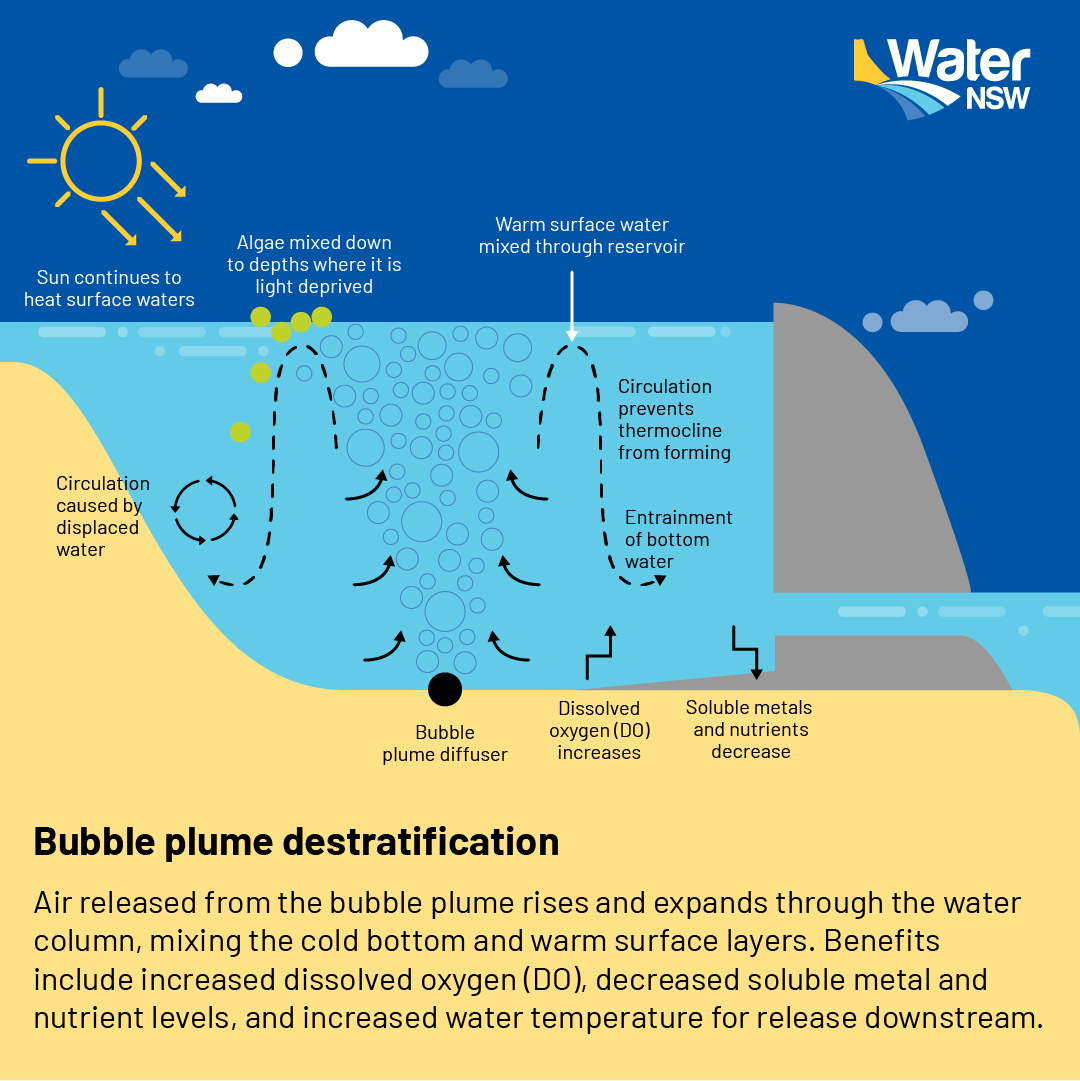
The bubble plume system at Pindari Dam operates by pumping compressed air through diffusers installed at depth within the reservoir. Rising air bubbles entrain and lift cold, dense hypolimnetic water upward, promoting vertical mixing throughout the water column. This destratification process reduces the thermal gradient between surface and bottom layers, meaning water released downstream more closely reflects a mixed, seasonally appropriate temperature rather than the artificially cold hypolimnion temperature. The Pindari trial recorded a temperature increase of over 6 degrees Celsius at the bottom of the dam within one month of system activation, a result consistent with the project’s target of improving downstream release temperatures by approximately 10 degrees Celsius over the operational programme. This 10-degree target is specific to the Pindari project brief established by WaterNSW and should not be conflated with broader CWP metrics.
The $26.2 million project is funded under the Australian Government’s Northern Basin Toolkit Program, which is itself a component of the up to $180 million investment in water management initiatives for the northern Murray-Darling Basin. Construction was delivered by civil contractor Eire Civil Infrastructure (also referenced in some May 2024 media releases as Eyre Constructions, though practitioners should verify the current contractor designation against WaterNSW primary sources). The trial commenced prior to the 2024 winter period and is scheduled to pause during winter before recommencing in spring 2024. This pause is a deliberate design feature, allowing the project team to assess ambient conditions and gather comparative data across seasonal thermal cycles before drawing final conclusions.
The ecological context underpinning the trial is significant. Species such as Golden Perch (Macquaria ambigua) and Murray Cod (Maccullochella peelii) rely on rising water temperatures in spring and early summer as a spawning trigger. Where CWP suppresses downstream temperatures, these thermal cues are absent or delayed, effectively preventing natural recruitment. Murray Cod is listed as a vulnerable species under the Environment Protection and Biodiversity Conservation Act 1999 (Cth), which means projects affecting its habitat carry specific federal obligations. The thermal suppression documented below NSW dams is therefore not merely a water quality metric issue but a threatened species management issue with direct EPBC Act implications for proponents and approving authorities alike.
From a water quality standards perspective, the bubble plume technology directly addresses physical and chemical stressor parameters under the ANZG 2018 Water Quality Guidelines. The ANZG 2018 framework specifies guideline values for temperature and dissolved oxygen in freshwater ecosystems, and CWP can cause persistent exceedances of both. While hypolimnetic water can also be oxygen-depleted, the primary documented ecological driver of harm in Australian rivers is thermal suppression rather than dissolved oxygen deficiency alone. The Pindari trial’s measurable temperature improvement within a single operational month demonstrates that active destratification can move reservoir discharge conditions meaningfully toward ANZG 2018 guideline compliance without requiring structural modification to dam outlet works or compromising water delivery operations.
Australian context: cold water pollution, the ANZG 2018 framework, and the Murray-Darling Basin Plan
Cold water pollution below major storage dams is a well-documented problem across south-eastern Australia, particularly in the Murray-Darling Basin system. The Murray-Darling Basin Plan, administered by the Murray-Darling Basin Authority (MDBA), establishes water quality and environmental flow objectives across the Basin’s river network. CWP sits at the intersection of water quality management and environmental flow delivery, because cold hypolimnetic releases can undermine the ecological effectiveness of environmental water allocations. Delivering an environmental flow pulse intended to trigger fish spawning has limited value if the water temperature remains suppressed well below the thermal threshold required to stimulate that biological response.
References and related sources
- Primary source: www.nsw.gov.au
- miragenews.com
- waternsw.com.au
- environment.sa.gov.au
- waternsw.com.au
How iEnvi can help
iEnvi provides specialist consulting services relevant to this topic. Our team includes CEnvP Site Contamination Specialists with experience across contaminated land, groundwater, remediation, ecology, and regulatory compliance.
- iEnvi ecology services
- iEnvi contaminated land investigation services
- iEnvi remediation and validation services
- iEnvi expert services and independent review services
This is an iEnvi Machete news summary. Prepared by iEnvi to summarise the source article for contaminated land, groundwater, remediation, approvals and site risk professionals.
Published: 03 Jun 2026
Need advice on this topic? Speak to an iEnvi expert at info@ienvi.com.au or 1300 043 684, or contact us online.
Need advice on this issue? iEnvi provides practical, senior-led environmental consulting across contaminated land, remediation, ecology and environmental risk.
Team credentials Contaminated land services Remediation services Groundwater services Talk to iEnvi