
Overview
On 28 May 2024, the Australian Minister for the Environment and Water, Tanya Plibersek, announced the registration of the second project under the Commonwealth’s Nature Repair Market (NRM) scheme. The project is located on a 19.9-hectare cattle grazing property at Doon Doon in the NSW Northern Rivers region and will be delivered by carbon service provider 24 Degree Forest. Most significantly, this project sits on the same parcel of land as an existing Australian Carbon Credit Unit (ACCU) project, making it the first registered demonstration of “project stacking” under the new market architecture established by the Nature Repair Act 2023 (Cth).
Project stacking refers to the ability of a landholder to generate biodiversity certificates under the NRM simultaneously with carbon credits under the Carbon Credits (Carbon Farming Initiative) Act 2011 (Cth) on a single defined land area. For environmental professionals working in ecological restoration, corporate biodiversity obligations, and EPBC Act offset planning, this announcement is not merely a ministerial media release. It is a proof-of-concept that fundamentally alters the financial modelling of restoration projects and the calculus of environmental offset procurement across the country.
For developers, in-house counsel, and corporate sustainability managers navigating Australia’s emerging nature markets, the Doon Doon registration establishes that dual-revenue restoration is operationally achievable under current legislation. The project also signals the direction of travel for federal environmental offset reform, with biodiversity certificates expected to become eligible instruments for meeting obligations triggered under the EPBC Act. Understanding how these schemes interact is now a practical requirement, not a theoretical exercise.
Key details of the Doon Doon Nature Repair Market project and stacking mechanism
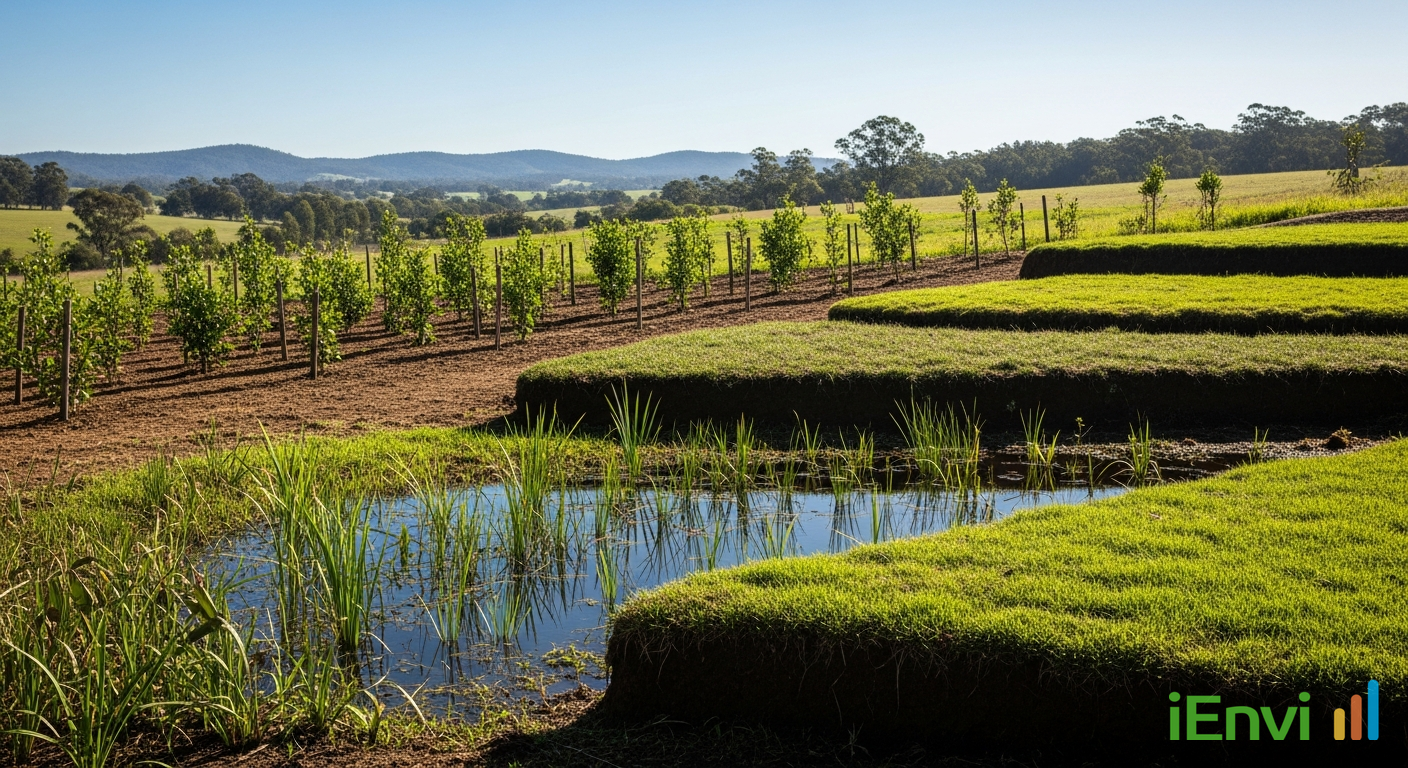
The Doon Doon project will establish 50,000 native plants across 19.9 hectares of steep, erosion-prone slopes to restore wet sclerophyll forest and native rainforest ecosystems. The project operates under the Nature Repair (Replanting Native Forest and Woodland Ecosystems) Methodology Determination 2025, which sets out the approved method for generating biodiversity certificates through active revegetation of degraded land. The planting programme specifically targets soil stabilisation around local creeks and gullies, meaning the project delivers co-benefits across ecological, hydrological, and geomorphic dimensions simultaneously.
The project’s registration on the same parcel as an active ACCU project is the technically critical element here. Under the NRM framework administered by the Clean Energy Regulator, biodiversity certificates are issued for measurable, verifiable improvements in biodiversity values. These are distinct from ACCUs, which represent one tonne of carbon dioxide equivalent abated or sequestered. The two credit types are issued under different legislative instruments and represent different environmental services. This distinction is what makes stacking legally permissible: the NRM does not require a landholder to retire land from carbon project participation, and the ACCU scheme does not preclude parallel biodiversity activities where they are consistent with the approved carbon method. The Doon Doon project is the first formal demonstration that these frameworks can operate concurrently in practice.
Importantly, the property will continue operating as a productive cattle breeding business alongside the restoration zone. This coexistence of agricultural production, carbon sequestration, and active biodiversity restoration on a single 19.9-hectare area challenges the assumption that conservation necessarily displaces productive land use. Practitioners advising rural landholders or agribusiness clients should note this operational model carefully, as it reframes restoration investment as an income diversification strategy rather than an opportunity cost.
Practitioners should also be aware of a forthcoming methodology that will broaden participation in the NRM significantly. The Clean Energy Regulator is currently developing the Enhancing Native Vegetation (ENV) method, which will allow landholders to generate biodiversity certificates by actively managing and improving existing native vegetation, rather than being limited to new replanting programmes. This is a material distinction from the current Replanting Native Forest and Woodland Ecosystems method, and when finalised, the ENV method is expected to open the NRM to a substantially larger cohort of land managers whose properties already support native vegetation communities that could benefit from improved management.
Australian context: Nature Repair Market, EPBC Act offset reform, and implications for QLD, NSW, VIC and SA practitioners
The Nature Repair Market was established under the Nature Repair Act 2023 (Cth) as part of the federal government’s response to the biodiversity crisis identified in the 2021 State of the Environment Report. Australia has one of the highest rates of biodiversity loss among developed nations, and the NRM represents an attempt to mobilise private capital for ecological restoration at scale. The first project registered under the scheme was also in the Northern Rivers region, and the second registration at Doon Doon confirms that early NRM activity is concentrated in high-rainfall, ecologically diverse coastal NSW landscapes where revegetation outcomes are more predictable and measurable.
The most consequential regulatory intersection for Australian environmental practitioners is between the NRM and the EPBC Act offset framework. Under ongoing EPBC Act reform, the federal government has indicated that biodiversity certificates issued under the NRM will be eligible to satisfy environmental offset requirements under the EPBC Act.
References and related sources
- Primary source: minister.dcceew.gov.au
- naturefoundation.org.au
- minterellison.com
- cer.gov.au
- EPBC Act
How iEnvi can help
iEnvi provides specialist consulting services relevant to this topic. Our team includes CEnvP Site Contamination Specialists with experience across contaminated land, groundwater, remediation, ecology, and regulatory compliance.
- iEnvi contaminated land investigation services
- iEnvi remediation and validation services
- iEnvi expert services and independent review services
This is an iEnvi Machete news summary. Prepared by iEnvi to summarise the source article for contaminated land, groundwater, remediation, approvals and site risk professionals.
Published: 28 May 2026
Need advice on this topic? Speak to an iEnvi expert at info@ienvi.com.au or 1300 043 684, or contact us online.
Need advice on this issue? iEnvi provides practical, senior-led environmental consulting across contaminated land, remediation, ecology and environmental risk.
Team credentials Contaminated land services Remediation services Groundwater services Talk to iEnvi