

Overview
The recent announcement by the Tasmanian Government to award 430,000 dollars in funding to twelve resource recovery and landfill operators across the state represents a critical evolution in Australian waste management. Administered under the Waste Levy and Data Readiness Grant Program, this initiative is designed to transition the local waste sector away from historical, observational reporting methods toward high-fidelity, auditable data systems. For property developers, legal advisers, local councils, and environmental consultants, this shift represents more than just a regulatory upgrade. It establishes a new baseline for how waste streams are quantified, tracked, and validated at every stage of a project lifecycle.
Historically, regional waste management across Tasmania and other parts of regional Australia has suffered from a lack of standardised, hard-instrumented data collection. Many facilities have relied on volumetric estimations, where gatehouse operators visually assess a load and apply arbitrary conversion factors to estimate weight. This practice introduces significant error margins, directly undermining the reliability of waste diversion metrics, carbon accounting, and regulatory compliance reports. By funding physical and digital infrastructure upgrades, the Tasmanian Government is establishing a reliable foundation for circular economy initiatives, ensuring that waste metrics are based on empirical measurements rather than subjective visual assessments.
The strategic timing of this funding coincides with a broader national push for environmental accountability. As landfill levies continue to rise across Australian jurisdictions, the financial consequences of inaccurate waste reporting have escalated dramatically. Developers and site owners must now recognise that the data generated at the waste facility gatehouse is a legally binding record that directly influences project costs, liability distributions, and compliance standings. This funding initiative serves as a clear signal that the regulatory tolerance for paper-based, estimated waste tracking is rapidly coming to an end.
Key details
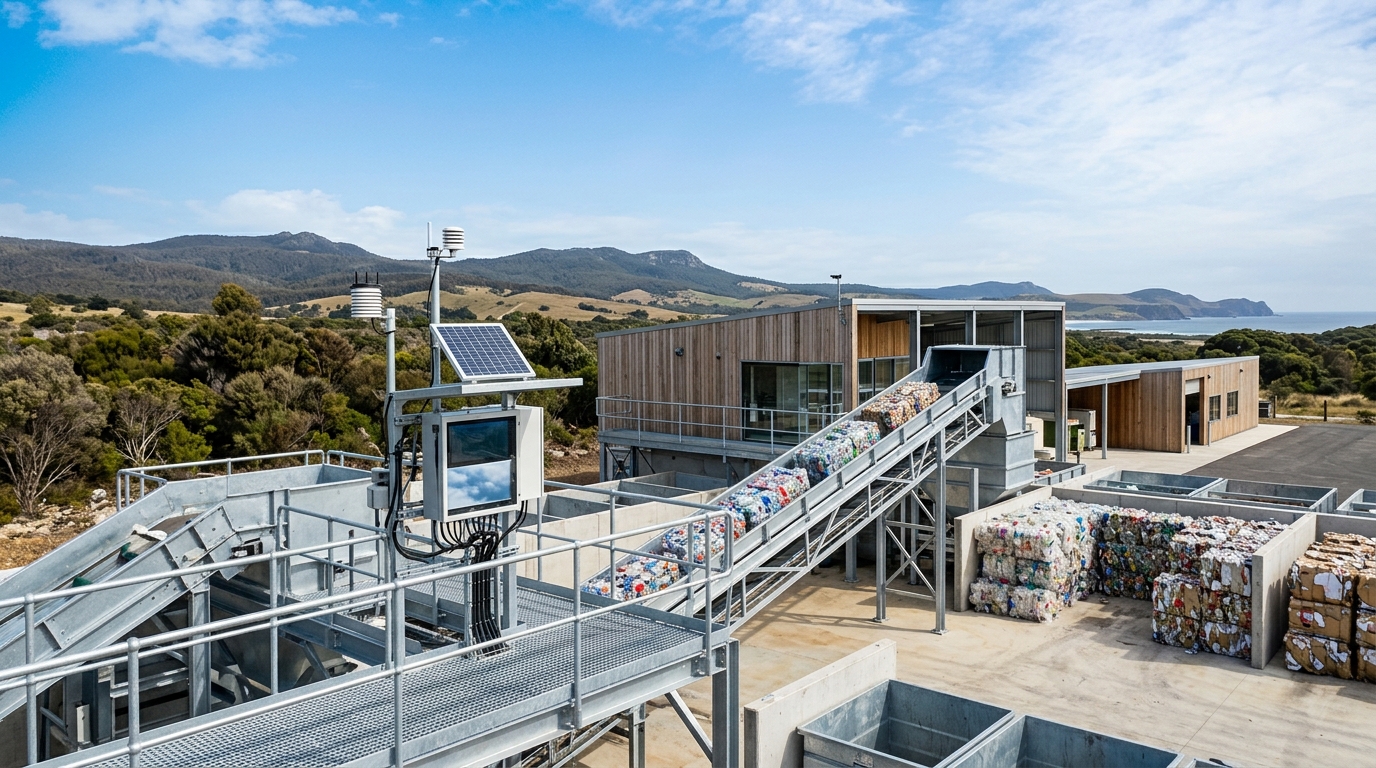
To understand the technical implications of this funding, one must examine the specific systems being targeted for upgrades. The 430,000 dollar grant pool is distributed among twelve distinct operators, including key municipal bodies such as the Hobart City Council and the Launceston City Council, alongside major commercial recycling entities like Sims Metal. These entities are utilising the funding to install advanced physical infrastructure, specifically modern digital weighbridges, automated gate management systems, and integrated point-of-sale software. These technologies are designed to work in unison to eliminate the human error associated with manual gatehouse transactions and volumetric load estimation.
The technical limitation of volumetric estimation lies in its inability to account for variable bulk density. For example, a three-cubic-metre skip containing loose timber has a radically different mass than the same volume filled with crushed concrete or wet clay. Under the Tasmanian Landfill Levy framework, waste levies are calculated on a per-tonne basis, meaning that volumetric conversion discrepancies directly lead to incorrect levy assessments, regulatory compliance risks, and financial penalties. The installation of certified digital weighbridges ensures that every vehicle entering or exiting a facility is weighed with precision, capturing true net mass values that are instantly logged into secure, cloud-hosted software databases.
In addition to these gatehouse controls, the integration of automated gatehouse systems and point-of-sale software creates an unalterable digital chain of custody. When a waste transport vehicle arrives at a facility, integrated systems can automatically capture vehicle registration details, driver identification, waste categorisation codes, and exact mass measurements. This digital automation eliminates manual data entry errors, which have historically been a primary source of data corruption in landfill compliance audits. For environmental consultants performing waste audits or validation assessments, this level of automated recordkeeping provides a highly reliable, verifiable trail that satisfies the stringent standards of environmental regulators.
By upgrading these twelve critical nodes in the Tasmanian waste network, the state is also preparing its infrastructure for more complex material tracking requirements. Modern resource recovery facilities require high-speed data acquisition to separate complex waste streams, such as comingled construction and demolition waste, from inert materials. The point-of-sale software funded under this program allows for granular classification of materials, ensuring that high-value recyclable commodities, such as structural steel and non-ferrous metals handled by operators like Sims Metal, are tracked with the same level of precision as landfilled materials.

Australian context
The infrastructure upgrades occurring in Tasmania directly mirror the broader legislative changes sweeping across other Australian jurisdictions. Under the National Waste Policy Action Plan, all Australian states and territories are working toward a collective target of an 80 per cent average resource recovery rate across all waste streams by the year 2030. Achieving this target is technically impossible without highly accurate, baseline data that can be trusted by state environmental protection agencies, federal auditors, and global environmental, social, and governance reporting bodies. Tasmania’s investment in digital data readiness is a necessary step to align its local industry with these national targets.
From a regulatory standpoint, the Tasmanian Landfill Levy framework operates under the Waste Minimisation and Resource Recovery Act 2022. This legislation establishes the legal mandate for levy collection and data reporting, imposing strict penalties for non-compliance or inaccurate recordkeeping. When compared to mature regulatory landscapes like New South Wales, where the Protection of the Environment Operations Act 1997 and its associated Waste Regulation impose extensive recordkeeping, weighbridge certification, and volumetric survey requirements, Tasmania has historically operated with less stringent digital oversight. This grant program is designed to rapidly close that regulatory gap, bringing Tasmanian waste facility compliance standards in line with those of New South Wales, Victoria, and Queensland.
This convergence of interstate regulatory standards has significant implications for national waste movements and the prevention of illegal dumping. Under the National Environment Protection (Movement of Controlled Waste between States and Territories) Measure, tracking the physical movement and ultimate disposal of hazardous or regulated waste streams is a complex compliance requirement. As states like Victoria enforce strict waste duties under the Environment Protection Act 2017, and Queensland implements its Waste Reduction and Recycling Act 2011, having compatible, high-fidelity digital tracking systems in place across state borders is essential. Tasmania’s transition to automated data capture ensures that its waste tracking data can seamlessly integrate into national tracking databases, mitigating the risk of interstate waste dumping and ensuring consistency in national waste statistics.
Practical implications
For environmental consultants, site auditors, developers, and project managers, the modernisation of waste data systems across Tasmania introduces several critical operational changes. When preparing a Construction Environmental Management Plan or a Remediation Action Plan, practitioners must now account for the enhanced capability of local receiving facilities. Projects can no longer rely on loose estimations of waste volumes when planning transport logistics and budgeting for disposal fees. With certified weighbridges and automated systems operational at municipal and commercial facilities, any discrepancy between onsite estimations and actual gatehouse measurements will be immediately flagged, potentially leading to significant project cost overruns or delays in site clearance validation.
The implementation of digital point-of-sale and gatehouse tracking also significantly reduces the risk of liability disputes for site developers and environmental consultants. In contaminated land management, establishing a clear, uninterrupted chain of custody from the point of excavation to the point of final disposal is paramount. If contaminated soil or hazardous waste is miscategorised or tracked incorrectly, the site owner faces severe regulatory penalties and reputational damage. The automated data streams generated by these newly upgraded Tasmanian facilities provide developers with solid, legally defensible documentation that proves compliance with waste classification guidelines and disposal permits, effectively mitigating long-term liability.
Additionally, local councils and planning authorities will need to update their assessment and auditing protocols to leverage this new source of high-quality data. Planning approvals that mandate specific waste diversion and recycling targets can now be audited with high precision. Councils will be able to demand verified, system-generated weighbridge dockets from developers rather than self-reported estimates. This shift will drive a higher standard of performance in the construction and demolition sector, as contractors will be held strictly accountable to the actual volumes of waste diverted from landfills and directed to resource recovery facilities.
Article Summary
In our experience delivering complex site contamination and waste management projects across Queensland, New South Wales, Victoria, and South Australia, we consistently see projects derailed by poor primary data at the gatehouse. This Tasmanian initiative addresses a vulnerability that senior environmental practitioners have highlighted for years: the systemic failure of manual, volumetric waste tracking. For developers and councils, this upgrade directly impacts the integrity of Waste Classification Reports, Remediation Action Plans, and ultimate Site Audit Statements. We can no longer tolerate the compliance risks associated with visual load estimations, which routinely lead to disputes over waste levy liabilities and soil disposal classifications during active civil works. The critical project-stage decision that must change in light of this data modernisation is the early-stage sampling design and waste stream budgeting during due diligence. Practitioners must design their sampling regimes to align with the precise, instrumented thresholds of receiving facilities, rather than relying on historical, loose conversions. As digital weighbridges and automated gatehouses become the national standard, clients who fail to reconcile their onsite environmental due diligence reports with precise gatehouse data will find themselves exposed to severe auditing penalties and project delays.
References and related sources
- Primary source: www.miragenews.com
How iEnvi can help
iEnvi provides specialist consulting services relevant to this topic. Our team includes CEnvP Site Contamination Specialists with experience across contaminated land, groundwater, remediation, ecology, and regulatory compliance.
- iEnvi ESG services
- iEnvi contaminated land investigation services
- iEnvi remediation and validation services
- iEnvi expert services and independent review services
This is an iEnvi Machete news summary. Prepared by iEnvi to summarise the source article for contaminated land, groundwater, remediation, approvals and site risk professionals.
Published: 21 May 2026
Need advice on this topic? Speak to an iEnvi expert at info@ienvi.com.au or 1300 043 684, or contact us online.
Need advice on this issue? iEnvi provides practical, senior-led environmental consulting across contaminated land, remediation, ecology and environmental risk.
Team credentials Environmental management plans Contaminated land services Remediation services Talk to iEnvi