

The reviewer claims the ruling was July 2024 and the fire response was May
Overview of the Diamond Creek Asbestos Dumping Case
The Heidelberg Magistrates’ Court delivered a landmark environmental enforcement ruling on 21 July 2024, sentencing Diamond Creek property owner Joseph Chetcuti to a $60,000 fine and ordering him to pay $12,000 in legal costs following an illegal waste dumping operation at his 19,000 square metre property on Black Gully Road in Victoria. The court also issued a binding remediation order requiring Chetcuti to fund a comprehensive site clean-up estimated to cost well over $1 million. This ruling is understood to represent the highest fine ever imposed on an individual for an environmental crime under the Environment Protection Act 2017 (Vic), and it sets a clear precedent for personal liability that cannot be extinguished by a property sale.
The case began in May 2023 when EPA Victoria and emergency services responded to an illegal fire at the property. What responding officers uncovered was not an isolated incident but a highly organised, industrial-scale operation systematically accepting construction and demolition waste, along with soil contaminated with asbestos. Chetcuti pleaded guilty to two charges: depositing and receiving waste and reportable priority waste at a site unlicensed to receive it, and failing to comply with an Environmental Action Notice (EAN) issued under Section 290(1) of the Environment Protection Act 2017 (Vic). EPA Victoria built its case using a combination of public pollution reports, physical inspections, and aerial and drone surveillance that tracked soil importation and the movement of commercially operated trucks to and from the site.
For environmental practitioners advising developers, investors, councils, and in-house legal teams across Australia, this case matters for several reasons that extend well beyond Victoria’s borders. It demonstrates that regulators are prepared to pursue individuals with the same vigour previously reserved for corporate entities, that personal liability for remediation survives a property transaction, and that enforcement technology has fundamentally changed the detection landscape for illegal waste operations. These are not hypothetical risks. They are live considerations in any due diligence, site acquisition, or development approval process where waste, fill, or soil importation is involved.
Key details of the Diamond Creek illegal waste ruling
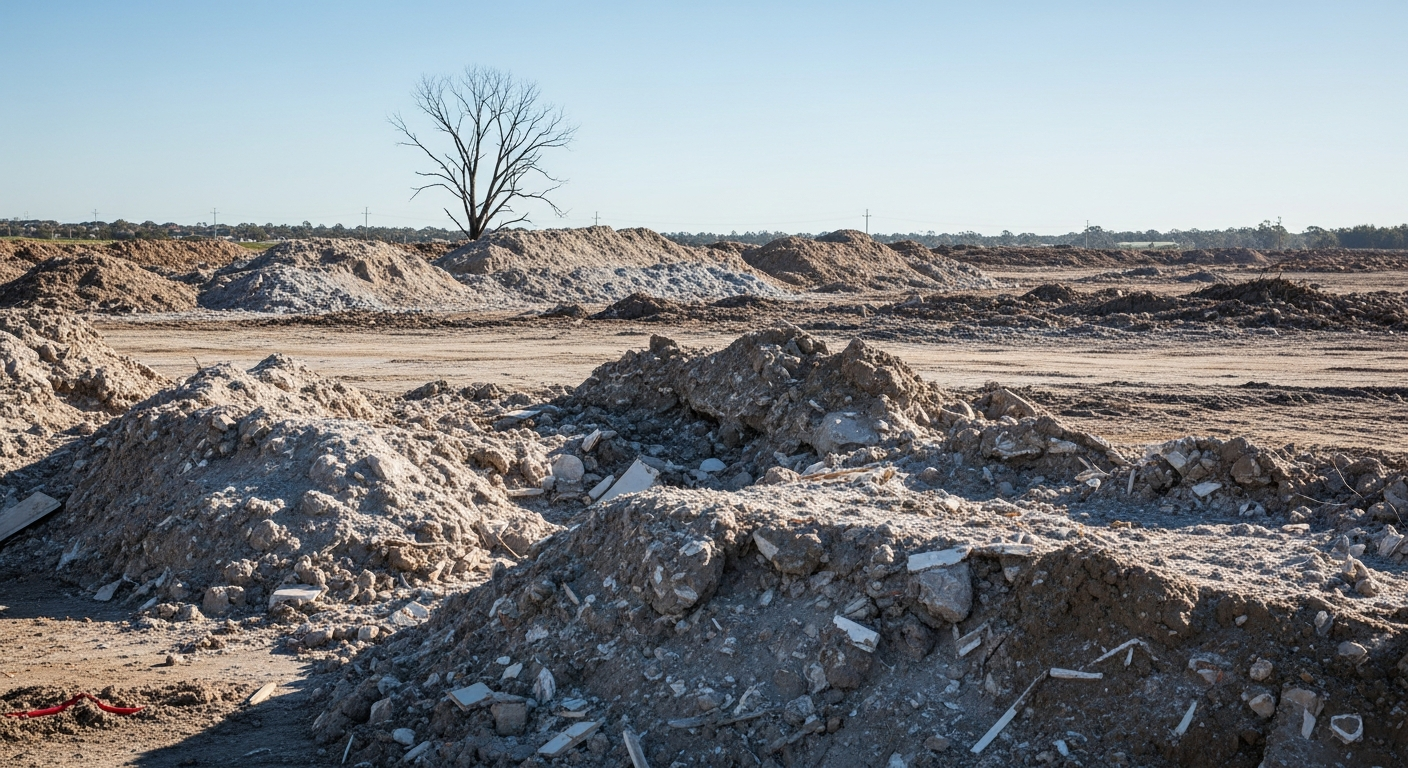
Chetcuti’s 19,000 square metre property at Black Gully Road, Diamond Creek, was being operated as an unlicensed waste facility. The site was accepting construction and demolition waste and asbestos-contaminated soil, both of which carry significant regulatory obligations under Victorian law. The two charges to which he pleaded guilty under the Environment Protection Act 2017 (Vic) carry distinct but complementary significance. The first charge, depositing and receiving waste and reportable priority waste at an unlicensed site, directly implicates the waste classification and tracking obligations set out under the Environment Protection Regulations 2021 (Vic). Under those regulations, any waste stream that includes asbestos or construction and demolition debris with hazardous characteristics must be classified as reportable priority waste and transported only to a lawfully authorised facility. There is no discretion available to a landowner to accept such material informally, regardless of what arrangements may have been made with transporters or generators.
The second charge, non-compliance with an Environmental Action Notice under Section 290(1) of the Environment Protection Act 2017 (Vic), reflects the escalating consequences of ignoring a formal regulatory direction. The EAN issued to Chetcuti was specific and technically demanding. It required him to immediately cease accepting waste and burning material on site, engage a qualified environmental professional to classify all stockpiled industrial waste in accordance with the Environment Protection Regulations 2021 (Vic), arrange removal of all waste to a licensed receiving facility, and obtain independent verification from a qualified occupational hygienist confirming that all asbestos-containing material had been safely removed and the site was clear. This is not a generic compliance direction. It describes a staged, technically complex remediation programme that requires specialist input at each step, and it mirrors the kind of scope typically covered by a Remedial Action Plan under formal site assessment frameworks.
The financial consequences are substantial and structured at multiple levels. The $60,000 fine represents the punitive element for the criminal offences. The $12,000 in legal costs adds a further direct financial burden. But both of those figures are dwarfed by the court-mandated clean-up order, which is estimated to exceed $1 million in total cost. This order is not contingent on Chetcuti retaining ownership of the land. It is attached to him personally and remains legally binding regardless of whether the property changes hands. This personal attachment of remediation liability is a critical detail that distinguishes this ruling from civil enforcement actions that might otherwise be extinguished or transferred through a property sale.
EPA Victoria’s use of aerial surveillance and drone monitoring to build the evidentiary case is also technically significant. Investigators tracked the importation of soil and the movement of commercial trucks using aerial observation, supplementing physical inspections and public pollution reports. This approach allowed regulators to establish a pattern of behaviour over time, which strengthened the prosecution’s case and supported the conclusion that the operation was deliberate and organised rather than opportunistic. The use of remote sensing and aerial imagery in environmental enforcement is not new, but this case illustrates how effectively it can be deployed to monitor remote sites and gather admissible evidence for environmental prosecutions.
References and related sources
- Primary source: www.epa.vic.gov.au
- epa.vic.gov.au
- epa.vic.gov.au
- sers.net.au
- NEPM Assessment of Site Contamination
- EPA Victoria
How iEnvi can help
iEnvi provides specialist consulting services relevant to this topic. Our team includes CEnvP Site Contamination Specialists with experience across contaminated land, groundwater, remediation, ecology, and regulatory compliance.
- iEnvi remediation services
- iEnvi asbestos services
- iEnvi due diligence services
- iEnvi expert services and independent review services
This is an iEnvi Machete news summary. Prepared by iEnvi to summarise the source article for contaminated land, groundwater, remediation, approvals and site risk professionals.
Published: 26 Jul 2026
Need advice on this topic? Speak to an iEnvi expert at info@ienvi.com.au or 1300 043 684, or contact us online.
Need advice on this issue? iEnvi provides practical, senior-led environmental consulting across contaminated land, remediation, ecology and environmental risk.
Team credentials Contaminated land services Remediation services Groundwater services Talk to iEnvi