
AgentRadio multi-agent framework beats a single frontier model on enterprise coding benchmark
Researchers from Coral AI Labs, working with several university partners, have published benchmark results showing that four smaller AI coding agents coordinated through a new communication framework called AgentRadio outperformed a single, larger, more expensive frontier model on complex enterprise software tasks. The framework allows autonomous agents to exchange messages mid-task, in real time, without pausing their main execution steps.
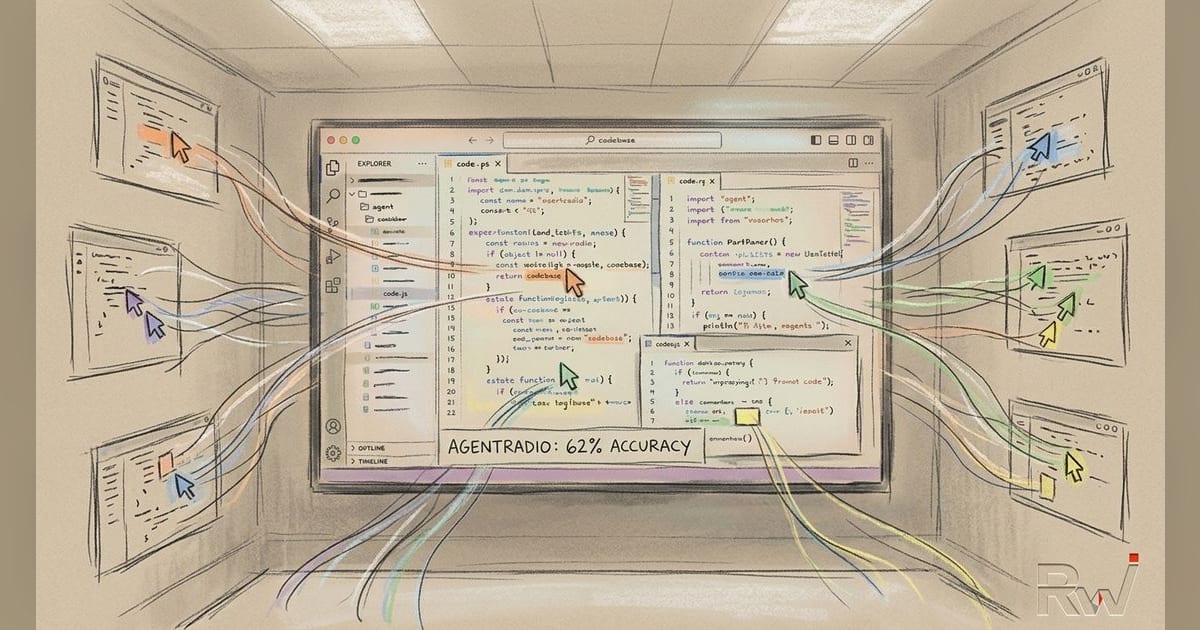
The headline result is straightforward. A team of four Claude Code agents running on Anthropic’s Claude Opus 4.6 model, coordinated via AgentRadio, achieved a 62.1% task resolution rate on a demanding enterprise coding benchmark. A single agent running on the newer and significantly more expensive Claude Opus 4.8 model achieved 57.2% on the same benchmark. In other words, orchestration of several cheaper models beat a single upgraded, higher-cost model.
For organisations that rely on AI tools to process large volumes of technical data, manage codebases or automate repetitive analytical workflows, this points to a shift in where performance gains actually come from. Rather than defaulting to the newest and most expensive model release, organisations may get better results, at lower cost, by investing in how multiple agents are coordinated during a task.
Key details
AgentRadio was tested on SWE-Atlas QnA, a benchmark designed to evaluate long-horizon reasoning and command execution across live, production-grade software repositories, including systems such as MinIO. This is not a toy benchmark. It requires agents to navigate real codebases, execute commands, interpret outputs, and resolve dependencies that emerge only once work is underway, such as unexpected server log dependencies discovered mid-task.
The comparative results across model configurations are specific and worth setting out in full. A single Claude Code agent running on Claude Opus 4.6 achieved a 32.3% success rate. A single agent on the newer Claude Opus 4.8 model lifted that to 57.2%. When four Claude Opus 4.6 agents were coordinated using AgentRadio, the success rate rose to 62.1%, exceeding the single larger model despite running on the older, cheaper underlying model. The pattern held on a different model family too. Four DeepSeek V4 Pro agents coordinated via AgentRadio improved resolution rates from 29.0% (single agent baseline) to 50.8%, an absolute gain of nearly 22 percentage points.
The technical mechanism behind these gains is the replacement of passive, sequential review loops with an asynchronous message-passing layer. In conventional multi-agent setups, a subagent typically completes an entire task before a supervisor or reviewing agent checks the output. If an agent takes a wrong turn early in a long task, that error is often not caught until the full sequence has run, wasting compute and time on a dead-end path. AgentRadio instead lets subagents broadcast state updates and log discoveries while tool-use cycles are still active. One agent finding an unexpected dependency, for example, can immediately update the shared project context so other agents adjust their approach without waiting for a full task cycle to complete.
This is a coordination-layer innovation rather than a new foundation model. The underlying language models (Claude Opus 4.6, Claude Opus 4.8, DeepSeek V4 Pro) are unchanged. What differs is the orchestration architecture sitting above them, which suggests the performance ceiling for a given model is not fixed and can be extended through better multi-agent design rather than through model upgrades alone.
Australian context
This is an international technology development with no direct regulatory dimension in Australia. Its relevance for Australian organisations sits in how AI-assisted tooling is procured, built and costed. Firms evaluating AI tools for code-based or data-processing workflows should not assume that subscribing to the newest, most expensive model tier is the most cost-effective path to better accuracy. A coordinated set of smaller models can, on this benchmark, outperform a single larger model at a lower inference cost.
It is worth noting that this benchmark was run on enterprise-scale software repositories. The source material makes no claims extending these results to other domains, and any application of multi-agent coordination to different task types would need its own testing and validation before being relied upon in production or for client deliverables.

Practical implications
For organisations already experimenting with AI-assisted code or data workflows, the key takeaway is architectural rather than a call to switch model providers immediately. The AgentRadio results indicate that how agents communicate mid-task matters as much as which model powers them. Teams building internal tools for data processing, script validation or repetitive technical checks should factor coordination design into their evaluation criteria, not just headline model benchmark scores.
References and related sources
- Primary source: venturebeat.com
- runtimewire.com
- https://venturebeat.com/ai/four-ai-agents-coordinating-in-real-time-outperformed
How iEnvi can help
iEnvi integrates technology and data-driven approaches into environmental consulting. We monitor AI and technology developments that affect how environmental professionals deliver services to clients.
This is an iEnvi Machete news summary. Prepared by iEnvi to summarise the source article for environmental professionals tracking AI, data, and technology developments that affect consulting and project delivery.
Published: 09 Aug 2026
Need advice on this topic? Speak to an iEnvi expert at info@ienvi.com.au or 1300 043 684, or contact us online.
Need advice on this issue? iEnvi provides practical, senior-led environmental consulting across contaminated land, remediation, ecology and environmental risk.
Contaminated land advice Remediation services Discuss your site Talk to iEnvi