
Overview
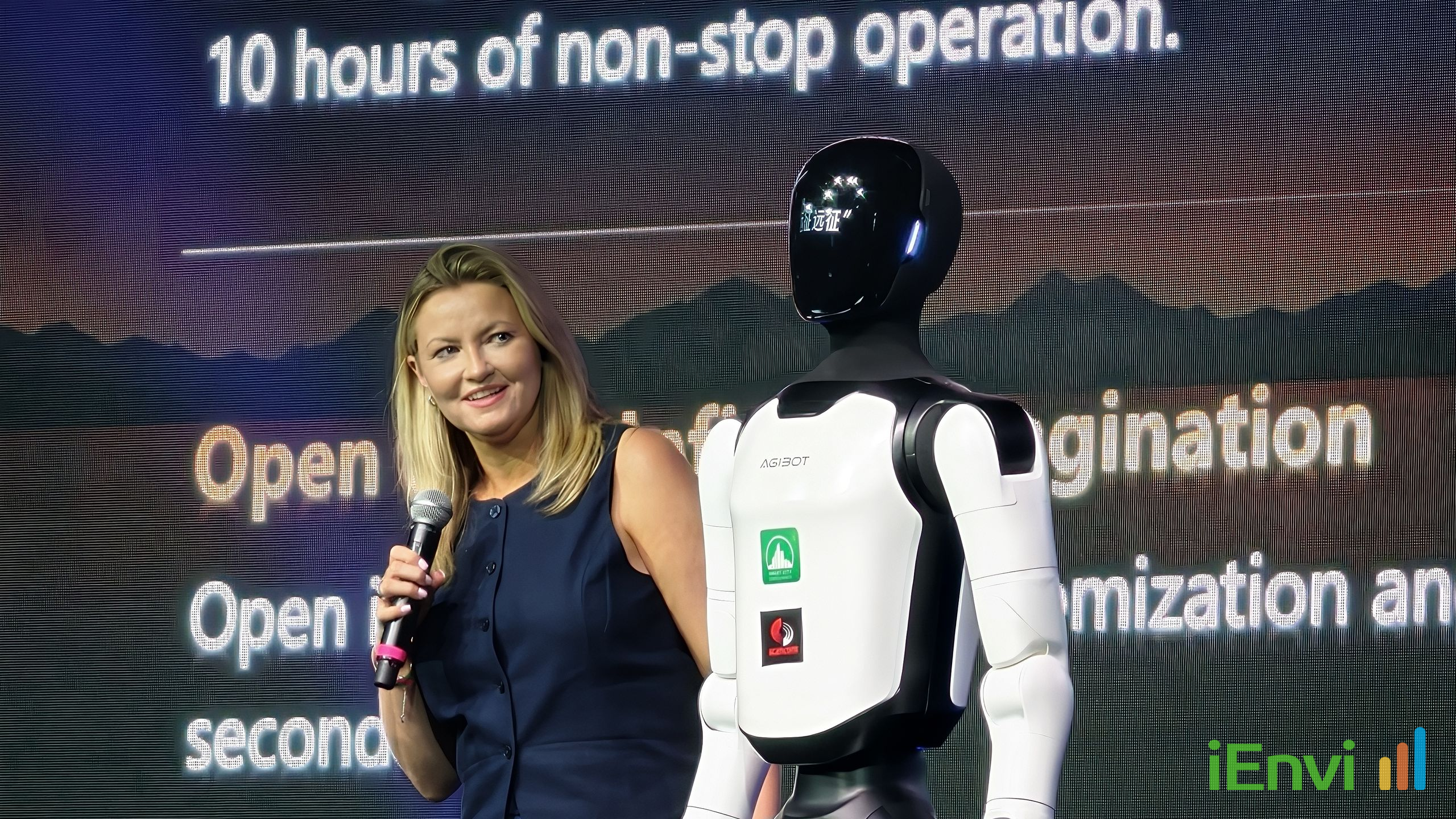
Chinese humanoid robotics developer Agibot has made its formal entry into the United Kingdom’s business-to-business market, bringing with it a production milestone that signals a meaningful shift in the trajectory of physical artificial intelligence. Founded in 2023 by former Huawei engineers, the company announced that its 15,000th robotic unit had rolled off the production line, a figure that places it well ahead of most Western robotics competitors in terms of manufacturing scale. The UK launch featured three distinct platforms: the full-sized A3 humanoid, the half-sized X2 humanoid, and the D1 quadruped range, each aimed at different operational environments within the B2B sector.
What distinguishes this announcement from the routine product launches that characterise the robotics industry is the evidence Agibot brought with it. Rather than laboratory demonstrations or controlled proof-of-concept trials, the company pointed to a six-day continuous live-stream deployment at Longcheer Technology’s manufacturing facility in Nanchang, China. In that trial, Agibot’s G2 industrial humanoid robots completed 64,828 discrete production-line tasks alongside human workers, contributing directly to the assembly of 17,625 tablet units. The reported task success rate was 99.99 per cent. These are not speculative projections; they are operational figures from an active mass-production environment.
For professionals and enterprise leaders across engineering, industrial operations, and technical consulting, the significance of this development lies less in the novelty of humanoid robots and more in the speed at which the technology has transitioned from unstable prototype to commercially viable, deployable hardware. The conversation is no longer about whether physical AI will reach the workplace; it is about the pace at which organisations need to assess their own workflows and prepare for its arrival.
Key details of Agibot’s technology, deployment scale, and manufacturing trajectory
The most technically significant aspect of the Nanchang deployment is that it occurred in an unmodified factory environment. Traditional industrial automation, whether robotic arms, conveyor systems, or automated guided vehicles, requires heavily engineered, structured surrounds: safety cages, dedicated lanes, and controlled inputs. Agibot’s G2 humanoid operated directly alongside human workers on a standard production line without modification to the facility layout or infrastructure. This is a meaningful technical threshold. It means the deployment cost calculus changes substantially, because the facility itself does not need to be rebuilt around the robot.
The 99.99 per cent task success rate across 64,828 operations translates to fewer than seven task failures over the entire six-day continuous trial. At that reliability level, the G2 is performing at a standard comparable to or exceeding the error rates associated with human workers on repetitive assembly tasks, where fatigue, distraction, and ergonomic strain accumulate over shift length. The tasks completed contributed to the assembly of 17,625 tablet units, confirming that the robots were performing steps integral to finished product output, not peripheral or low-consequence support functions.
Agibot’s manufacturing ramp-up is equally notable. The company reports that the increase from 5,000 cumulative units to 10,000 cumulative units took only three months. The subsequent jump to 15,000 units, announced at the UK launch, indicates that monthly production rates are continuing to accelerate. For context, this trajectory places Agibot’s output well beyond the volumes achieved by most humanoid robotics developers globally at this stage of their development cycle. William Shi, President of Agibot Europe and America, addressed the labour displacement question directly at the launch, framing the technology not as a cost-cutting tool but as a solution to chronic labour shortages in high-turnover, high-risk industries: “In some jobs, they want to be replaced… we’ve got to factor people doing dangerous, boring, and repeatable jobs.”
Beyond manufacturing, Agibot has publicly indicated its intention to expand into service-oriented B2B roles. Named target sectors include retail food service, live entertainment, and longer-term aspirations in healthcare and education. The company’s stated commercial rationale is grounded in the structural problem of roles that carry high physical risk, extreme repetition, or significant worker turnover, categories where human recruitment and retention costs are high and where the value proposition for physical AI agents is strongest.
Australian business and professional services context for physical AI deployment
Australia’s professional services and industrial sectors are not insulated from the implications of this development. The country faces well-documented labour shortages across a range of industries, including construction, resources, environmental consulting, and manufacturing. The National Skills Commission has consistently identified trades, technicians, and operational roles as areas of persistent undersupply. Physical AI systems that can perform reliable, repeatable tasks in unmodified environments directly address the operational gap that many Australian businesses have been managing through overtime, contractor costs, or deferred activity.
From a regulatory and workplace health and safety perspective, the framing that Shi articulated at the UK launch aligns with obligations that already exist under Australian WHS legislation. The model Work Health and Safety Act, adopted across most Australian jurisdictions, places a duty on persons conducting a business or undertaking to eliminate or minimise risks to workers so far as is reasonably practicable. Where a task involves repetitive motion injury risk, heat stress, exposure to hazardous substances, or other conditions that accumulate harm over time, the availability of a reliable physical AI alternative becomes a factor that duty holders may increasingly need to consider when demonstrating that risks have been minimised so far as is reasonably practicable.
References and related sources
- Primary source: www.techradar.com
- substack.com
- tgstat.ru
- https://www.techradar.com/pro/in-some-jobs-they-want-to-be-replaced-chinese-robo
How iEnvi can help
iEnvi integrates technology and data-driven approaches into environmental consulting. We monitor AI and technology developments that affect how environmental professionals deliver services to clients.
This is an iEnvi Machete news summary. Prepared by iEnvi to summarise the source article for environmental professionals tracking AI, data, and technology developments that affect consulting and project delivery.
Published: 05 Jul 2026
Need advice on this topic? Speak to an iEnvi expert at info@ienvi.com.au or 1300 043 684, or contact us online.
Need advice on this issue? iEnvi provides practical, senior-led environmental consulting across contaminated land, remediation, ecology and environmental risk.
Contaminated land advice Remediation services Discuss your site Talk to iEnvi