
Global humanoid robot shipments surge 272% in H1 2026
Global shipments of humanoid robots hit 19,100 units in the first half of 2026, a 272% increase on the same period last year, according to market intelligence reported by Forbes on 11 August 2026. Chinese manufacturers accounted for more than 97% of that volume, with domestic Chinese buyers absorbing 85% of total demand. This is not a research curiosity anymore. Over 70% of the units shipped in H1 2026 are working in real industrial and commercial settings, including automotive assembly lines, component handling operations, and logistics facilities, rather than sitting in university labs or trade show booths.
For engineering, consulting, and site management firms across Australia, this matters because physical AI hardware is now cheap enough and reliable enough to appear on live worksites within the next planning cycle, not the next decade. Environmental consultants, planners, and project managers who advise on site works, remediation, or facility operations increasingly need to understand what these machines can do, who supplies them, and what regulatory and supply chain risks come attached to that hardware.
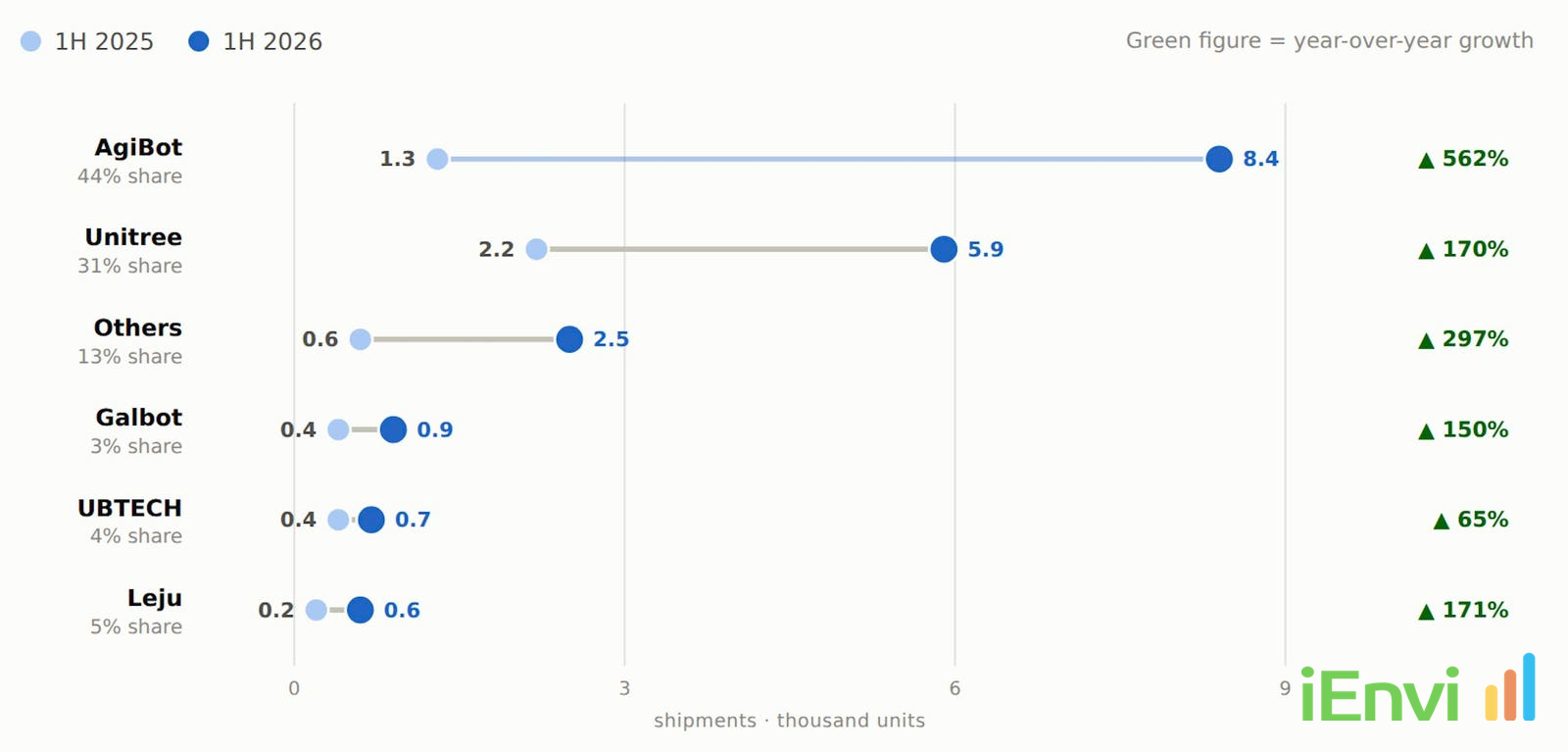
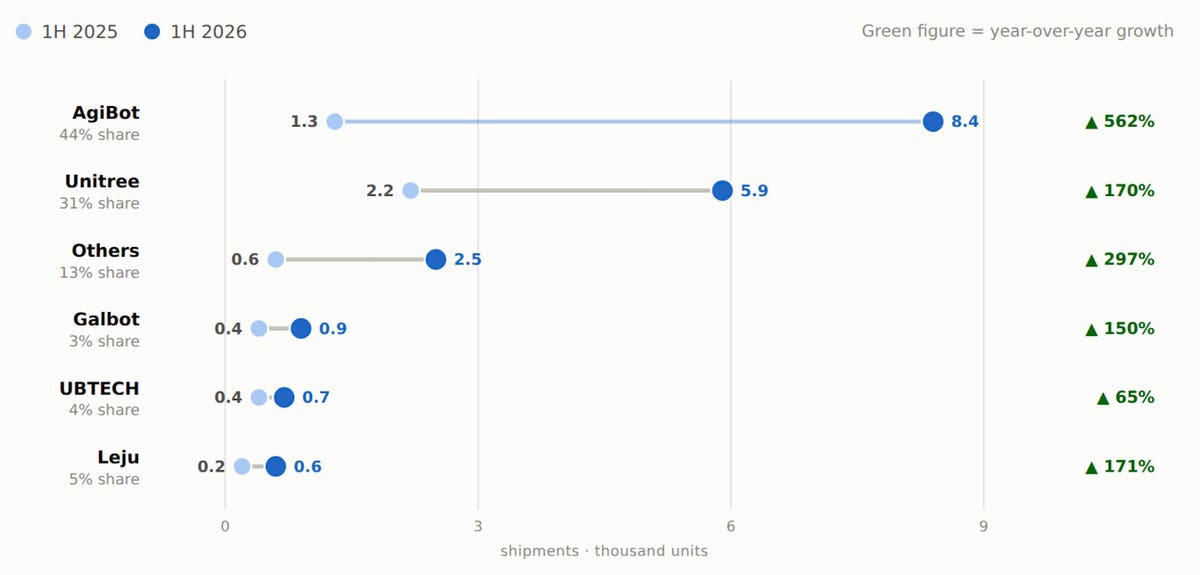
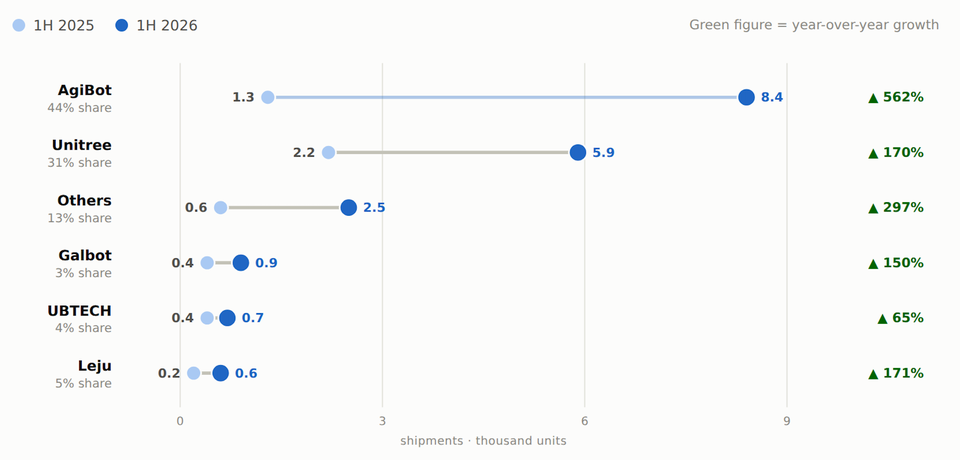
The scale of the shift is best illustrated by the new market leader. Shanghai-based AgiBot overtook Unitree to become the top global vendor, shipping roughly 8,400 units for a 44% market share, a 562% year-on-year jump. Unitree held 31% share. Together the two firms now control 75% of the entire global humanoid robot market, a level of concentration that has direct consequences for anyone thinking about sourcing this equipment for Australian projects.
AgiBot and Unitree take 75% market share as deployments turn commercial
The 19,100-unit figure for H1 2026 represents total global shipments of humanoid robots, tracked across research, industrial, and commercial deployment categories. Chinese vendors captured over 97% of that volume, and Chinese buyers absorbed 85% of total demand, meaning the vast majority of both supply and consumption sits inside China’s domestic market. Full-year 2026 shipments are projected to reach approximately 60,000 units, with the market intelligence cited by Forbes forecasting a scale-up toward 500,000 units annually by 2030.
AgiBot’s 562% year-on-year growth to 8,400 units and 44% share displaced Unitree, which held 31% share in the same period. This 75% combined market concentration is attributed to centralised component manufacturing inside China, particularly for precision reducers, tactile sensors, and planetary roller screws, the mechanical components that drive cost down in humanoid actuator assemblies. That supply chain concentration is the mechanical explanation for why unit costs have fallen faster than most Western manufacturers anticipated.
The deployment data point is arguably the more consequential figure for industrial and commercial planning purposes. More than 70% of shipped units are now operating in production environments such as automotive assembly, component handling, and logistics hubs. That crosses a threshold market analysts treat as the marker between demonstration-stage robotics and genuine commercial deployment. It indicates the technology has moved past the pilot phase for a meaningful share of the installed base.
On the Western side, companies including Tesla, Figure, and Boston Dynamics are reported to be prioritising software reliability, safety standards, and end-to-end task execution ahead of mass-volume scaling. Recent US import restrictions on Chinese humanoid hardware add a further complication, effectively bifurcating the global market into a high-volume, lower-cost Chinese hardware stream and a slower, software-first Western development stream. As one industry commentator put it, this divergence is not necessarily a fatal setback for Western firms, who appear to be aiming for sustainable, reliable market entry rather than rapid but potentially flawed volume scaling.
Australian business and professional services implications
Australia does not manufacture humanoid robots domestically at any scale, so the practical question for local businesses is procurement, not production. With Chinese vendors controlling 97% of global shipments and 75% of that volume concentrated in just two firms, Australian companies looking at humanoid robotics for warehousing, logistics, or industrial handling will be sourcing almost exclusively from Chinese supply chains in the near term, unless they wait for Western software-first platforms to reach comparable price points.
This creates a genuine decision point for Australian firms in manufacturing, logistics, mining services, and facilities management. Buying early means accessing lower-cost Chinese hardware that is already proven in comparable industrial settings overseas, but it also means exposure to geopolitical supply chain risk, given that the United States has imposed import restrictions on Chinese humanoid hardware and Australia’s trade posture may shift in response over the coming years. Firms that delay may find Western alternatives from Tesla, Figure, or Boston Dynamics offer stronger safety certification pathways and software reliability, but at higher unit cost and slower availability.
For professional services firms, including consultancies that advise on workplace safety, site operations, and technology procurement, the practical implication is that clients are going to start asking about humanoid robots on operational sites well before local regulatory and safety certification frameworks have caught up. Work health and safety regulators in each Australian jurisdiction have not yet published specific guidance for humanoid robot deployment in industrial settings, which leaves early adopters to rely on general plant and equipment safety obligations under existing WHS legislation until purpose-built standards emerge.
Practical implications
Businesses evaluating humanoid robots for site operations should treat vendor concentration as a procurement risk in its own right. With two Chinese manufacturers controlling three quarters of global supply, pricing, spare parts availability, and ongoing firmware support all depend on a narrow supplier base that could be disrupted by trade policy changes at short notice. Procurement teams should factor dual-sourcing options, spare parts holdings, and contract exit provisions into any early purchase decision, and price in the possibility that Australia’s import settings shift in line with those of the United States.
Firms should also document how any deployed units fit within existing plant and equipment obligations under WHS legislation, and monitor Safe Work Australia and state regulators for humanoid-specific guidance as it emerges. For most Australian operators, the sensible near-term step is a scoped pilot in a controlled environment rather than a fleet purchase, so that safety, maintenance, and workforce integration questions can be answered before this hardware arrives on live worksites at scale.
References and related sources
- Primary source: www.forbes.com
- skycrumbs.com
- youtube.com
- gasgoo.com
- NEPM Assessment of Site Contamination
How iEnvi can help
iEnvi integrates technology and data-driven approaches into environmental consulting. We monitor AI and technology developments that affect how environmental professionals deliver services to clients.
This is an iEnvi Machete news summary. Prepared by iEnvi to summarise the source article for environmental professionals tracking AI, data, and technology developments that affect consulting and project delivery.
Published: 13 Aug 2026
Need advice on this topic? Speak to an iEnvi expert at info@ienvi.com.au or 1300 043 684, or contact us online.
Need advice on this issue? iEnvi provides practical, senior-led environmental consulting across contaminated land, remediation, ecology and environmental risk.