
Grok 4.6 release and its relevance to consultancy AI workflows
On 12 August 2026, Elon Musk’s SpaceXAI (formerly xAI) released Grok 4.6, a frontier large language model built specifically for long-running autonomous agents, software engineering tasks and multi-step knowledge work. The model scored 61 on the independent Artificial Analysis Intelligence Index, placing it in a tie with OpenAI’s GPT-5.6 Sol Max as the world’s third most capable AI model, ahead of Moonshot AI’s Kimi K3 and just behind Anthropic’s Claude Opus 5 and Claude Fable 5.
This release matters to environmental professionals not because Grok 4.6 does contaminated land assessment or ecological survey work (it does not, and nothing in the source material claims that), but because it signals where the underlying technology that increasingly sits inside consultancy workflows is heading. Environmental consultancies, planning firms and legal practices already use large language models for literature review, data QA scripting, spatial data processing and report drafting support. A model optimised for reliable, low-cost, long-horizon task completion changes the economics and risk profile of those internal tools, whether firms build them in-house or licence them through platforms such as Cursor, OpenRouter or Vercel.
For developers, councils and legal teams instructing environmental consultants, the relevant takeaway is indirect but real. As the AI tools underpinning consultancy back-office workflows become cheaper and more reliable at multi-step tasks, the pace and cost structure of desktop assessments, data compilation and report production is likely to shift over the coming years. This article sets out the technical detail behind the Grok 4.6 release and what it signals for technical consultancies more broadly, without overstating direct application to site assessment science.
Key details
Grok 4.6 was trained using agentic reinforcement learning combined with regenerated supervised fine-tuning trajectories. According to the release material, this training approach gives the model built-in self-testing and verification behaviour in long-trajectory agent tasks, meaning it checks and validates its own code or research outputs before taking the next tool action in a workflow. This is a departure from earlier generations of frontier models, which typically executed each step without an internal verification loop.
On complex, long-horizon benchmarks such as AA-Briefcase, Grok 4.6 completed multi-step tasks in an average of approximately 53 turns and roughly 0.5 billion input tokens. By comparison, Claude Opus 5 required approximately 103 turns and around 2.0 billion input tokens to complete equivalent tasks. This is a substantial reduction in the number of reasoning loops and total token consumption needed to finish a given workflow, which has direct implications for compute cost and processing time in agentic systems.
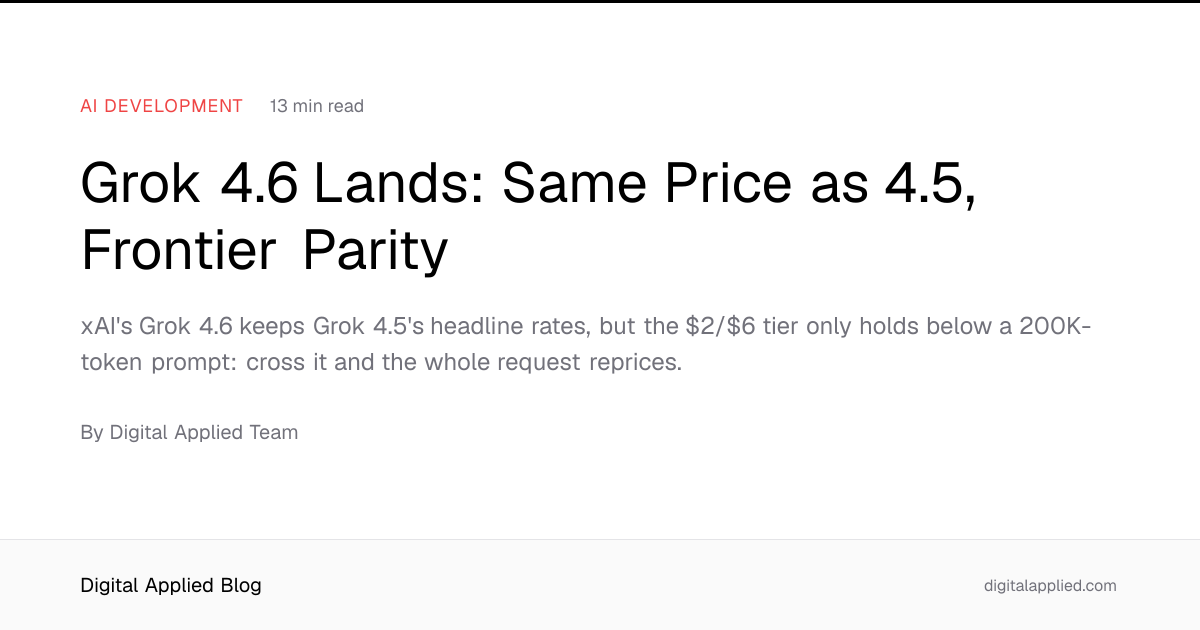
List pricing for the Grok 4.6 API remains unchanged from Grok 4.5, at USD 2.00 per 1 million input tokens and USD 6.00 per 1 million output tokens, based on a 200,000 token prompt context. This places Grok 4.6’s output pricing at roughly one-fifth the cost of GPT-5.6 Sol for equivalent workloads, while matching it on the Artificial Analysis Intelligence Index score. The model features a 500,000 token context window and a knowledge cutoff of 1 February 2026, and is available immediately through the xAI API, Cursor, Grok Build, OpenRouter, Vercel and Cloudflare.
The release material frames the improvement as a shift in competitive focus among frontier labs, from raw benchmark performance toward the unit economics and reliability of autonomous agent execution. The stated design goal is a model that can sustain long-running, multi-step technical work such as software development and research synthesis without accumulating hallucinated steps or looping unnecessarily, which is the practical failure mode that has limited enterprise adoption of agentic AI to date.
Australian context: agentic AI and professional services workflows
Australian environmental, planning and legal consultancies are part of a broader professional services sector that has been progressively adopting large language models for internal productivity over the past three years, covering tasks such as literature search, drafting support, database querying and script-based data QA. The Grok 4.6 release is relevant to this sector not as an environmental regulation development, but as a signal of where the underlying AI infrastructure that firms rely on is trending, both in capability and in cost.
The reported reduction in turn count and token consumption for multi-step agent tasks, from roughly 103 turns down to around 53 turns for an equivalent workload, is significant for any Australian firm running automated data processing pipelines, whether that is GIS script automation, statistical treatment of large environmental datasets, or document cross-referencing across multiple guideline documents. Fewer reasoning loops per task translates directly into lower compute cost and faster turnaround for firms that have built or licensed agentic tooling into their internal systems.
For Australian business leaders and in-house counsel evaluating AI vendor relationships, the flat pricing structure at USD 2.00 input and USD 6.00 output per million tokens, alongside a claimed fivefold cost advantage over a comparably scored competitor model, is a useful data point when assessing total cost of ownership for agentic AI tools embedded in document management, coding assistants or research platforms used across professional services generally, including those adjacent to environmental consulting.

Practical implications
Firms that have integrated AI copilots into internal workflows, such as automated QA scripts for laboratory data, spatial interpolation routines, or first-pass drafting of technical sections, should factor releases like Grok 4.6 into periodic reviews of vendor pricing and tool selection. The reported halving of turn counts and reduction in token consumption for long-horizon tasks means that the cost of running an equivalent internal pipeline may fall meaningfully between model generations, and firms locked into older tooling may be paying more per task than the current market rate.
The built-in verification behaviour described in the release material is also relevant to risk management. A model that checks its own outputs before proceeding to the next step reduces, but does not eliminate, the risk of compounding errors in automated multi-step workflows. Nothing in this release changes the professional obligation for qualified staff to review and sign off on any output that feeds into a deliverable, whether that is a data table, a figure, or drafted report text. Automated verification is a workflow efficiency, not a substitute for professional review.
For clients instructing consultants, the practical question remains the same as it has been for the past several years: ask how the firm uses AI tooling in producing deliverables, what human review sits over automated outputs, and how data confidentiality is handled when material passes through third-party AI platforms. The direction of travel signalled by this release, toward cheaper and more reliable agentic execution, means those questions will only become more relevant as adoption deepens across the professional services sector.
References and related sources
- Primary source: venturebeat.com
- digitalapplied.com
- beehiiv.com
- 9to5mac.com
- cursor.com
How iEnvi can help
iEnvi integrates technology and data-driven approaches into environmental consulting. We monitor AI and technology developments that affect how environmental professionals deliver services to clients.
This is an iEnvi Machete news summary. Prepared by iEnvi to summarise the source article for environmental professionals tracking AI, data, and technology developments that affect consulting and project delivery.
Published: 13 Aug 2026
Need advice on this topic? Speak to an iEnvi expert at info@ienvi.com.au or 1300 043 684, or contact us online.
Need advice on this issue? iEnvi provides practical, senior-led environmental consulting across contaminated land, remediation, ecology and environmental risk.
Contaminated land services Ecological assessment Talk to iEnvi