
Overview
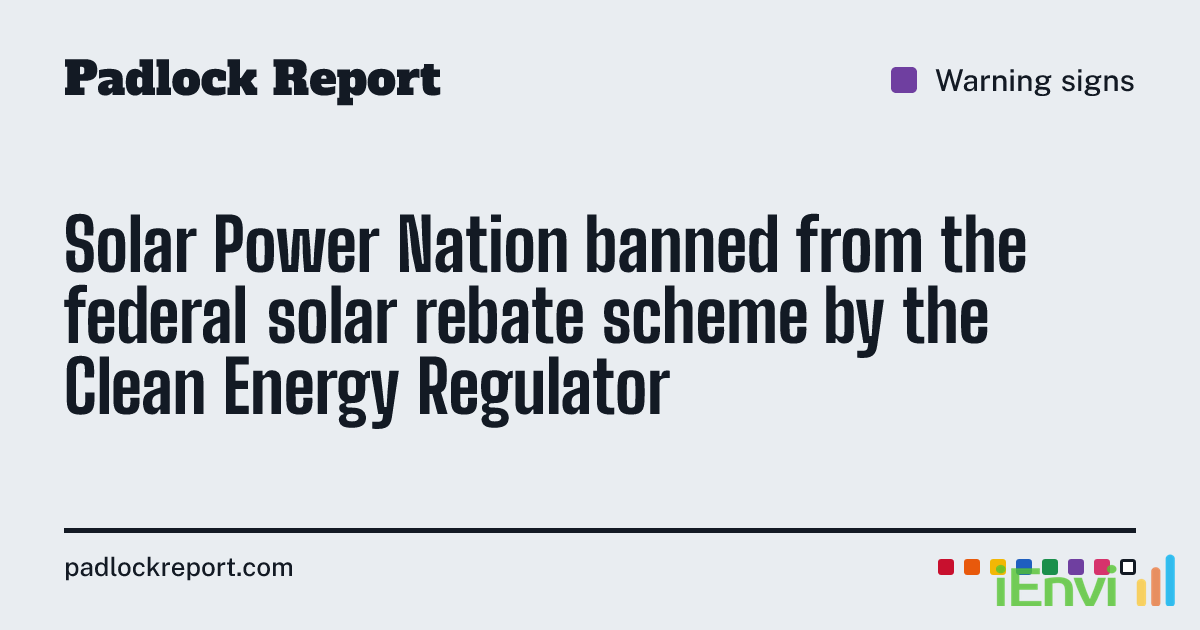
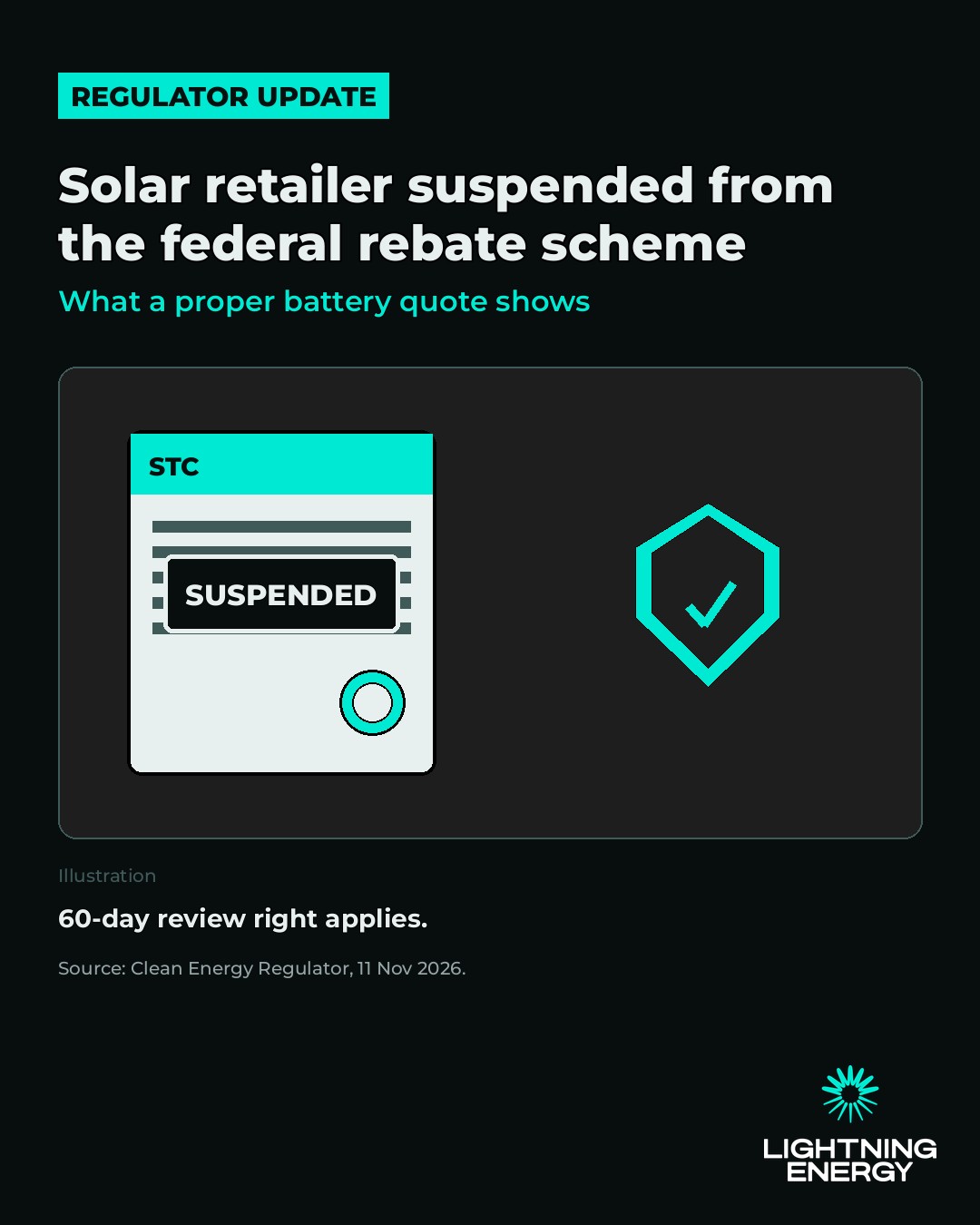
On 11 November 2026, the Clean Energy Regulator (CER) announced that it had permanently suspended Sydney-based solar and battery retailer 1 Solar Australia Pty Ltd, trading as Solar Power Nation, as a registered person under the Small-scale Renewable Energy Scheme (SRES). The CER stated it is no longer satisfied that the company meets the statutory “fit and proper person” requirements under Commonwealth clean energy legislation. As a result, the company can no longer act as a registered agent under the SRES and cannot create Small-scale Technology Certificates (STCs). STCs are the mechanism through which the federal incentive for rooftop solar photovoltaic (PV) systems is delivered. Since 1 July 2025, they also deliver the incentive for eligible small-scale battery installations.
The federal suspension was the last of several actions against the company. Solar Power Nation had already been expelled as an approved seller under the New Energy Tech Consumer Code (NETCC). South Australia’s Commissioner for Consumer Affairs had also issued a formal Public Warning Notice. In announcing the decision, CER Chair Tony Chappel said the regulator maintains “a zero-tolerance approach for any poor business practice that can create an adverse outcome for the customer”. He added that it will act decisively to protect scheme integrity. According to the CER, the company has 60 days to request a review of the decision.
This is an energy regulation matter rather than an environmental finding, but it has practical relevance for environmental professionals and their clients. Consultants advising on ESG reporting, Scope 2 decarbonisation, property portfolio upgrades and transaction due diligence often deal with on-site solar and battery assets. Developers, councils, strata committees and in-house legal teams buy these systems in volume. For these groups, the case is a reminder that the value of the federal incentive depends on the regulatory standing of the retailer or agent, and that this standing can be lost after a contract has been signed.
Key details
The legislative basis for the decision is the Renewable Energy (Electricity) Act 2000 (Cth) and the Renewable Energy (Electricity) Regulations 2001 (Cth). The Act provides for the registration of persons who participate in the certificate market and allows the Regulator to suspend a registration where it is no longer satisfied the registered person is a fit and proper person. The Regulations set out further detail on eligibility, suspension and scheme administration. The fit and proper person test lets the CER take into account a registered person’s conduct and compliance history. It does not have to rely only on whether paperwork has been lodged correctly.
Under the SRES, the owner of an eligible small-scale system can create STCs or assign the right to create them. Most owners assign that right to a registered agent, usually the retailer or a specialist certificate trader, in exchange for a discount at the point of sale. The agent then creates the certificates in the CER’s REC Registry and sells them. The SRES applies to small-scale solar PV systems up to 100 kW capacity. STCs must be created within 12 months of the installation date. A registered person who has been permanently suspended cannot create STCs. This affects any customer who assigned certificate rights to that entity, as well as future sales.
The enforcement sequence is relevant for anyone assessing supplier risk. Two separate actions came before the federal sanction:
- Expulsion from the NETCC approved seller list. The NETCC is the voluntary industry code covering the sale of new energy technology products such as solar PV and batteries to consumers. It is administered by the Clean Energy Council.
- A formal Public Warning Notice from South Australia’s Commissioner for Consumer Affairs. This is a state consumer protection tool used to alert the public to a trader’s conduct.
The CER’s decision is described as a permanent suspension. However, the company has a 60-day window to seek a review, so the final position may not be settled until that period closes and any review is determined. The CER’s published statement does not describe the specific conduct behind the fit and proper finding beyond its concern for adverse customer outcomes and scheme integrity. Practitioners should not assume the underlying facts until further detail is published or the review process concludes.
Australian context
The SRES is a national scheme administered by a Commonwealth regulator. Consumer protection for solar and battery sales, however, is largely enforced by state and territory agencies. These include NSW Fair Trading, Queensland’s Office of Fair Trading, Consumer Affairs Victoria and South Australia’s Commissioner for Consumer Affairs. In this case, a South Australian Public Warning Notice and an industry code expulsion came before the federal decision. For clients with property across several states, a warning issued in one jurisdiction can be an early signal of risk for a retailer operating nationally. Supplier checks that look only at the client’s home state may miss it.
On-site solar and batteries now form part of the decarbonisation plans of many organisations that report emissions. These include entities reporting under the National Greenhouse and Energy Reporting (NGER) scheme and those preparing climate-related financial disclosures under AASB S2. Rooftop generation reduces purchased grid electricity, which is the basis of Scope 2 emissions. The physical asset and its emissions benefit are not directly affected by the retailer’s registration status. The financial case for the installation, however, often assumes the point-of-sale STC discount. Any dispute over certificate creation can then affect project cost, budget reconciliation and the expected payback period.
For clients procuring solar or battery systems, checking a retailer’s registration status, code membership and any state consumer warnings before signing is a simple step. Contracts can also set out who carries the risk if certificates cannot be created as planned.
References and related sources
- Primary source: cer.gov.au
- pv-tech.org
- padlockreport.com
- lightning-energy.com.au
How iEnvi can help
iEnvi provides specialist consulting services relevant to this topic. Our team includes CEnvP Site Contamination Specialists with experience across contaminated land, groundwater, remediation, ecology, and regulatory compliance.
- iEnvi ESG services
- iEnvi contaminated land investigation services
- iEnvi remediation and validation services
- iEnvi expert services and independent review services
This is an iEnvi Machete news summary. Prepared by iEnvi to summarise the source article for contaminated land, groundwater, remediation, approvals and site risk professionals.
Published: 15 Nov 2026
Need advice on this topic? Speak to an iEnvi expert at info@ienvi.com.au or 1300 043 684, or contact us online.
Need advice on this issue? iEnvi provides practical, senior-led environmental consulting across contaminated land, remediation, ecology and environmental risk.
Team credentials Contaminated land services Remediation services Groundwater services Talk to iEnvi