
Overview
Attackers have breached storage systems at Fireworks AI, a US-based model inference provider used by the productivity platform Notion, and accessed Notion AI chat transcripts that were held in persistent storage. Fireworks operates under a “Zero Data Retention” (ZDR) architecture by default. VentureBeat reported the incident on 11 November 2026, with an update on 12 November 2026. Notion confirmed that an unauthorised third party accessed a subset of Fireworks’ development and storage infrastructure. The exposed data included chat transcripts that Notion used for classification and usage analysis in its Insights feature.
Notion has stated that fewer than 1% of its corporate workspaces were affected. It has advised affected organisations to treat the transcripts, and any credentials pasted into AI chat windows, as exposed. The percentage is small. The mechanism is the important part. The transcripts were not retained because of the primary chat function. They were retained because they fed a secondary analytics feature that ran outside the default memory-only protections.
The incident is a useful test case for Australian consultancies, law firms, councils and developers that use AI assistants built into everyday software. Procurement teams rarely ask one question: when a vendor says data is not retained, which parts of the service does that promise actually cover? Environmental consulting work routinely involves confidential transaction information, unreleased laboratory results and correspondence with regulators. That makes AI data retention a professional risk question, not only an IT one.
Key details
The intrusion began on 23 October, when attackers compromised an external cloud provider that hosted Fireworks AI’s research and development machines. According to Fireworks, the intruders used that foothold the following day to pivot into internal development environments. They then triggered unauthorised workloads across attached persistent storage. The entry point was neither Notion nor Fireworks’ production inference service. It was a third-tier provider sitting beneath the inference vendor. For risk assessment, this means the supply chain behind a single AI feature can be at least three organisations deep.
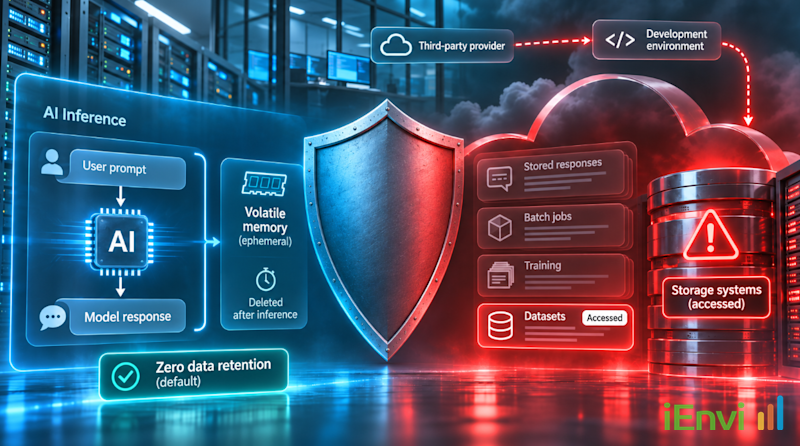
Fireworks clarified the scope of its retention commitments in a security bulletin. Under the default ZDR architecture, prompt and generation tokens are held strictly in volatile memory. Fireworks states that real-time interactive inference, its Training SDKs and its Nexus platform all operate with ephemeral memory. Asynchronous endpoints are different. Batch APIs, stored response caches and fine-tuning datasets maintain persistent object storage. Fireworks also identifies offline workloads such as batch inference jobs and custom model evaluations as exceptions to memory-only handling. In short, the ZDR default applies to the interactive path and does not follow data into batch, cache or training paths.
The compromised data was Notion AI chat transcripts used for classification and usage analysis in the Insights feature. According to the reporting, this analysis ran outside the live conversation, which placed the transcripts in the persistent storage tier. Users often treat internal AI assistants as quick drafting tools, so transcripts of this kind can contain API keys, customer identifiers, proprietary financial information and meeting minutes. Once that material is retained and then breached, revoking access and tracing where the data went both become difficult.
Notion said its response included immediate revocation of all exposed API tokens detected within the impacted transcripts. Security guidance accompanying the incident reports advises security operations teams to review vendor configurations wherever SaaS platforms integrate multi-tier large language model gateways. The aim is to confirm that batch and analytics pipelines enforce the same ephemeral policies as real-time inference. Token revocation has an obvious limit. It deals with machine-detectable secrets that can be cancelled and reissued. It does nothing for written content such as commercial terms, draft findings or personal information. Once that content is disclosed, it cannot be recalled.

Australian context
Both Notion and Fireworks AI are US companies, and no Australian regulatory action has been reported. However, Australian organisations using affected tools carry their own legal obligations. Under Part IIIC of the Privacy Act 1988 (Cth), the Notifiable Data Breaches (NDB) scheme applies when unauthorised access to personal information is likely to result in serious harm to the individuals concerned, and remedial action has not prevented that likely risk. The scheme covers APP entities. These are generally businesses with annual turnover above $3 million, plus certain smaller entities. An entity that suspects an eligible data breach must carry out a reasonable and expeditious assessment within 30 days. If the breach is confirmed as eligible, it must notify the Office of the Australian Information Commissioner (OAIC) and affected individuals. The obligation rests with the entity that holds the information, even where the breach occurred at a vendor’s sub-processor.
Two Australian Privacy Principles are directly relevant. APP 11 requires entities to take reasonable steps to protect personal information from misuse, interference, loss and unauthorised access. Accepting a vendor’s ZDR claim without checking which features sit outside it may fall short of that standard. APP 8, read with section 16C of the Act, deals with disclosure of personal information to overseas recipients. Depending on how the arrangement is structured, an Australian entity can be held accountable for an overseas recipient’s handling of that information. US-hosted inference providers and their sub-processors fall squarely within this question. Public sector clients have their own requirements. Australian Government agencies are APP entities regardless of size. State and territory agencies, including local councils, are generally covered by state or territory privacy legislation. In New South Wales, for example, the Privacy and Personal Information Protection Act 1998 (NSW) has included a mandatory data breach notification scheme for public sector agencies since November 2023. Consultants handling council or agency information may also be bound by contract terms that restrict offshore processing or set short deadlines for reporting a suspected breach to the client.

What organisations should check
For Notion customers in the affected group, the immediate steps follow Notion’s own advice. Rotate any passwords, API keys or access tokens that staff may have pasted into Notion AI chats, rather than relying solely on Notion’s automated revocation. Then work out whether the transcripts held personal information and, if so, whether the NDB assessment process or a state-based scheme applies.
For everyone else, the useful questions are about scope. Ask AI vendors which features and sub-processors use persistent storage, including analytics, insights, batch processing and model evaluation. Check whether those features are switched on by default and whether they can be turned off at the workspace level. Ask for a current list of sub-processors and where each one hosts data.
Internal policy matters as much as vendor terms. Staff should not paste credentials, unreleased laboratory data, client transaction details or regulator correspondence into AI assistants unless the organisation has confirmed how that tool stores and processes inputs. A ZDR label describes how one path through a vendor’s system works. It does not necessarily describe every path.
References and related sources
- Primary source: venturebeat.com
- youtube.com
- aboutdfir.com
- youtube.com
How iEnvi can help
iEnvi integrates technology and data-driven approaches into environmental consulting. We monitor AI and technology developments that affect how environmental professionals deliver services to clients.
This is an iEnvi Machete news summary. Prepared by iEnvi to summarise the source article for environmental professionals tracking AI, data, and technology developments that affect consulting and project delivery.
Published: 15 Nov 2026
Need advice on this topic? Speak to an iEnvi expert at info@ienvi.com.au or 1300 043 684, or contact us online.
Need advice on this issue? iEnvi provides practical, senior-led environmental consulting across contaminated land, remediation, ecology and environmental risk.
Contaminated land advice Remediation services Discuss your site Talk to iEnvi