
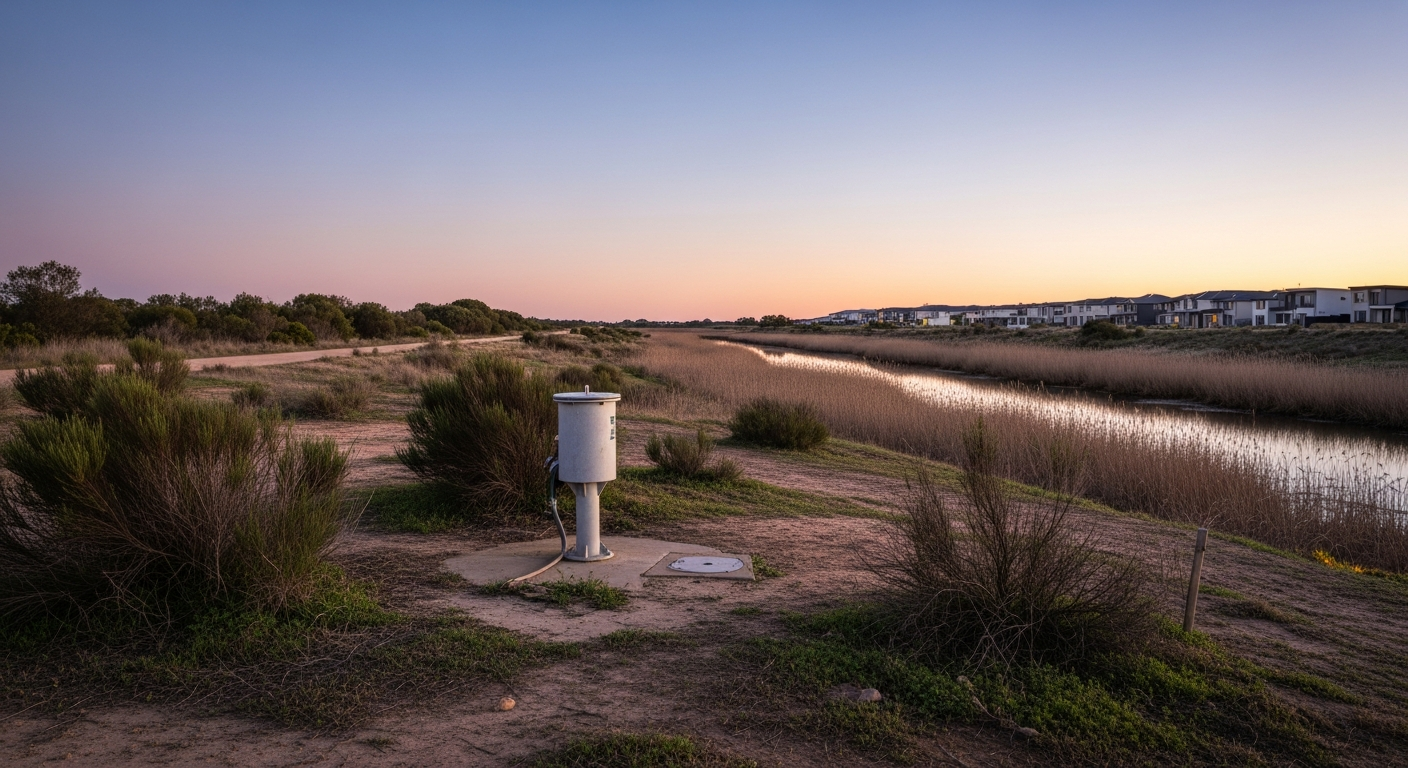
What is a Conceptual Site Model in contaminated land assessment?
A Conceptual Site Model (CSM) is a written and graphical representation of an environmental system. It links contamination sources to exposure pathways and sensitive receptors. Australia’s National Environment Protection (Assessment of Site Contamination) Measure 1999 (amended 2013) requires a CSM at every stage of contaminated land investigation. This includes the initial Preliminary Site Investigation, Detailed Site Investigation, remediation, and post-remediation verification. A CSM is not a one-off deliverable. It is a living document, refined iteratively as new data emerges.
By Michael Nicholls, Managing Director, iEnvironmental Australia. CEnvP Site Contamination Specialist.
Why the Conceptual Site Model is the Foundation of Every Site Assessment
Ask any experienced contaminated land consultant where investigations go wrong. The answer is rarely the laboratory analysis. More often, it is a poorly constructed Conceptual Site Model. Such a model might misidentify receptors, overlook exposure pathways, or treat the site as a static system rather than a dynamic one. An incomplete CSM, or one based on unchecked assumptions, can misdirect an entire investigation. This can lead to inadequate remediation scope and ultimately leave a site with unmanaged risk.
The CSM is the logical thread running through every contaminated land project. It answers three fundamental questions: where is the contamination coming from, how could it reach people or the environment, and who or what could be harmed? Get those three elements right and the rest of the investigation falls into place efficiently. Get them wrong and costs escalate.
This guide explains what a CSM must contain under Australian requirements. It covers how it evolves from Preliminary Site Investigation (PSI) through to remediation. It also details what separates a serviceable CSM from one that will satisfy a regulator, an auditor, and the client.
What the ASC NEPM Requires
The National Environment Protection (Assessment of Site Contamination) Measure 1999 (ASC NEPM), last amended in 2013, sets the national framework for contaminated land assessment across all Australian jurisdictions. Schedule B2 of the NEPM specifically requires a CSM to be developed. It must be presented in both written and graphical formats, and progressively refined throughout the assessment process.
Formally, the NEPM defines a CSM as “a written or pictorial representation of an environmental system and the biological, physical and chemical processes that determine the transport of contaminants from sources through environmental media to environmental receptors in the system.”
Schedule B2 of the ASC NEPM 2013 (Site Characterisation) sets out the current Australian approach. The first deliverable of any site investigation is a site history review, and the CSM is built directly from it. Sampling strategies, laboratory analysis scope, and Data Quality Objectives (DQOs) must all be informed by the initial CSM, with Schedule B2 also guiding how those DQOs are defined, tested and iteratively refined as new data is collected.
In practice, this means the consultant must have a working model of the site system before a single borehole is drilled or a soil sample collected. That model guides what is sampled, where, and at what depth.
The Core Components of a Well-Constructed CSM
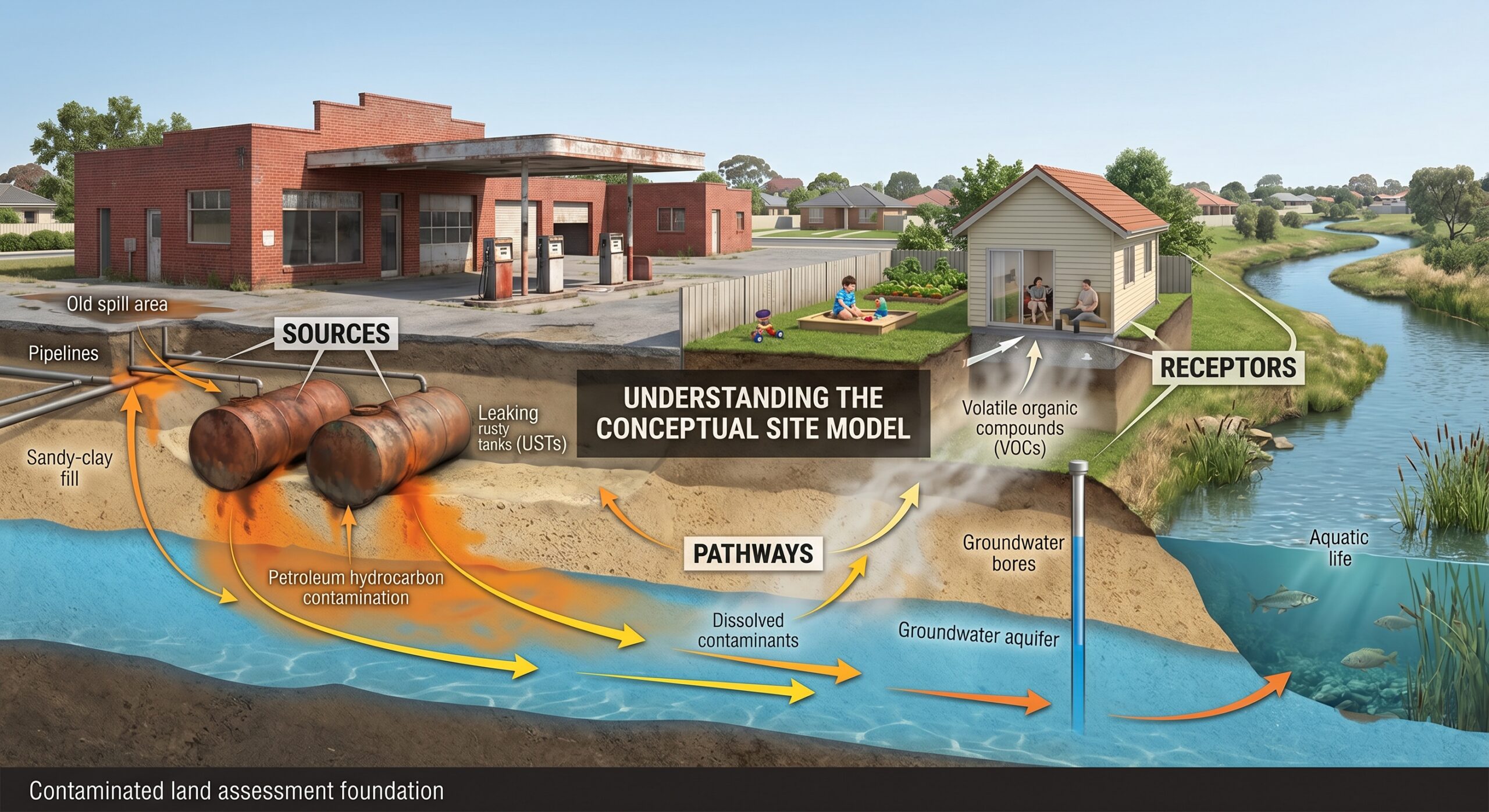
A compliant and defensible CSM must address three interconnected elements: sources, pathways, and receptors. These are commonly presented in a source-pathway-receptor (SPR) linkage table or flow diagram. Site-specific plans, cross-sections, and explanatory text support this.
Sources
Sources are the origin points of contamination. A thorough CSM identifies all likely Contaminants of Potential Concern (COPCs) based on site history. This includes past land uses, former occupants, neighbouring activities, and historical aerial imagery. For a former service station, COPCs typically include total petroleum hydrocarbons (TPH), benzene, toluene, ethylbenzene and xylenes (BTEX), and lead. For an industrial site, the list might extend to heavy metals, chlorinated solvents, or asbestos-containing materials in fill.
Crucially, the CSM must identify not just what contaminants are expected but where source areas are located. Above-ground fuel storage areas, underground storage tanks, chemical storage bays, drainage lines, sumps, and spill areas all require explicit consideration.
Pathways
Pathways describe how contamination moves from its source to a receptor. They include:
- Direct contact, ingestion or dermal contact with contaminated soil
- Inhalation, volatilisation of contaminants from soil or groundwater into indoor or outdoor air
- Groundwater migration, leaching of contaminants from soil to shallow groundwater, which may then migrate laterally off-site
- Surface water and sediment pathways, stormwater runoff carrying contaminants to drains, waterways, or coastal environments
- Vapour intrusion, volatile organic compounds migrating upward through soil and entering enclosed structures including utilities or through slabs
The geology and hydrogeology of the site determine which pathways are plausible. A site underlain by clay will constrain downward leaching. A sandy or gravelly site with shallow groundwater will have very different pathway dynamics. The CSM must document soil stratigraphy, groundwater depth and flow direction, and any preferential pathways (service trenches, drainage easements, permeable fill layers).
Receptors
Receptors are people, ecosystems, or environmental media that could be harmed if a pathway is complete. The CSM must address both current and future land use scenarios. A site currently used as a car park may be rezoned for residential use. The CSM must consider the residential receptor (including children playing in garden soil) even if that use has not yet commenced.
Off-site receptors are equally important. Neighbouring properties, subsurface pipes and conduits, groundwater bores, surface water bodies, and ecologically sensitive areas must all be identified. In Queensland, the CSM must explicitly address secondary exposure mechanisms to off-site ecosystems. This is a requirement that catches many consultants who focus only on the site boundary.
How the CSM Evolves Across the Assessment Lifecycle
Preliminary Site Investigation (PSI)
The PSI is primarily a desktop exercise. It involves a thorough review of historical records, aerial photography, council records, EPA regulatory databases, and adjacent land uses, combined with a site inspection. The initial CSM produced at PSI stage is necessarily based on limited information, and this is appropriate. Its purpose is to identify what contamination could plausibly be present, where it might be located, and what pathways and receptors require further investigation.
A well-written PSI CSM clearly identifies data gaps. These are the questions that cannot be answered without intrusive investigation. These gaps directly scope the DSI. A PSI CSM that claims to fully characterise risk is almost certainly overreaching. Conversely, one that identifies no data gaps is likely incomplete.
PSI costs in Australia typically range from $4,000 to $6,000 for a standard commercial site, with timelines of two to four weeks, with additional cost for any sampling completed.
Detailed Site Investigation (DSI)
The DSI tests and refines the PSI CSM through intrusive sampling. Boreholes, test pits, groundwater monitoring wells, and vapour probes are positioned based on the source areas and pathways identified in the initial CSM. Laboratory results either confirm the model or require it to be revised. Revision is not a failure; it is the process working correctly.
By the conclusion of the DSI, the CSM should accurately reflect the lateral and vertical extent of contamination, the environmental media affected, the contaminant concentrations relative to applicable guideline values, and the risk posed to identified receptors under current and future land use. This refined CSM forms the basis for risk assessment and, where contamination exceeds acceptable levels, remediation planning.
DSI costs vary widely, from around $10,000 for a simple residential site to well over $100,000 for large industrial properties with multiple contaminants or deep groundwater plumes.
Remediation and Post-Remediation
The CSM informs remedial strategy selection. An excavation and off-site disposal approach suits a shallow, laterally constrained soil contamination scenario. In-situ chemical oxidation (ISCO) or bioremediation might be preferred where contamination is deep or where excavation is impractical. The CSM must be consulted at every decision point. If remediation reveals unexpected contamination, the CSM is updated before the scope is extended.
Post-remediation verification sampling is designed to confirm that source-pathway-receptor linkages have been severed. It is not simply about confirming a certain mass of material has been removed. A CSM-centred approach to verification is more defensible and more likely to satisfy a regulatory auditor.
State and Territory Regulatory Context
While the NEPM provides the national framework, each state and territory has specific implementation guidance that practitioners must know:
- NSW: The EPA’s Consultants Reporting on Contaminated Land guidelines (2020) and the Sampling Design Guidelines (2022) both emphasise that sampling depth and grid design must be explicitly informed by the CSM. The CSM must distinguish between variability (natural environmental diversity) and uncertainty (lack of data). These two conditions require different investigative responses.
- Victoria: Planning Practice Note PPN30 and the EPA’s guidance on the Environment Protection Act 2017 require PSI reports to include a CSM identifying likely sources, pathways, and receptors under the proposed land use scenario. The Victorian environmental audit system follows NEPM methodology throughout.
- Queensland: The Queensland Auditor Handbook for Contaminated Land and Technical Practice Guideline TPG 6 set formal requirements for Suitably Qualified Persons (SQPs), including a minimum of three years’ relevant experience. The Contaminated Land Investigation Document (CLID) must contain a detailed CSM with explicit coverage of regional physical environment and source-to-receptor pathways, including secondary mechanisms to off-site ecosystems.
- South Australia: Assessment and management of site contamination follows the NEPM framework, with CSM requirements consistent with national guidance. The EPA SA provides guidance through its contaminated site assessment guidelines.
- NT and Tasmania: Both the NT EPA and EPA Tasmania publish standalone CSM guidance. They place particular emphasis on graphical CSMs as communication tools for engaging stakeholders who may not have technical backgrounds.
Common Failures and How to Avoid Them
Our consultants regularly review investigation reports prepared by others. The same shortcomings appear repeatedly:
- Treating the CSM as a checklist item rather than an analytical tool. The CSM is described but not used to drive investigation design.
- Failing to identify data gaps. An initial CSM based entirely on desktop data should nearly always acknowledge significant uncertainty about subsurface conditions.
- Static CSMs. The CSM prepared at PSI stage is pasted unchanged into the DSI report, regardless of what the sampling revealed. If field data contradicts the initial model, the model must be updated.
- Narrow receptor identification. Only on-site current occupants are considered, with no account taken of future land use, neighbouring properties, or groundwater users.
- Overlooking vapour intrusion pathways. This is particularly relevant for former dry cleaners, fuel retailers, or chemical manufacturers near residential buildings.
- Inadequate site history research. This involves assuming contamination type without verifying historical operations. A site described as a “tannery” may have used vegetable-based tanning rather than chromium. This changes the entire COPC list.
Common Questions
Is a CSM always required, or only for high-risk sites?
A CSM is required for every contaminated land investigation conducted under the NEPM. This applies regardless of site size or perceived risk. For low-risk sites, the CSM may be brief and straightforward. For complex sites, it will be a substantial technical document. The requirement is universal; the level of detail is proportionate to site complexity.
Who is qualified to prepare a CSM?
In Australia, suitably qualified persons with demonstrated experience in contaminated land assessment must prepare CSMs. Queensland formally requires a minimum of three years’ relevant experience. In practice, senior professionals with CEnvP (Certified Environmental Practitioner) or equivalent qualifications should review or prepare CSMs for complex sites. An auditor should be engaged early, particularly in Victoria and Queensland, to confirm what the regulatory authority will expect the CSM to address.
Can a CSM be prepared without site access?
A preliminary CSM can be developed from desktop data alone. This is appropriate for the PSI stage. However, a site inspection is standard practice at PSI and contributes materially to the model. A DSI-stage CSM cannot be finalised without field data; the sampling results are what refine and validate it.
What happens if the CSM turns out to be wrong?
CSMs are expected to evolve. If field data contradicts the initial model, for example, contamination is found in a direction or medium not anticipated, the CSM must be updated. This is not a failure of the investigation process; it is evidence the process is working. The critical issue is that changes to the CSM are documented, the implications for investigation scope are considered, and the updated model drives subsequent decisions.
How iEnvi Can Help
iEnvironmental Australia’s consultants have developed Conceptual Site Models for sites ranging from small residential redevelopments to major industrial properties across NSW, Queensland, Victoria, and South Australia. Our team includes CEnvP-qualified site contamination specialists who understand what regulators and auditors expect. They also know how to structure a CSM that holds up through the full assessment and remediation lifecycle.
We prepare CSMs as part of our Preliminary and Detailed Site Investigation services. We can also provide independent review of CSMs prepared by others where a second opinion is needed before regulatory submission.
Contaminated land assessment | Remediation services | PSI and DSI services | Talk to iEnvi
For innovative solutions that are focussed on giving you the very best outcome, contact our expert team of environmental consultants today.
References and further reading
All guidelines below have been cross-checked against current Australian primary sources:
- NEPC — Assessment of Site Contamination NEPM (overview)
- Federal Register of Legislation — National Environment Protection (Assessment of Site Contamination) Measure 1999, as amended 2013
- ASC NEPM Schedules B1 (HILs/HSLs), B2 (Site Characterisation), B3 (Laboratory Analysis), B5 (GILs), B6 (Ecological Risk), B7 (Health-Based Investigation Levels)
- NSW EPA — Contaminated Land program
- NSW Contaminated Land Management Act 1997
- Victoria — Environment Protection Act 2017
- Victoria EPA — what we do
- Queensland — Environmental Protection Act 1994
- Queensland Department of Environment — Contaminated land
- South Australia EPA — Site contamination
- PFAS National Environmental Management Plan 3.0 (DCCEEW)
- Australian Drinking Water Guidelines 2011 (NHMRC, updated 2024)
- Australian and New Zealand Guidelines for Fresh and Marine Water Quality (ANZG 2018)
Need advice on this issue? iEnvi provides practical, senior-led environmental consulting across contaminated land, remediation, ecology and environmental risk.
Contaminated land advice Remediation services Groundwater services Asbestos in soil advice Talk to iEnvi