
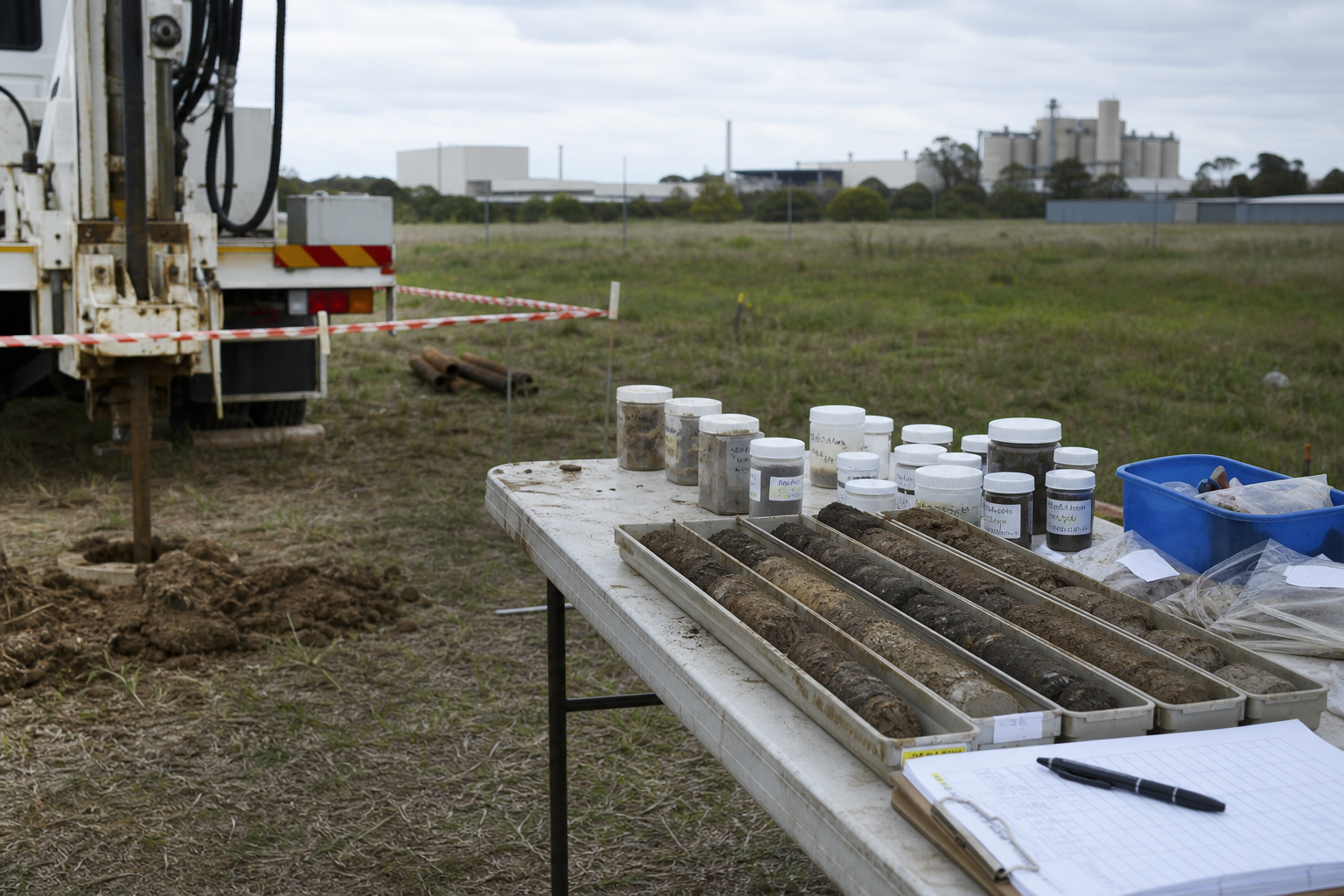
A Preliminary Site Investigation (PSI) decides whether contamination is a credible issue and whether enough is already known to stop. Many sites never need more than that. A Detailed Site Investigation (DSI) follows when the PSI leaves the source, the pathway, the receptor or the scale of impact open.
This article covers when a DSI is warranted, what the National Environment Protection (Assessment of Site Contamination) Measure 2013 (NEPM) Schedule B2 expects, how a Sampling and Analysis Quality Plan (SAQP) and an updated conceptual site model (CSM) organise the work, and how results feed a Remediation Action Plan (RAP), site audit, planning and transactions. High-level notes follow for Queensland, New South Wales, Victoria and South Australia.
When a Preliminary Site Investigation is not enough
A PSI compiles history, land use, geology and hydrogeology, known or suspected contaminants, and a first-pass CSM. It may include targeted sampling where that is enough to confirm or rule out a concern. It is not enough when:
- the site history points to a source that has not been located or bounded, such as former workshops, underground tanks, fill of unknown origin or chemical storage;
- soil or groundwater results sit above investigation or screening levels, or they are too few, too shallow or in the wrong place to support a decision;
- potential receptors cannot be dismissed, including on-site users, adjoining residents, groundwater users, surface water or vapour intrusion into buildings;
- a change of use, excavation, basement or sensitive land use is proposed, and residual uncertainty would leave the planning or transaction case incomplete;
- multiple media may be involved, so soil data alone cannot close a groundwater or vapour question.
If a competent environmental professional cannot state, with a documented CSM and data of known quality, that contamination is absent, confined, or already characterised for the decision at hand, a DSI is the next piece of work.
What NEPM 2013 Schedule B2 asks a DSI to do
Schedule B2 is the national guidance for site investigation. It distinguishes the PSI from the DSI. The purpose of the DSI is to collect data of sufficient quality and density to characterise the nature and extent of contamination, refine the CSM, and support a risk evaluation and management decision.
A DSI is not a larger PSI. It is a designed investigation. It should confirm or revise contaminant identity, concentration and spatial distribution in the media that matter; identify source zones, migration pathways and exposure routes with enough certainty to support risk assessment or to show that a pathway is incomplete; produce data that can be compared with investigation and screening levels, or that can feed a site-specific assessment where generic levels are not appropriate; and document data quality, including laboratory methods, detection limits, field quality control and limitations that affect interpretation.
The investigation should be proportionate: as large as the decision requires and no larger. Iterative work is acceptable. A first phase may bound a source. A second phase may close a groundwater or vapour question once soil results have focused the program. What is not acceptable is an unplanned scatter of samples that cannot be tied back to the CSM or to a stated data quality objective.
Sampling and Analysis Quality Plan
The SAQP turns the CSM and the decision into a field and laboratory program. Write it before mobilisation, not after the first laboratory report arrives.
A usable SAQP states the decisions the DSI must support; the data quality objectives (analytes, media, detection limits and spatial coverage, so that a non-detect or a low result actually means something); sample locations, depths and rationale, linked to the CSM rather than to a grid chosen for convenience; field methods for soil, groundwater and, where relevant, soil vapour or indoor air; quality control including duplicates, rinsate blanks and trip blanks where volatile organics are in play; and health, safety and environmental controls, including unexpected finds.
Record what will not be sampled and why. That stops later reviewers from treating a gap as an omission. If groundwater wells are not being installed because the CSM shows no plausible pathway and soil results will test that assumption, say so. If vapour is deferred until soil and groundwater results are in, say so, and define the trigger that would start that work.
Refining the conceptual site model
The CSM is the story of the site in a form that can be tested. A PSI CSM is often a sketch of possible sources, pathways and receptors. The DSI turns that sketch into a model that can carry a decision.
Refinement usually means locating source zones in three dimensions, not only on a site plan; distinguishing primary sources still in place from secondary sources such as residual product or contaminated fill; confirming hydrogeology at the scale of the site, including water table depth, gradient, preferred pathways and the relationship between fill, natural soil and bedrock; deciding which exposure pathways are complete; and identifying off-site migration, or showing that it is not occurring at concentrations of concern.
Update the CSM after each phase. Tables of results without a revised source-pathway-receptor narrative are not a DSI. A polished CSM drawing that is not supported by the sampling layout will not survive a site auditor or a planning review.
Soil, groundwater and vapour
Most DSIs need a clear position on three media. Not every site needs all three sampled, but each should be considered.
Soil investigation characterises fill and natural profiles, vertical distribution, and the difference between isolated hotspots and widespread impact. Depth of sampling should match the decision: surface soils for direct contact, deeper soils for excavation, foundations and leaching to groundwater. Analyte lists should follow the CSM. A long default suite is not a substitute for thinking about what the land use actually used and stored.
Groundwater investigation is warranted where a source could leach, where historical use involved solvents, fuels or other mobile contaminants, or where receptors use or could use the aquifer. Wells should test the CSM: upgradient, source, downgradient, and at the site boundary where off-site migration is a question. A single well in the middle of the site rarely answers those questions. One sampling round can be a start. It is often not a close-out.
Vapour investigation is relevant where volatile or semi-volatile contaminants are present in soil or groundwater near current or proposed buildings, or where preferential pathways such as services, basements or lift pits could connect a source to indoor air. Soil vapour, sub-slab and indoor air are different measurements and answer different questions. Screening with soil and groundwater data first is consistent with a staged approach, provided the trigger for vapour work is defined.
Field observations belong in the interpretation: odour, staining, product, PID readings and lithology. Laboratory numbers without those observations are incomplete.
How DSI results feed RAP, site audit, planning and transactions
A DSI is rarely an end in itself. Write the report for the next decision.
If contamination cannot remain under the proposed use, the same data set should define extents, volumes, acceptance criteria and validation methods for a RAP. If it cannot, the RAP will stall while more investigation is done.
Where a site auditor is engaged, the auditor will test whether the DSI met Schedule B2, whether the SAQP was followed, whether data quality supports the conclusions, and whether the CSM is consistent with the results. Gaps that were not flagged in the SAQP become audit issues. State limitations clearly.
Planning authorities use the DSI to decide whether a change of use, subdivision or development can proceed, and under what conditions. An investigation that does not match the proposed layout (buildings, basements, gardens, service trenches) will be sent back.
Buyers, sellers and lenders use the DSI to price risk, set conditions precedent, and decide whether a warranty or a price adjustment is needed. A DSI that answers the land-use question, identifies off-site liability and states what is still unknown is usable. A DSI that reports concentrations without a decision framework is not.
State notes
National guidance sits under Schedule B2. The statutory wrap around it differs by jurisdiction.
Queensland organises contaminated land work around the Environmental Protection Act framework and a Suitably Qualified Person (SQP). The SQP is responsible for the standard of the investigation and for statements used in planning and land-register decisions. Scope the DSI so the SQP can stand behind the CSM, the data quality and the recommendation that follows, including whether further management or a site management plan is required.
New South Wales investigation follows the NEPM and NSW EPA contaminated land guidelines. A site auditor is required in defined circumstances, including some planning pathways and some voluntary management proposals. Where an auditor will be used, bring that requirement into the SAQP. Designing a DSI and then discovering that an auditor expected a different well network or a vapour program is a frequent cause of rework.
Victoria’s Environment Protection Act 2017 and the Environment Protection Regulations sit over NEPM investigation practice. Duties to minimise risk of harm, and the need to understand contamination before change of use or development, mean a DSI is often the document that shows the duty has been considered with adequate information. Groundwater quality restricted use and environmental audits remain relevant where the scale of impact or the planning pathway requires them.
South Australia administers site contamination assessment under the Environment Protection Act 1993 and associated site contamination arrangements. Notification, assessment and auditor pathways depend on the nature of the contamination and the proposed use. The DSI should be explicit about whether site contamination is present, whether it extends off site, and whether a site contamination auditor will be required for the next step.
These notes are orientation only. Check the current state guideline and the specific planning or audit pathway before fieldwork.
Practical takeaways
- Commission a DSI when the PSI cannot close the source, pathway, receptor or scale questions that the next decision requires.
- Write the SAQP against those decisions. Locations, depths, analytes and media should be argued from the CSM.
- Treat soil, groundwater and vapour as linked questions. Sample what the CSM requires, and record why other media are deferred.
- Update the CSM with every phase. Results tables are not a substitute for a tested source-pathway-receptor model.
- Design the DSI so a RAP, auditor, planner or purchaser can use it. If extents, data quality or remaining uncertainty are unclear, the next document will not land.
- Match the report to the jurisdiction: SQP statements in Queensland, auditor expectations in New South Wales where an audit is in play, duty-to-minimise-harm evidence in Victoria, and site contamination notification and auditor triggers in South Australia.
- Keep the work proportionate. Schedule B2 does not reward volume. It rewards a program that can support a defensible management decision.
Need advice on this issue? iEnvi provides practical, senior-led environmental consulting across contaminated land, remediation, ecology and environmental risk.
PSI services DSI services CEnvP and SQP credentials Contaminated land services Talk to iEnvi