
Can a former service station with an EPA groundwater notification be redeveloped for fuel again?
It can be, if current data supports it. A detailed site investigation that targets the old fuel infrastructure, checks the regulator’s records and resamples groundwater can show whether the historical impact has declined and whether the land is suitable for the proposed use. In some cases, as here, no remediation is needed.
iEnvi completed a Detailed Site Investigation (DSI) of a former highway roadhouse and service station in the Limestone Coast region of South Australia. The investigation found the site suitable for its proposed redevelopment as a truck fuel stop without soil remediation, giving the developer current data and a clear contamination position for its development application.
The Problem
The underground fuel tanks had been removed some years earlier and impacted soil around them was excavated. Soon after, the then owner notified the South Australian Environment Protection Authority (EPA) under section 83A of the Environment Protection Act 1993 of site contamination affecting groundwater, based on petroleum hydrocarbons detected in groundwater. The old monitoring wells had since been decommissioned, so there was no current groundwater data.
Council pre-lodgement advice indicated that a site contamination assessment was likely to be needed for the development application and that a referral to the EPA was likely. The developer needed to know whether the historical contamination would stand in the way of the new use.
Project Summary
iEnvi reviewed the previous reports, the EPA public register, historical aerial photographs, registered groundwater bores and planning information, and inspected the site. The site was open ground with remnant slabs, stockpiles and a burn pile.
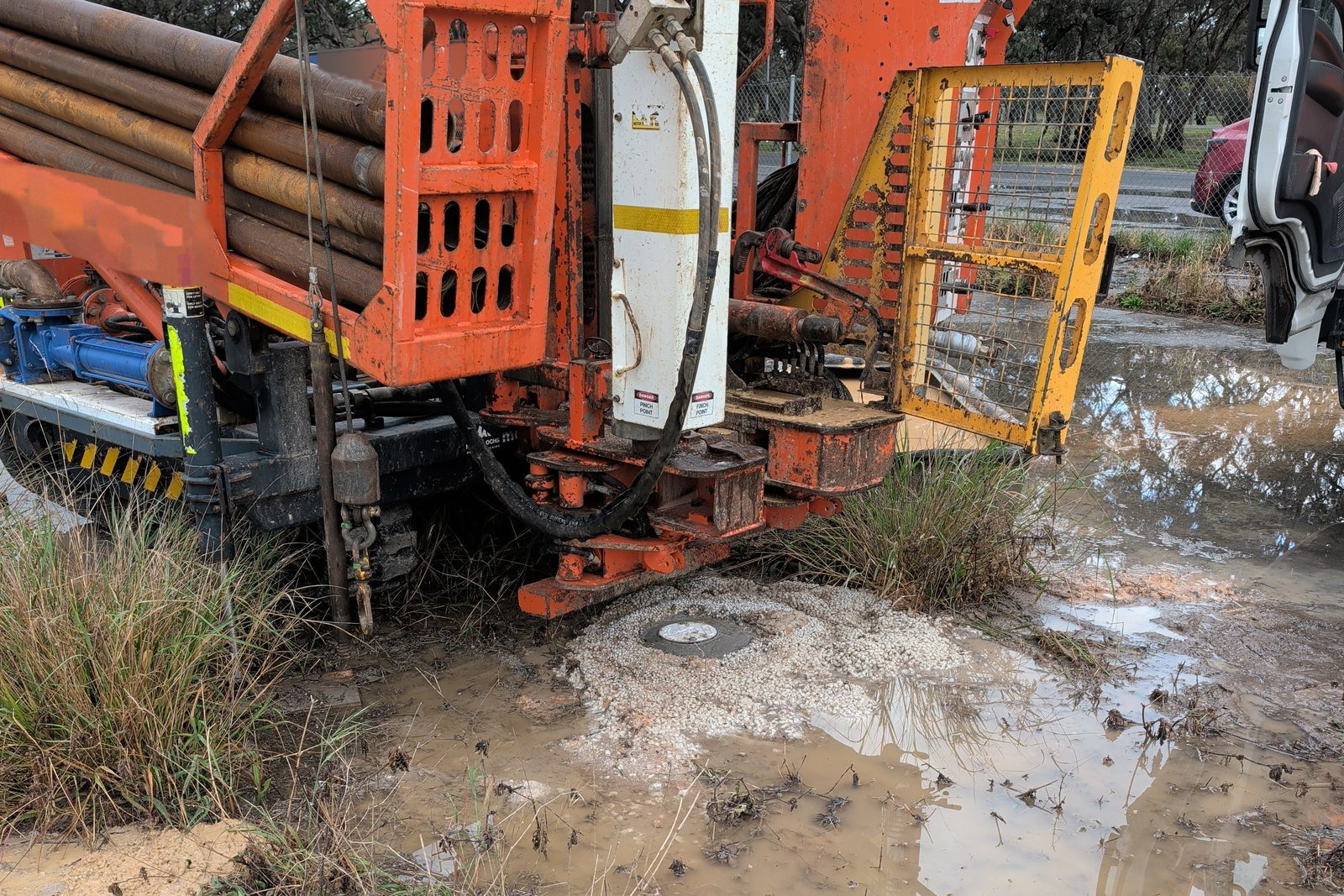
Fieldwork targeted the former fuel infrastructure and the footprint of the proposed development:
- Soil sampling at 12 locations, five of them drilled to 3 m, with 14 primary samples analysed for petroleum hydrocarbons, BTEXN and metals, and selected samples for PAHs, volatile organic compounds and PFAS.
- Installation and sampling of a new groundwater monitoring well, with groundwater found more than 22 m below the top of the well casing.
- Laboratory analysis at a NATA accredited laboratory, with an inter-laboratory duplicate for quality control.
Results
No soil result exceeded the adopted commercial and industrial criteria. Volatile hydrocarbons were below laboratory reporting limits in every soil sample and in groundwater, so vapour intrusion was not indicated. Low levels of heavier hydrocarbons were detected in a few surface samples, and lead and PFAS were well below criteria.
Heavier hydrocarbons in the new well were about 4% of the level reported when the tanks were removed, which is consistent with a decline in the historical impact. On this basis the investigation did not identify a need for further notification to the EPA for these results. Some dissolved metals were above freshwater ecological screening values. These metals are not typical indicators of a fuel release and are considered likely to reflect natural background conditions in the local geology.
Solution & Benefit
The DSI concluded the land is suitable for the proposed truck fuel stop without soil remediation. The developer now has current, defensible data to support the development application and any EPA referral, rather than relying on historical records alone. That same data gives lenders and purchasers a clearer basis for their own decisions.
We recommended testing the stockpiles and burn pile before they are moved, as they were outside this scope, and having the new well decommissioned by a licensed well driller once it is no longer needed. These are site management steps rather than conditions of the suitability conclusion for the assessed area.
Related services
Detailed site investigations | UPSS and underground tank services | Environmental consultants in South Australia | Talk to iEnvi
Redeveloping a former service station or fuel site? Send us the details through our enquiry form or call 0411 492 159.
Related services for this project. iEnvi links delivered project work back to the service pathways clients use for similar sites — investigation, remediation, ecology and environmental management.
DSI services UPSS investigation and validation Soil remediation Contaminated land advice Talk to iEnvi