
How do you discharge construction dewatering safely on acid sulfate soil mapped land?
iEnvi set clear water quality discharge targets, characterised the pit water in the laboratory, and designed a simple clarifier with light lime dosing so iron-rich groundwater could be treated before release to Council stormwater at Victoria Point, Queensland.
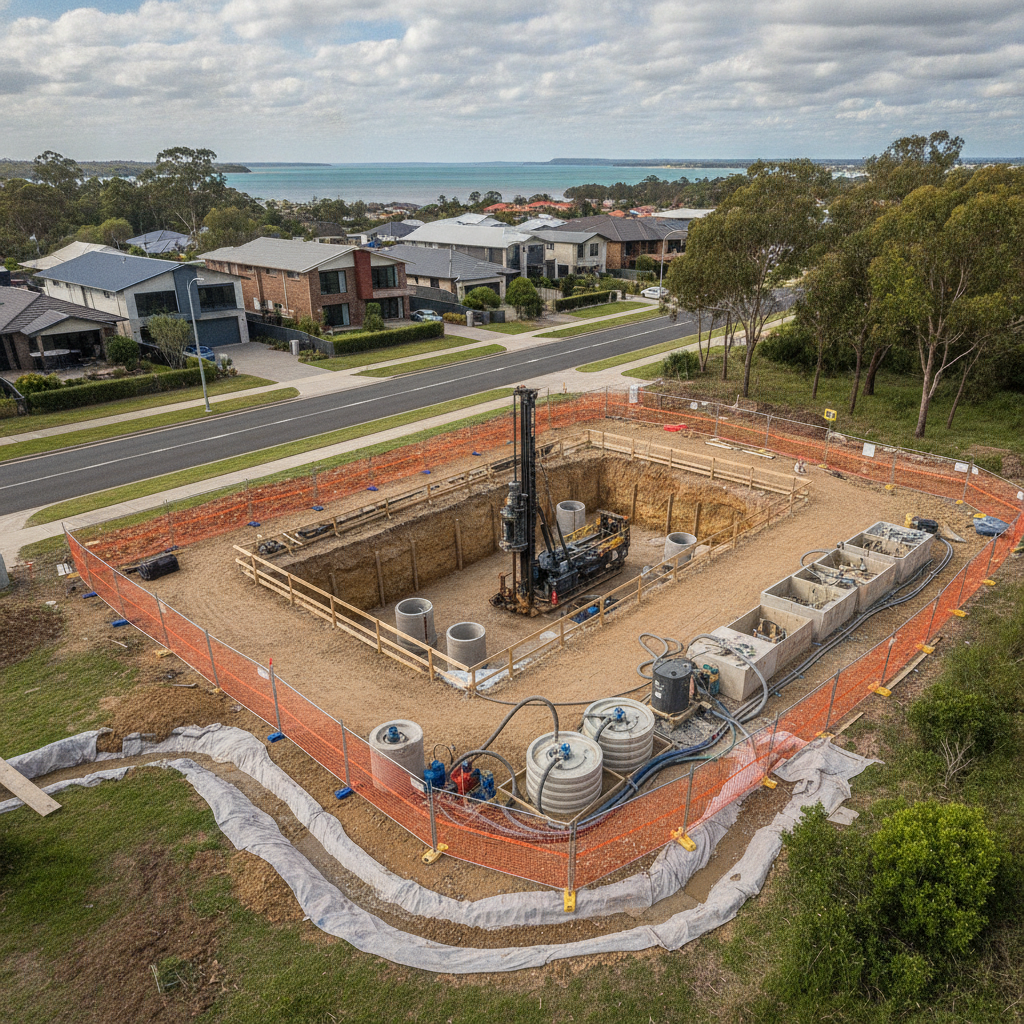
A Dewatering Management Plan (DMP) sets out how extracted groundwater will be treated, tested and discharged so construction can keep moving without harming the receiving environment. At Victoria Point, Queensland, iEnvi prepared a DMP for a shored under-road bore launch pit on land mapped as acid sulfate soil (ASS), where continuous dewatering was needed for about a week of thrust boring.
Dewatering on acid sulfate soil mapped land
Thrust boring under a road needs a dry launch pit, and on ASS mapped land that continuous dewatering is not a set-and-forget pump job. Measured inflow was roughly 0.4 to 0.5 litres per second (about 35 to 43 kilolitres a day), with discharge planned to the Council stormwater network that drains toward Moreton Bay.
Field strip readings initially suggested very low pH. Laboratory analysis told a different story: near-neutral water (pH 6.8), very low suspended solids, and iron as the main parameter above guideline, with zinc and total aluminium only marginally elevated. Because the iron and zinc were dissolved, settling alone would not fix the problem. A controlled pH lift was needed.
The Dewatering Management Plan and discharge targets
Council confirmed no separate dewatering permit was required under the existing development approval, although the general environmental duty under the Environmental Protection Act 1994 (Qld) still applied. iEnvi prepared a Dewatering Management Plan the site team could actually use, sitting beside the site Acid Sulfate Soil Management Plan that covers excavated soil.
Discharge targets drew on ANZG (2018) freshwater guideline values, hardness-modified where needed, for aluminium and zinc, with pH held between 6.5 and 8.5. Because ANZG (2018) publishes no default guideline value for iron, the plan carried an adopted discharge limit of 0.3 mg/L for iron, consistent with the ANZECC (2000) interim value.
Treated discharge to Council stormwater
Treatment was deliberately simple: pump pit water to a clarifier sized for the flow, dose hydrated lime to hold pH around 7.5 to 8.0, let the metal floc settle, then sample at a hold point before release. Residence time in the clarifier, together with the aeration that comes with pumped transfer, supports oxidation of dissolved ferrous iron so the floc settles rather than passing through in solution. If pH or clarity fell outside the band, discharge stopped until the water was back within targets.
The plan also covered monitoring, dosing guidance, contingency options (recirculate, store, or tanker off site) and a daily discharge log ready for Council or regulator review. The contractor received a clear, printable control document instead of vague “treat before discharge” advice, and Council and the project team could see how pit water would meet stormwater expectations on ASS mapped land without over-engineering a one-week dewatering window.
When do you need a Dewatering Management Plan in Queensland?
Any construction dewatering that discharges off site in Queensland needs to satisfy the general environmental duty, and development approvals or local government requirements often expect the controls to be documented. On ASS mapped land the bar is higher again, because disturbed groundwater can carry acidity and dissolved metals. A short, site-specific DMP that sets targets, treatment steps, hold points and contingencies is usually the most practical way to demonstrate both.
Related services
Groundwater and water services | Construction Environmental Management Plans | Talk to iEnvi
Need dewatering or acid sulfate soil water controls a contractor can run and a regulator can sign off? Contact iEnvi on 1300 043 684.
Need advice on this issue? iEnvi provides practical, senior-led environmental consulting across contaminated land, remediation, ecology and environmental risk.
Environmental management plans Groundwater services Environmental management Talk to iEnvi