
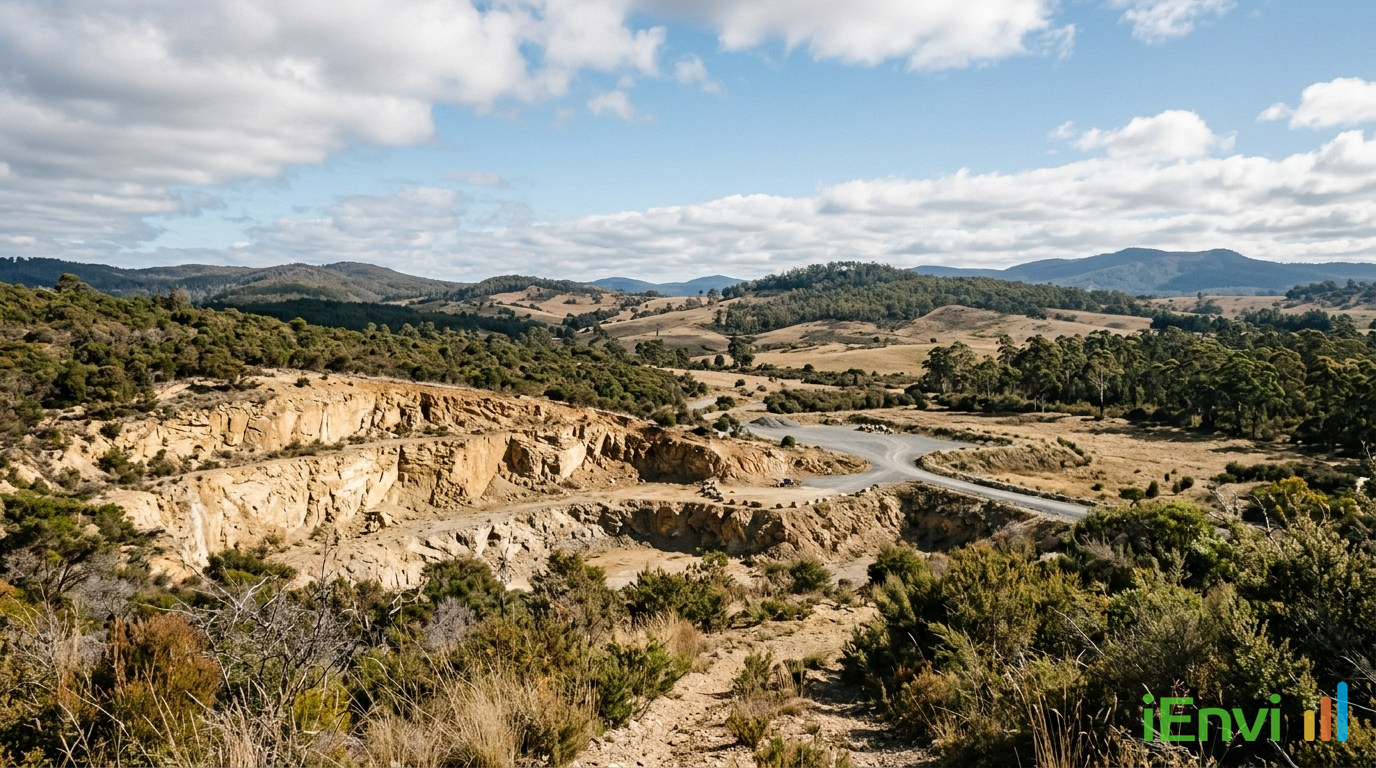
Logie Farm Quarry Expansion Assessment Overview
On 28 April 2026, a delegate of the Board of the Environment Protection Authority (EPA) Tasmania concluded its environmental assessment of a proposal by Gowing Bros Ltd to significantly intensify operations at the Logie Farm Quarry, located across the Sorell and Clarence City Council municipalities in southern Tasmania. The proposal seeks to triple the site’s annual processing (materials handling) capacity from 5,000 cubic metres to 15,000 cubic metres, aligning it with the site’s existing extraction limits, and introduces a new activity of up to four blasting campaigns per year for dolerite extraction and safety benching. The EPA determined the expansion can proceed in an environmentally sustainable manner, but only subject to a suite of targeted operational conditions addressing noise, blasting, dust management, water quality, and natural values.
The assessment is significant for environmental practitioners and their clients because it illustrates precisely how the regulatory threshold shifts when an operational intensification introduces genuinely new high-impact activities onto an already-approved site. The quarry’s existing approval had not contemplated blasting. Introducing that activity, even at a modest frequency of four campaigns annually, fundamentally changed the environmental risk profile and triggered a more rigorous level of public and regulatory scrutiny. The 28-day public consultation period generated community representations focused heavily on dust, noise, and water quality, and those representations directly shaped the conditions ultimately imposed by the EPA Board delegate.
For developers, councils, and planners managing extractive industry projects in Tasmania and elsewhere in Australia, the Logie Farm Quarry outcome is a practical demonstration that capacity expansions at existing sites are not treated as administrative updates. When the nature of the activity changes alongside the scale, the regulatory burden escalates in proportion to the new risk profile, and approvals are conditional on management frameworks comprehensive enough to satisfy both the regulator and the surrounding community.
Key Details of the Logie Farm Quarry Assessment in Tasmania
The proposal was assessed as a Level 2 Activity under Schedule 2 of the Environmental Management and Pollution Control Act 1994 (Tas) (EMPCA). The EPA Board delegate conducted the assessment in accordance with the Environmental Impact Assessment (EIA) Principles defined under Section 74 of EMPCA. These principles require that the assessment consider the precautionary principle, intergenerational equity, conservation of biological diversity and ecological integrity, improved valuation and pricing of environmental resources, and the principle of integration of economic, social, and environmental considerations. The Level 2 classification reflects the moderate-to-significant potential for environmental harm associated with the expanded scope of operations, and it requires a formal environmental assessment process including public exhibition of the Environmental Effects Report (EER).
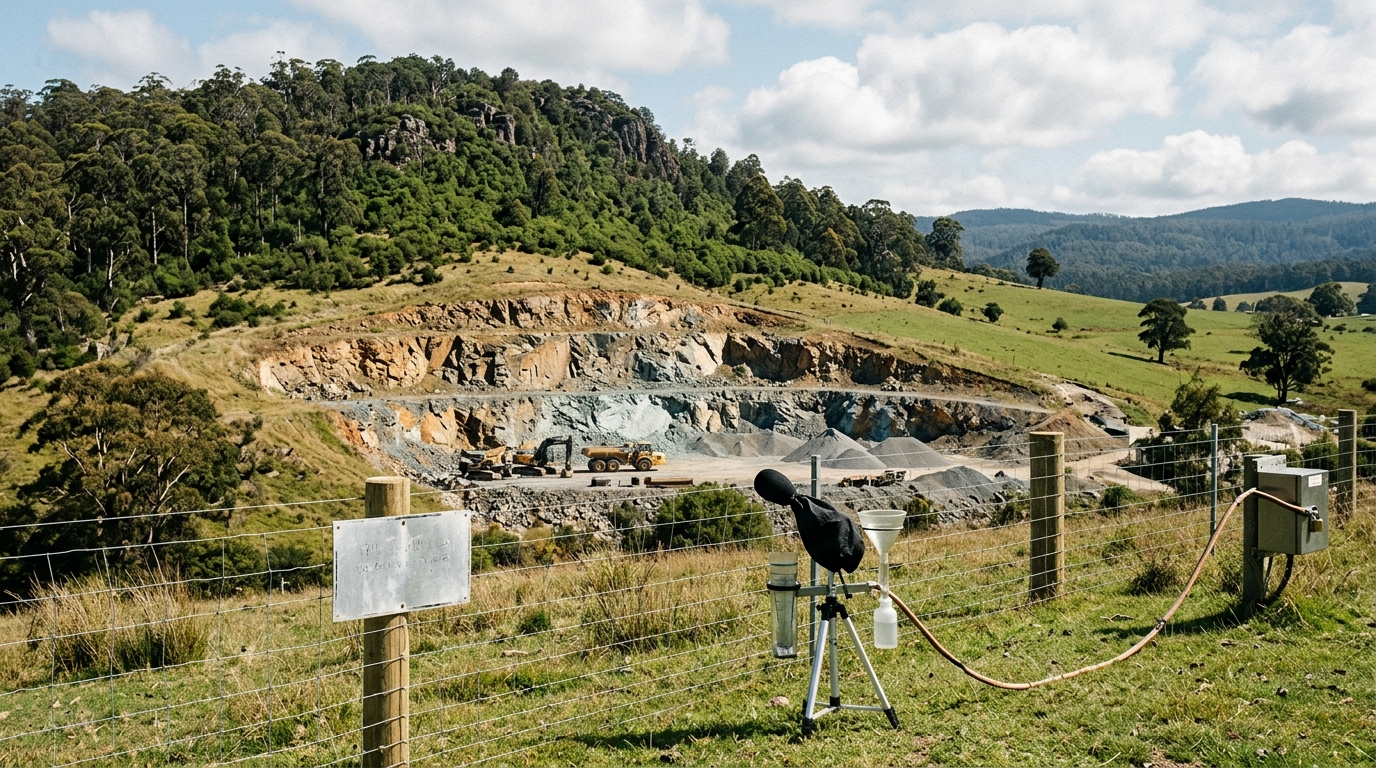
The core operational change at the heart of the assessment is the introduction of blasting. The existing site approval covered mechanical extraction and processing. The new proposal adds dolerite extraction and safety benching using explosives, capped at four blasting campaigns per annum. Blasting introduces ground vibration, airblast overpressure, flyrock risk, and dust generation at intensities and spatial extents that mechanical operations do not produce. The EPA’s decision to impose highly specific conditions on blast monitoring and management reflects the fact that these impacts require quantified performance limits, not merely best-practice guidance. While the specific numerical thresholds included in the final permit conditions are set out in the EPA’s assessment report, the requirement for blast monitoring programmes is explicit in the published determination.
The tripling of annual processing capacity from 5,000 m3 to 15,000 m3 also introduces proportionally increased traffic movements, material stockpiling, water use, and stormwater runoff generation. Community representations during the public consultation period identified dust and water quality as primary concerns, and the EPA’s response was to mandate targeted management plans rather than rely on generalised environmental management commitments. The conditions imposed include requirements for dust suppression measures, stormwater runoff management controls, and the protection of natural values on and adjacent to the site. The quarry sits across the boundary of two local government areas, Sorell and Clarence City Council, which adds a layer of planning complexity given that land use and amenity considerations are managed at the council level while environmental performance is regulated by the EPA.
The published assessment confirms that the EPA was satisfied the proposal can be implemented in an environmentally sustainable manner, but that satisfaction is explicitly conditional. This is not an unconditional approval. The operator must comply with the imposed conditions from the commencement of expanded operations, and ongoing compliance monitoring will be the mechanism by which the EPA verifies that community amenity and environmental values are being protected at the higher operational scale. The structure of this outcome, conditional approval following public consultation-driven condition setting, is consistent with how Level 2 assessments under EMPCA are designed to function.
Australian context: EMPCA Tasmania and parallels with mainland extractive industry regulation
Tasmania’s EMPCA 1994 provides the primary legislative framework for environmental impact assessment and pollution control in the state. The Level 2 Activity classification under Schedule 2 is the operative trigger for formal EIA at this scale of extractive industry operation, sitting between the lower-threshold Level 1 activities and the more intensive Level 3 assessments reserved for proposals with the highest potential for significant environmental harm.
References and related sources
- Primary source: epa.tas.gov.au
How iEnvi can help
iEnvi provides specialist consulting services relevant to this topic. Our team includes CEnvP Site Contamination Specialists with experience across contaminated land, groundwater, remediation, ecology, and regulatory compliance.
- iEnvi contaminated land investigation services
- iEnvi remediation and validation services
- iEnvi expert services and independent review services
This is an iEnvi Machete news summary. Prepared by iEnvi to summarise the source article for contaminated land, groundwater, remediation, approvals and site risk professionals.
Published: 03 May 2026
Need advice on this topic? Speak to an iEnvi expert at info@ienvi.com.au or 1300 043 684, or contact us online.
Need advice on this issue? iEnvi provides practical, senior-led environmental consulting across contaminated land, remediation, ecology and environmental risk.
Contaminated land services Remediation services Groundwater services Ecological assessment Talk to iEnvi