
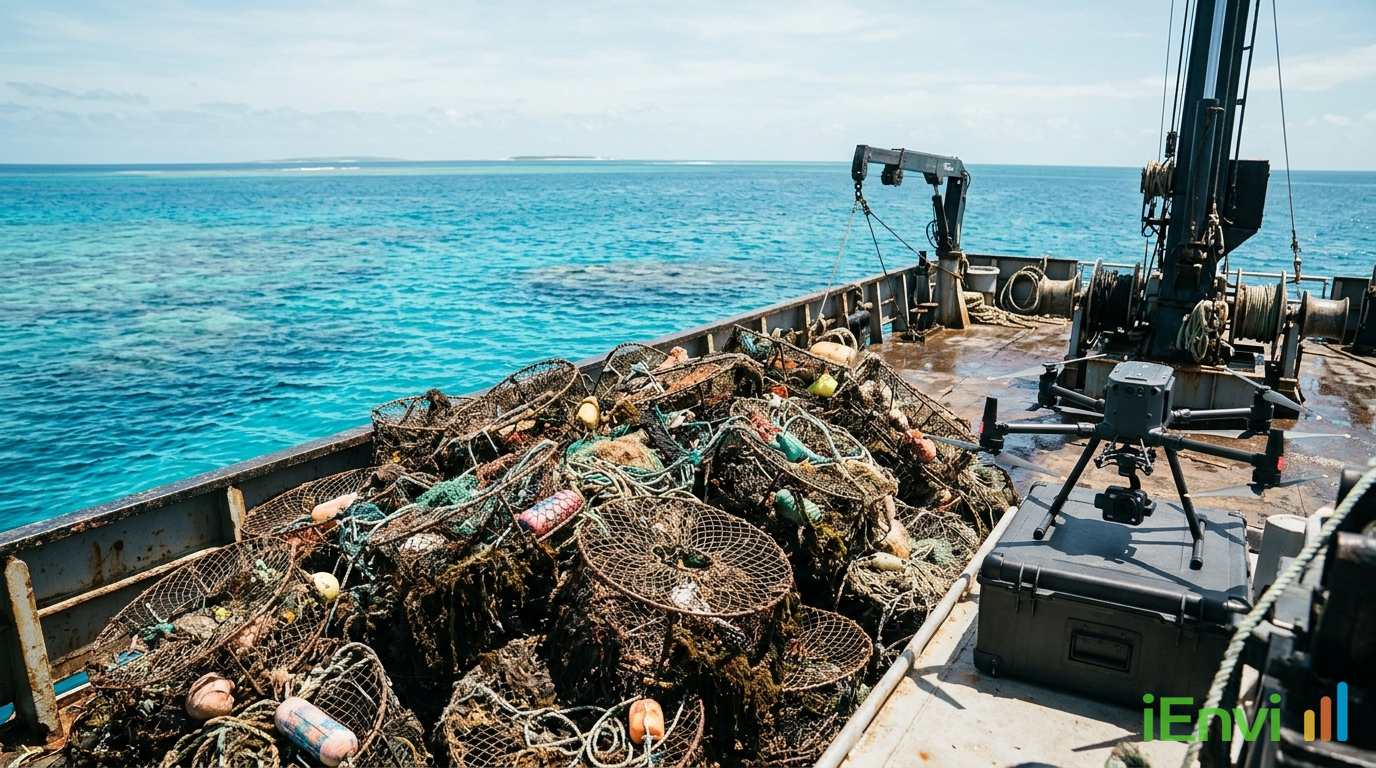
Joint operation removes 786 crab pots and derelict fishing gear from Great Barrier Reef waters
A joint Commonwealth and Queensland compliance operation has removed 786 non-compliant crab pots and items of abandoned or derelict fishing gear from priority waters of the Great Barrier Reef World Heritage Area. The results were announced on 3 November 2026 by Federal Minister for the Environment and Water Murray Watt and Queensland Minister for Primary Industries Tony Perrett. The sweep covered waters from Port Douglas in Far North Queensland to Central Queensland.
Queensland Boating and Fisheries Patrol (QBFP) officers carried out the operation alongside Indigenous Land and Sea Rangers. They used marine patrol vessels and remotely piloted aircraft (drones) to find submerged, unserviceable and unmarked apparatus. The work was delivered under a collaborative agreement between the Commonwealth Department of Climate Change, Energy, the Environment and Water (DCCEEW) and the Queensland Department of Primary Industries, with $250,000 in funding from the Australian Government’s Reef Trust.
For environmental practitioners, the headline number matters less than how the gear was found. Pairing aerial survey with vessel patrols, and involving Traditional Owner ranger groups directly in compliance work, shows how regulators now inspect large, sensitive marine areas. Commercial and recreational fishers using Reef waters should expect lost, abandoned or unmarked apparatus to be detected more readily.
786 items of non-compliant crab apparatus and the ghost fishing risk in Reef waters
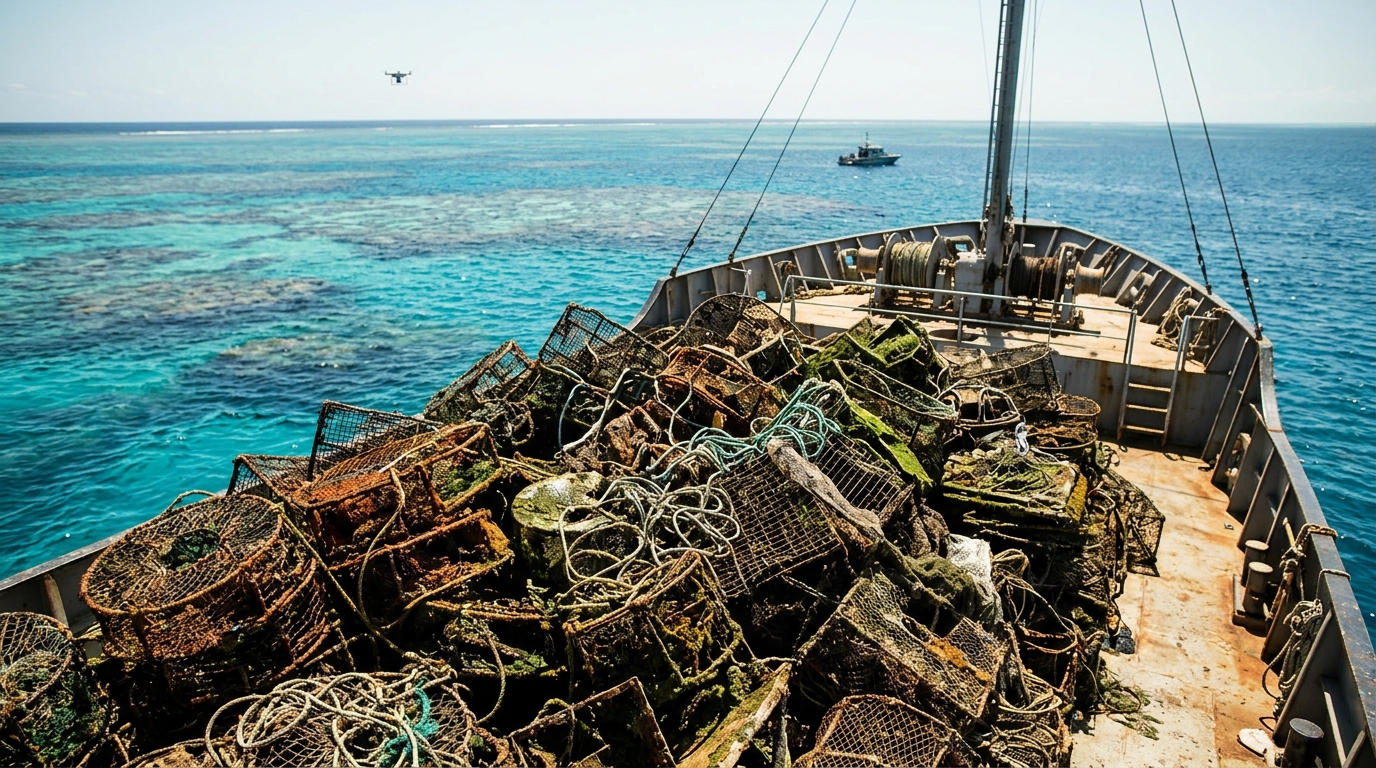
The operation removed 786 units of non-compliant crab apparatus and derelict fishing gear. This brings the total number of non-compliant fishing apparatus seized by QBFP across the Great Barrier Reef World Heritage Area between 2023 and 2026 to 2,892 units. The latest operation therefore accounts for roughly 27 per cent of all seizures recorded across that period.
The targeted gear fell into three categories: apparatus that was submerged, apparatus that was unserviceable, and apparatus that was unmarked. In Queensland, crab apparatus must meet marking and use requirements under the Fisheries Act 1994 (Qld) and the Fisheries (General) Regulation 2019 (Qld). Gear that cannot be linked to an owner, or that has deteriorated to the point where it is no longer being tended, is the gear most likely to keep catching animals with nobody checking it. This is often called “ghost fishing”.
Ghost fishing is the main ecological concern. A pot that is never retrieved can keep trapping target species, and those trapped animals then attract other animals into the same trap, so the cycle sustains itself. Abandoned pots and float lines also pose a drowning and entanglement risk for threatened and protected marine fauna. These include marine turtles, dugong and cetaceans such as inshore dolphins and whales. Removing almost 800 units directly reduces both the physical debris load and the entanglement hazard in World Heritage waters.
The detection method is the most notable technical feature. Submerged and unmarked gear is hard to see from the deck of a patrol vessel, particularly in turbid inshore waters, mangrove-fringed creeks and shallow estuaries. Drones give officers a vantage point that lets them cover larger areas and pick out debris that would otherwise be missed. Vessel crews can then be directed to specific targets for retrieval. Combining aerial survey with surface retrieval is a practical model for any large-area marine inspection programme.
EPBC Act, marine debris threat abatement plan and Reef Trust funding
Several overlapping Commonwealth and Queensland frameworks govern derelict fishing gear in Great Barrier Reef waters. Under the Environment Protection and Biodiversity Conservation Act 1999 (Cth) (EPBC Act), the Great Barrier Reef Marine Park, World Heritage properties, and listed threatened and migratory species are all matters of national environmental significance. Marine turtles and dugong fall within those listings. All cetaceans receive separate protection under Part 13 of the Act. Within the Commonwealth Marine Park, the Great Barrier Reef Marine Park Act 1975 (Cth) and the Great Barrier Reef Marine Park Zoning Plan 2003 apply. The Marine Parks Act 2004 (Qld) governs the adjoining state Great Barrier Reef Coast Marine Park.
Marine debris already has a defined place in national environmental policy. Injury and fatality to vertebrate marine life caused by ingestion of, or entanglement in, harmful marine debris is listed as a key threatening process under the EPBC Act. A threat abatement plan for the impacts of marine debris on vertebrate wildlife has been in place since 2018. Abandoned crab pots and lost fishing line are exactly the kind of debris that plan addresses. Compliance sweeps like this one are the on-water delivery of that national policy.
The funding pathway is also worth noting. The Reef Trust is the same Commonwealth mechanism behind many Great Barrier Reef catchment water quality and resilience projects. Directing Reef Trust money to gear removal and enforcement shows that physical debris is now treated as a Reef health pressure in its own right, alongside sediment and nutrient runoff. The operational role of Indigenous Land and Sea Rangers is consistent with how sea country management is now delivered across much of coastal Queensland. Rangers take part in compliance and monitoring work directly, not only in consultation.
Crab apparatus compliance and marine debris monitoring in Reef waters
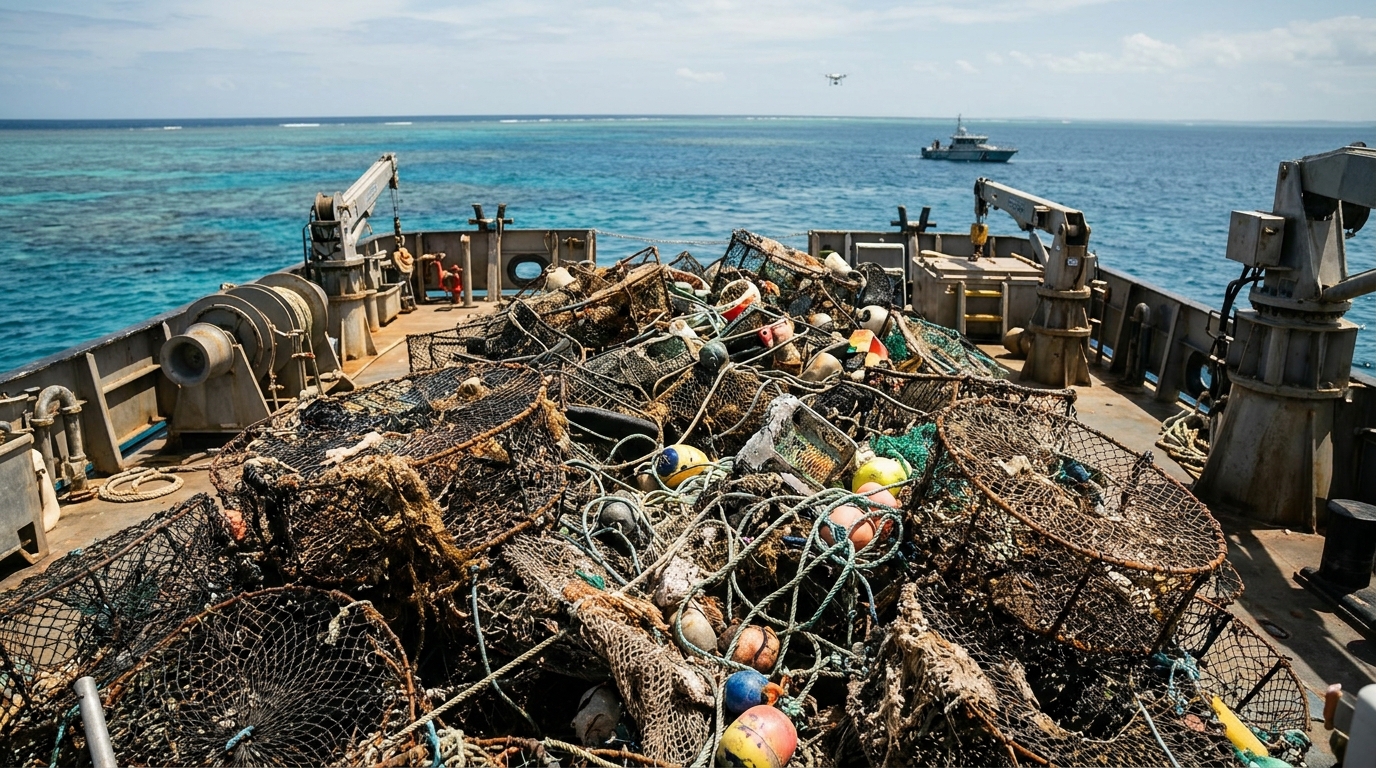
Crab apparatus used in Queensland waters must comply with the marking and use requirements of the Fisheries Act 1994 (Qld) and the Fisheries (General) Regulation 2019 (Qld). Apparatus that is unmarked, unserviceable or left submerged without being tended can be seized. With 2,892 units seized across the World Heritage Area between 2023 and 2026, and 786 removed in this operation alone, enforcement in Reef waters is active and ongoing.
Commercial and recreational fishers should check that their pots and dillies are correctly marked, kept in serviceable condition and checked regularly. Gear that is lost should be retrieved where possible. The use of drones means unmarked or abandoned apparatus in shallow and turbid inshore waters is now far more likely to be found than in the past.
For environmental consultants and natural resource managers, the operation offers a working example of how to survey for marine debris across large, hard-to-access areas. Aerial survey to locate targets, followed by vessel-based retrieval, can be applied to debris monitoring and clean-up programmes in other estuarine and inshore settings. The involvement of Indigenous Land and Sea Rangers also shows the value of engaging Traditional Owner groups early when planning monitoring or compliance work on sea country.
References and related sources
- Primary source: minister.dcceew.gov.au
- EPBC Act
How iEnvi can help
iEnvi provides specialist consulting services relevant to this topic. Our team includes CEnvP Site Contamination Specialists with experience across contaminated land, groundwater, remediation, ecology, and regulatory compliance.
- iEnvi ecology services
- iEnvi contaminated land investigation services
- iEnvi remediation and validation services
- iEnvi expert services and independent review services
This is an iEnvi Machete news summary. Prepared by iEnvi to summarise the source article for contaminated land, groundwater, remediation, approvals and site risk professionals.
Published: 04 Nov 2026
Need advice on this topic? Speak to an iEnvi expert at info@ienvi.com.au or 1300 043 684, or contact us online.
Need advice on this issue? iEnvi provides practical, senior-led environmental consulting across contaminated land, remediation, ecology and environmental risk.
Team credentials Contaminated land services Remediation services Groundwater services Talk to iEnvi