
What does UPSS due diligence involve in a transaction?
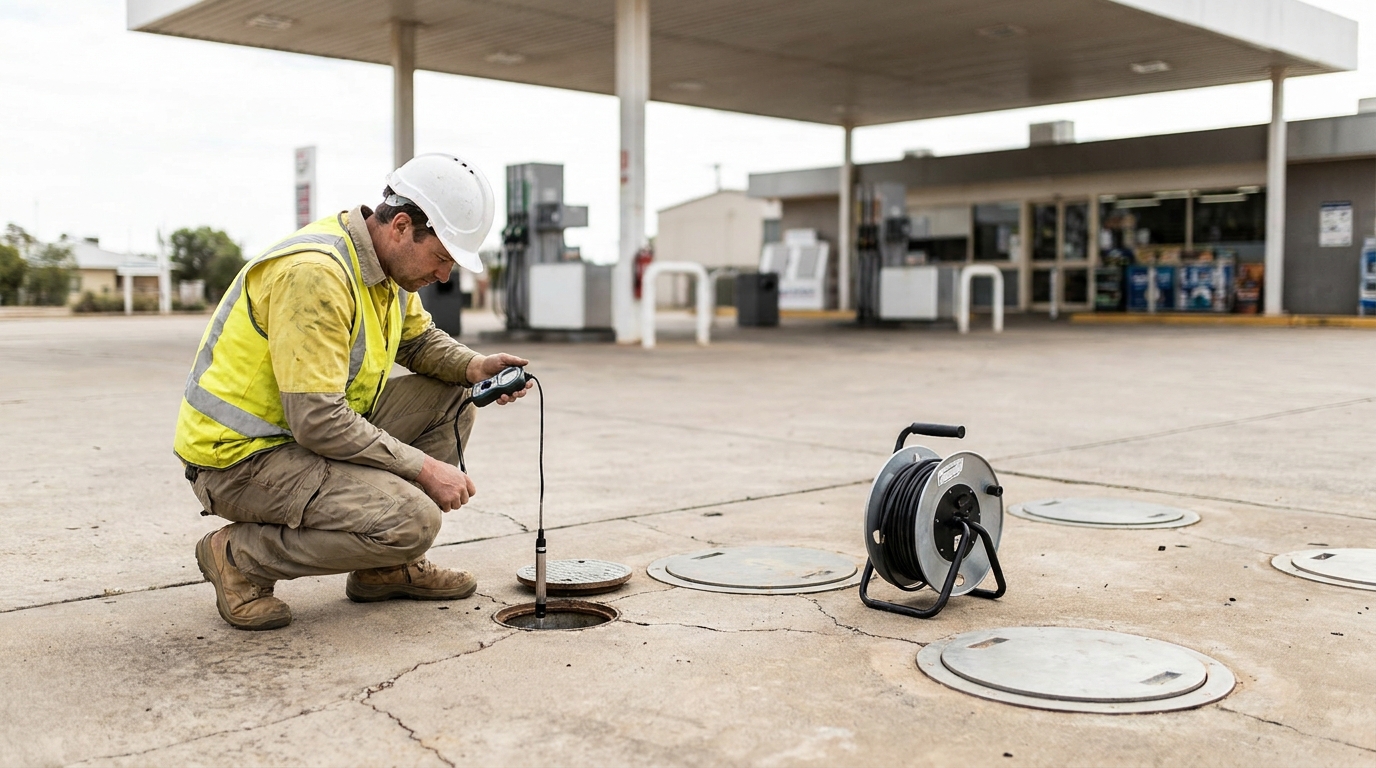
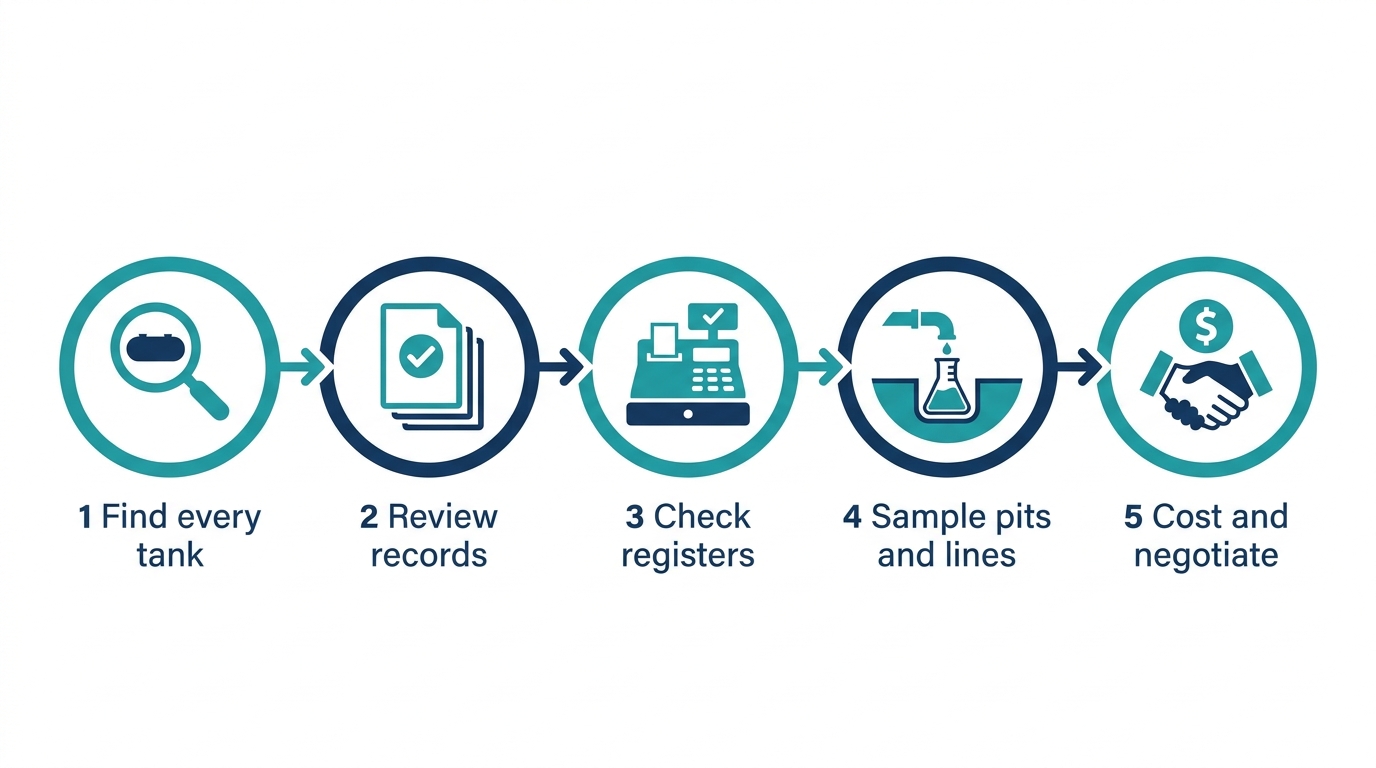
Underground petroleum storage systems (UPSS) are the underground tanks and pipework, with their fill points, vents, pumps and dispensers, that store and deliver fuel or used oil at service stations, depots, transport yards and many industrial sites. In a sale, purchase, lease or business acquisition, UPSS due diligence means finding every current and former tank, reviewing its operating, leak detection and decommissioning records, checking registers and regulatory history and, where the risk warrants it, sampling soil, groundwater and soil vapour around tank pits, lines and dispensers. The findings tell a buyer what they are inheriting and what it could cost to remove, validate or remediate, and they give both sides hard evidence to negotiate price, indemnities and conditions.
Few site features move a deal like a buried fuel tank. An operating service station, a former depot or an industrial yard with an old diesel tank can all carry petroleum contamination that is invisible from the surface, can persist for many years and can move beyond the boundary. Good UPSS due diligence finds that out before the price is fixed.
This is the seventh article in our series on environmental due diligence (EDD) for M&A in Australia. Earlier articles covered why environmental due diligence matters in Australian M&A, Phase 1 vs Phase 2 environmental assessments, negotiating price, warranties, indemnities and escrow, vendor environmental due diligence, PFAS liabilities in transactions and contaminated land registers and notices by state. This one focuses on UPSS on service station and industrial sites, what to look for, and how the findings protect a buyer and support a seller’s price.
Why UPSS sites need their own due diligence
A UPSS is a system, not just a tank. It includes the tanks, fill points, vent lines, product pipework, pumps, dispensers and any leak detection equipment such as groundwater monitoring wells. Pipework joints, dispensers and fill points are common leak points, so contamination is often found away from the tank pit as well as in it.
UPSS sites raise four issues a general site review can miss.
- Hidden or forgotten tanks. Many sites once had a tank for a fleet, generator or workshop. Some were removed without records and some were left in the ground.
- Mobile contamination. A large enough release of petrol or diesel can form light non-aqueous phase liquid (LNAPL) on the water table, which smears through the soil as groundwater levels rise and fall. More soluble compounds such as benzene dissolve into groundwater and can travel off site, bringing in neighbours and sometimes the regulator.
- Vapour risk. Volatile compounds from petrol, such as benzene and the lighter hydrocarbon fractions, can move as vapour into buildings. Petroleum vapours often break down in oxygenated soil, so the risk depends on source depth, soil type and building design, and soil vapour data often decides whether a site suits a more sensitive use.
- Ongoing regulatory duties. In some states the person responsible for a UPSS has specific leak detection, record keeping, reporting and decommissioning obligations, which a buyer or incoming operator takes on from settlement or completion.
Where UPSS turn up in transactions
The obvious cases are operating and former service stations, fuel depots and truck stops. We also find them at transport yards, bus and council depots, car dealerships, workshops, manufacturing plants, marinas, farms and older buildings once heated by oil. Many former service stations are now shops or housing with no visible trace of their fuel history.
Deal structure matters too. In a portfolio sale the question is how much removal, remediation and validation to price in. In a lease it is the baseline condition and who carries the make-good. In a business or asset acquisition, the buyer takes on the operating duties for the tanks it will run and, as the new owner or occupier, can face statutory liability for existing contamination it did not cause.
The regulatory framework for UPSS
Requirements differ between states. The points below are general and current at the time of writing.
New South Wales
New South Wales has the most detailed regime, the Protection of the Environment Operations (Underground Petroleum Storage Systems) Regulation 2019. Since 1 September 2019, local councils have been the appropriate regulatory authority for most UPSS sites. The NSW EPA regulates systems operated by public authorities, licensed premises, unincorporated areas and sites under earlier EPA notices until they are complied with. Under the Regulation and the EPA’s guidelines for implementing it:
- a UPSS must not be used unless a fuel system operation plan (formerly an environment protection plan) is in place, covering loss monitoring, incident management, maintenance, as-built drawings, a site plan showing groundwater monitoring wells, the standards and specifications followed, and training
- groundwater monitoring wells are the preferred method of leak detection, with results kept for at least seven years
- leaks or spills causing or likely to cause material harm must be notified to the appropriate regulatory authority immediately, followed by a written leak notification within seven days
- a tank not used to store petroleum for two years, or not intended to be used again, is taken to be abandoned and must be decommissioned, by removal or, where removal is not reasonably practicable, by filling with an inert solid
- the local council must be notified at least 30 days before decommissioning (or as soon as practicable if urgent), and a duly qualified person’s report must be served on the council within 60 days of decommissioning or, if remediation is required, of remediation being completed
- when a site is sold or responsibility otherwise changes, the system records must pass to the new person responsible, and the guidelines expect this within 30 days.
These duties fall on the person responsible for the system, who may be the operator rather than the landowner. Abandoned tanks at workplaces must also be notified to SafeWork NSW, and contamination can trigger the duty to report under the Contaminated Land Management Act 1997. Our article on the NSW duty to report contamination explains when that applies.
Queensland
Queensland has no equivalent UPSS regulation. Instead, storing petroleum products or oil in underground tanks with more than 200 litres capacity is a notifiable activity under item 29 of Schedule 3 of the Environmental Protection Act 1994. Land where that activity has occurred can be listed on the Environmental Management Register, and a seller of listed land must give the buyer written notice before agreeing to sell. Owners and occupiers who become aware of a notifiable activity on their land may also need to notify the department. Our Queensland EMR removal guide explains how a listing can be removed once investigation supports it.
Victoria, Tasmania and other jurisdictions
In Victoria, the Environment Protection Act 2017 imposes a general environmental duty on anyone whose activities could cause harm, and a duty to manage contaminated land on people in management or control of land. On a UPSS site that usually means both the owner and the operator. Tasmania has the Environmental Management and Pollution Control (Underground Petroleum Storage Systems) Regulations 2020, administered by EPA Tasmania, which deal with matters such as loss monitoring, leak and loss notification, groundwater monitoring wells and decommissioning with soil and groundwater assessment. Elsewhere, fuel storage is mainly governed by dangerous goods and work health and safety laws and contaminated land legislation. Several states, including Victoria, Western Australia and South Australia, also have duties to report or notify certain contamination. Our article on contaminated land registers and notices by state sets out what to search in each.
Standards and assessment criteria
Three standards come up repeatedly. AS 1940:2017 covers the storage and handling of flammable and combustible liquids. AS 4897-2008 covers the design, installation and operation of UPSS, including inventory control and loss investigation, and is referenced in the NSW guidelines. AS 4976-2008 covers the removal and disposal of underground petroleum storage tanks. Contamination is assessed under the National Environment Protection (Assessment of Site Contamination) Measure 1999, as amended in 2013 (ASC NEPM). Its health screening levels (HSLs) for petroleum hydrocarbons, developed by CRC CARE, cover benzene, toluene, ethylbenzene, xylenes (BTEX), naphthalene and the F1 to F4 hydrocarbon fractions. Vapour intrusion HSLs for soil, groundwater and soil vapour vary with land use, soil texture and depth, and matter most for the volatile compounds and lighter fractions. The ASC NEPM also sets ecological screening levels and management limits. An exceedance of an HSL is a trigger for further assessment, not an automatic clean-up requirement.
What a UPSS due diligence records review should cover
A good preliminary site investigation on a fuel site goes well beyond a walkover and a register search. We ask for, and test the seller’s answers against:
- A tank and line inventory. Every current and former tank, its age, construction, capacity, product and status, with as-built drawings.
- Operating records. In NSW, the fuel system operation plan and any earlier environment protection plans. In every state, loss monitoring and inventory reconciliation records, tank and line integrity testing, and maintenance and repair history.
- Leak detection results. Groundwater monitoring well results, observations of odour or sheen, and any leak notifications or incident records.
- Decommissioning and validation reports. For any removed or abandoned tank, the decommissioning report, tank pit and line validation sampling, and any council or regulator correspondence. Our guide to UPSS validation requirements in NSW and Queensland explains what a defensible report looks like.
- History and searches. Aerial photographs, dangerous goods, register, title and planning records, which often reveal tanks the owner does not know about.
- The setting. Depth to groundwater, nearby bores, waterways, basements and sensitive neighbours.
Gaps in the records are findings in their own right. A removed tank with no validation report is a site where the buyer cannot rely on the absence of contamination.
When to move to intrusive investigation
Where the Phase 1 shows real risk, a targeted detailed site investigation before exchange or completion is usually money well spent. It typically means:
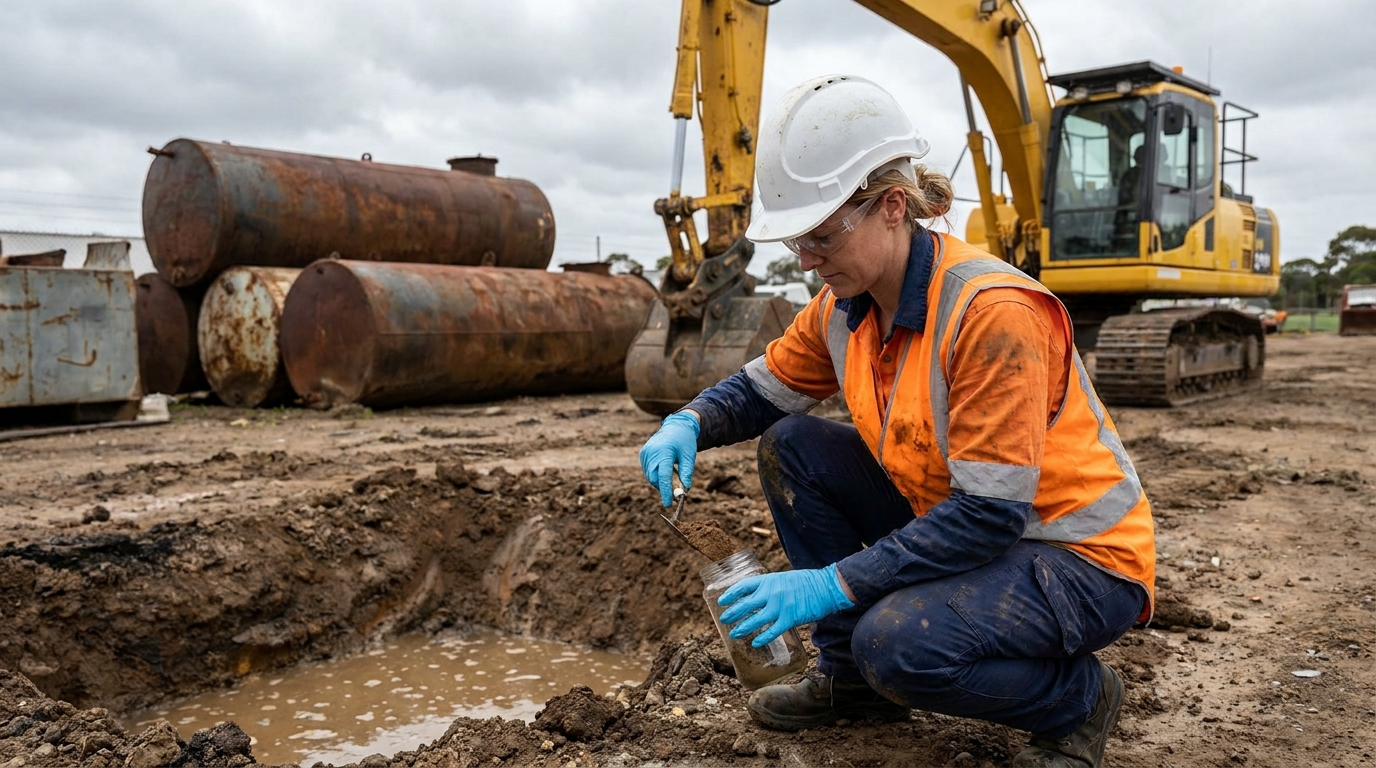
- soil sampling around tank pits, along product lines, under dispensers and at fill points and vents
- installing or sampling groundwater monitoring wells, gauging for LNAPL and assessing whether dissolved impacts extend toward the boundary, using methods such as low flow groundwater sampling
- soil vapour sampling where buildings exist or are planned over or near the impacted area
- analysis for petroleum hydrocarbon fractions, BTEX and naphthalene, plus lead, polycyclic aromatic hydrocarbons or other contaminants where the site history points to them, assessed against criteria for the actual and proposed land use.
Intrusive work around live fuel infrastructure needs service location and careful planning, so schedule it early in the deal timetable. Where the seller will not allow sampling, that refusal is itself information a buyer should price.
Sampling results can trigger reporting duties. These usually sit with the owner, the polluter or the person responsible for the system rather than a prospective buyer, but a seller who receives the results may then hold a duty. The site access agreement should settle who gets the data and who reports. Legal professional privilege may protect advice, but it does not remove a statutory duty to notify.
How UPSS findings reduce risk and give price leverage
Petroleum hydrocarbons are well understood, so once the facts are known the outcomes can usually be costed with reasonable confidence, although LNAPL and off-site migration are harder to pin down. That is what makes UPSS due diligence useful in a negotiation: it turns an open-ended worry into costed scenarios.
For buyers
- Price. Costed scenarios for removal, validation, remediation and monitoring support a price adjustment rather than a vague discount request.
- Conditions. A buyer can require the seller to decommission redundant tanks and provide a validation report before completion, or make completion conditional on satisfactory results. If the seller decommissions, the buyer’s consultant should review the scope and validation.
- Contract protection. Known impacts can be covered by a specific indemnity, a retention or escrow, or a remediation obligation on the seller, as discussed in our article on negotiating price, indemnities and escrow. Outside statutory notices, sellers are generally not obliged to volunteer contamination information, but they must not mislead, so warranties and disclosure matter.
- Operating compliance. If the buyer will keep operating the system, the due diligence confirms whether it can lawfully stay in use, what upgrades are needed and which records must be handed over.
- Finance and future use. Lenders often require an environmental report, and reliance on it, before lending against a fuel site. A clear report also protects the next refinance or sale.
For sellers
A seller who commissions vendor due diligence before marketing, assembles the tank records, decommissions redundant tanks properly and has validation completed can replace a buyer’s worst-case assumptions with evidence. In NSW, build the council notice period into the sale timetable. In Queensland, a well-supported investigation may also open the path to removing an EMR listing, as in our former service station EMR removal in eastern Brisbane. It also lets the seller control scope and timing.
Leases, asset sales and share sales
Where a fuel site is leased, both landowner and operator can carry liability, so the lease should say who owns the tanks, who holds the operating duties and who decommissions at the end of the term. A baseline investigation at the start or renewal of a lease, like our petrol station lease renewal baseline in Western Sydney, records the condition of the site at that point and makes make-good disputes far easier to resolve. In an asset sale the buyer takes the land and its condition. In a share sale the company stays the same, so the buyer also inherits the company’s history, notices and liabilities for every site it has owned or operated. The due diligence should therefore extend to former sites.
Common mistakes on UPSS sites
- Assuming there are no tanks because none are visible. Fill points get sealed over and dispensers get removed.
- Treating a tank removal certificate as a validation report. Removal records do not show whether the ground is clean.
- Backfilling a tank pit before validation sampling is done.
- Leaving redundant tanks in place because the deal is moving fast, which moves the problem to the buyer and often costs the seller more in price.
Why iEnvi specialises in UPSS due diligence for transactions
We investigate, remediate and validate fuel sites for buyers, sellers, landlords, operators, lenders and their lawyers across Queensland, New South Wales, Victoria and South Australia. Our work includes:
- UPSS investigation, remediation, validation and tank pit reporting, from operating service stations to legacy fuel sites.
- Purchase due diligence on fuel sites, such as our rural service station investigation in Far North Queensland, and UPSS investigation and EMR removal on the Darling Downs.
- Decommissioning advice where tanks cannot be removed, such as our in-situ UPSS abandonment by foam filling in the Wide Bay region.
- Remediation, remediation action plans and groundwater work, including post-remediation groundwater monitoring at a service station in Melbourne’s west.
Our work is led by Michael Nicholls, a Certified Environmental Practitioner (CEnvP) Site Contamination Specialist. See our team and credentials, our contaminated land services and our environmental due diligence for property transactions and M&A service.
Talk to iEnvi about a fuel site in your transaction
If you are buying, selling, leasing or financing a service station, depot or industrial site with current or former fuel tanks, talk to us before the due diligence period starts. We can scope the records review and sampling around your timetable, cost the realistic outcomes and give your advisers findings they can use. Send us a message through our contact page.
This article is general information only and is not legal or financial advice. UPSS, dangerous goods and contaminated land requirements differ between states and territories and change over time, so get advice that suits your deal and sites.
References
- NSW Environment Protection Authority. Guidelines for implementing the Protection of the Environment Operations (Underground Petroleum Storage Systems) Regulation 2019 and Decommissioning an underground petroleum storage tank or system.
- Protection of the Environment Operations (Underground Petroleum Storage Systems) Regulation 2019 (NSW).
- Environmental Protection Act 1994 (Qld), Schedule 3, item 29.
- Environment Protection Act 2017 (Vic) and EPA Victoria, Guide to the duty to manage contaminated land (Publication 1977).
- Environmental Management and Pollution Control (Underground Petroleum Storage Systems) Regulations 2020 (Tas).
- Standards Australia. AS 1940:2017, AS 4897-2008 and AS 4976-2008.
- National Environment Protection (Assessment of Site Contamination) Measure 1999, as amended 2013, Schedule B1.
- Friebel, E. and Nadebaum, P. (2011). Health screening levels for petroleum hydrocarbons in soil and groundwater, CRC CARE Technical Report 10.
Need advice on this issue? iEnvi provides practical, senior-led environmental consulting across contaminated land, remediation, ecology and environmental risk.
PSI services DSI services UPSS investigation and validation Team credentials Talk to iEnvi