

Overview
The NSW National Parks and Wildlife Service (NPWS) released its June 2026 progress update on the $49.5 million ecological restoration and visitor infrastructure programme at the Gardens of Stone State Conservation Area (SCA), located near Lithgow in the central tablelands of New South Wales. The update, published on 29 June 2026, details substantial progress in converting former commercial state forest into a functioning native sandstone ecosystem, including the confirmed establishment of 10,000 native plants across the reserve since restoration activities commenced. The programme represents one of the most technically ambitious large-scale land rehabilitation projects currently underway in eastern Australia.
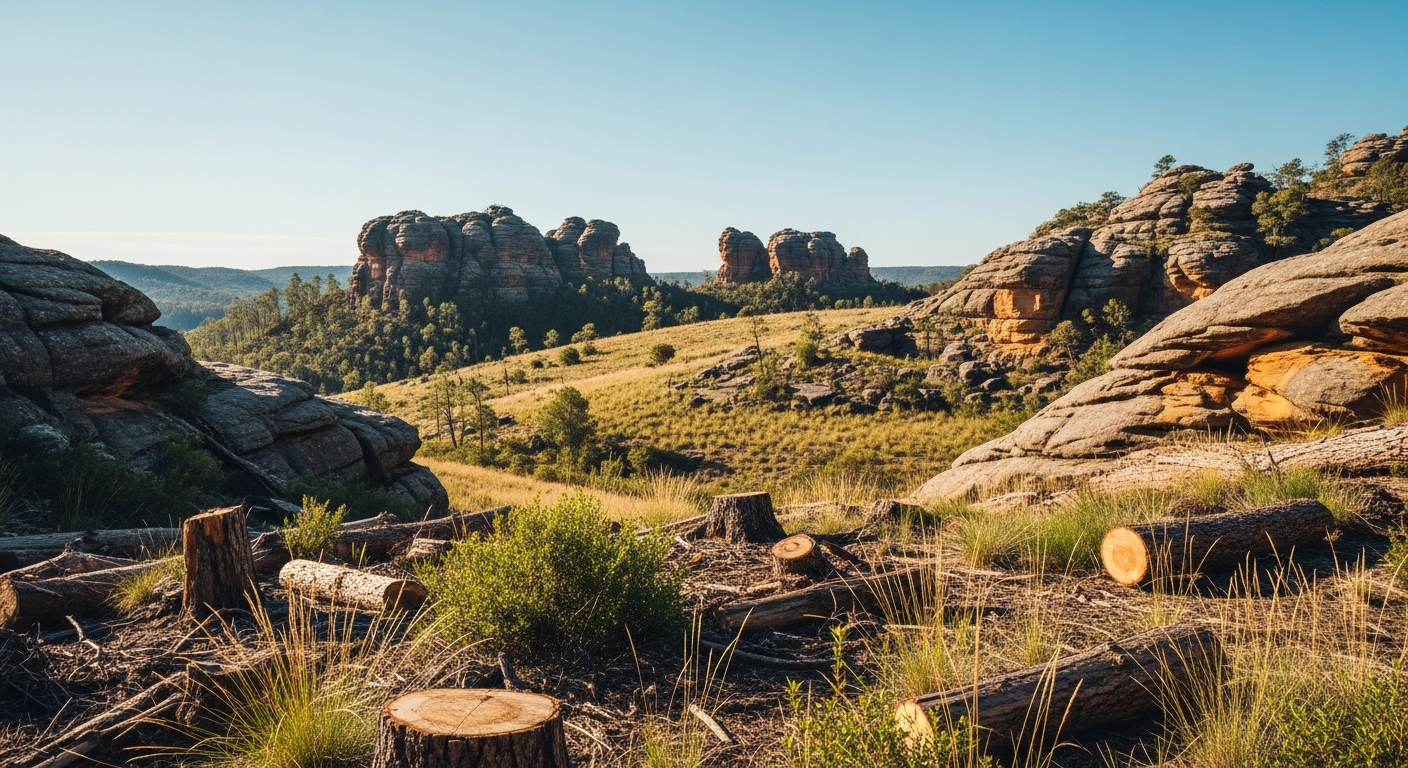
The 28,322-hectare reserve was transferred from Forestry Corporation NSW management to NPWS in 2022, bringing with it the legacy of intensive pine plantation forestry. At the time of handover, approximately 110 hectares of the park were occupied by invasive Radiata pine monoculture. The June 2026 update confirms that pine eradication is continuing throughout winter 2026, with active ecological restoration trials running in parallel to test rehabilitation techniques suited to the area’s fragile sandstone geology and sensitive ecological communities, including endangered Montane peatlands and swamps.
For environmental professionals working in biodiversity offsetting, ecological impact assessment, land rehabilitation, and planning approvals, this project is important for reasons that extend beyond its immediate geography. It is generating real-world, landscape-scale data on how to rehabilitate highly modified forestry land back to native ecological condition on sandstone substrates. That is a technically difficult problem with direct relevance to offset site management, post-mining rehabilitation, and development approval conditions across New South Wales, Queensland, Victoria, and South Australia.
Key details of the Gardens of Stone restoration programme
The total programme budget is $49.5 million, allocated across ecological restoration works and visitor infrastructure upgrades under the Gardens of Stone SCA Plan of Management and Visitor Infrastructure Master Plan. The pine eradication component targets approximately 110 hectares of Radiata pine plantation that were established during the site’s former life as state forest. Radiata pine (Pinus radiata) is an aggressive environmental weed in Australian native ecosystems. It suppresses native understory growth through canopy shading and leaf litter acidification, depletes the native seedbank, and spreads via wind-dispersed seed into adjacent pristine bushland, including critically sensitive pagoda and heath communities.
Because the Gardens of Stone SCA contains fragile sandstone pagoda landforms and a mosaic of sensitive ecological communities, crews cannot use conventional heavy machinery for pine removal across much of the site. NPWS has instead deployed low-impact removal techniques including ringbarking, hand pulling of smaller specimens, and drill-and-fill herbicide treatment for established trees. Drill-and-fill involves drilling holes into the base of the trunk and injecting a concentrated herbicide solution directly into the cambium, killing the tree in place without the soil disturbance associated with mechanical uprooting. This approach is particularly important on steep sandstone terrain where ground disturbance would accelerate erosion and damage the root mat structure that stabilises shallow soils.
The restoration trials currently underway are testing a suite of active rehabilitation methodologies designed to accelerate ecosystem recovery following pine removal. These include mulch and log reuse from cleared pine material, brush matting to stabilise bare soil surfaces and provide a microclimate conducive to native germination, direct seeding of locally provenanced native species, and targeted erosion control measures on slopes and drainage lines. The autumn 2026 planting of 5,000 native tubestock brought the programme’s cumulative total to 10,000 established native plants, representing a measurable milestone in the revegetation works. The objective of the trials is to produce documented best-practice guidelines for sandstone ecosystem restoration applicable across the broader region.
In addition to the ecological works, infrastructure upgrades at the Broad Swamp carpark and loop walk are nearing completion, with a public reopening scheduled for Friday, 3 July 2026. These upgrades are specifically engineered to direct visitor movement away from the endangered Montane peatlands and swamps ecological community, which is protected under both the Biodiversity Conservation Act 2016 (NSW) and the National Parks and Wildlife Act 1974 (NSW). Montane peatland systems are highly sensitive to physical disturbance, hydrological alteration, and nutrient inputs from foot traffic, making passive visitor management through infrastructure design a critical component of ongoing protection.
Australian context: biodiversity offsets, land rehabilitation frameworks, and relevance to NSW and national practice
The Gardens of Stone programme operates under two primary NSW regulatory instruments: the National Parks and Wildlife Act 1974 (NSW), which governs the management of state conservation areas and the protection of threatened species and ecological communities, and the Biodiversity Conservation Act 2016 (NSW), which underpins the Biodiversity Offsets Scheme (BOS) and the framework through which biodiversity credits are generated, retired, and audited. The site’s endangered Montane peatlands and swamps ecological community is listed under the Biodiversity Conservation Act 2016 (NSW), meaning that any disturbance to that community on or adjacent to a development site would ordinarily trigger formal assessment or offsetting requirements under the Biodiversity Offsets Scheme.
References and related sources
- Primary source: www.environment.nsw.gov.au
- nsw.gov.au
- nsw.gov.au
- nsw.gov.au
- nsw.gov.au
- EPBC Act
How iEnvi can help
iEnvi provides specialist consulting services relevant to this topic. Our team includes CEnvP Site Contamination Specialists with experience across contaminated land, groundwater, remediation, ecology, and regulatory compliance.
- iEnvi contaminated land investigation services
- iEnvi remediation and validation services
- iEnvi expert services and independent review services
This is an iEnvi Machete news summary. Prepared by iEnvi to summarise the source article for contaminated land, groundwater, remediation, approvals and site risk professionals.
Published: 02 Jul 2026
Need advice on this topic? Speak to an iEnvi expert at info@ienvi.com.au or 1300 043 684, or contact us online.
Need advice on this issue? iEnvi provides practical, senior-led environmental consulting across contaminated land, remediation, ecology and environmental risk.
Team credentials Contaminated land services Remediation services Groundwater services Talk to iEnvi