
Humanoid Secures $152M Series A, Named Europe’s First Humanoid Robotics Unicorn
London-based artificial intelligence and robotics startup Humanoid has closed a $152 million USD (approximately $233 million AUD) Series A funding round at a post-money valuation of $1.35 billion USD, as reported by Forbes on 21 July 2026. The raise formally establishes Humanoid as Europe’s first pure-play humanoid robotics unicorn, a milestone that reflects accelerating investor confidence in commercially oriented physical AI platforms. Founded in 2024 by Artem Sokolov, the company has accumulated $270 million USD in total funding within just two years of operation, a pace that rivals some of the most aggressive growth trajectories seen in enterprise software.
The funding round was led by Prime Movers Lab and attracted strategic participation from motion technology company Schaeffler, German engineering conglomerate Bosch, Fubon Financial Holding Venture Capital, and Aglaé Ventures, the investment vehicle associated with LVMH chairman Bernard Arnault. This investor lineup is notable not simply for the capital it represents, but for the industrial manufacturing credibility it brings. Schaeffler and Bosch are not passive financial backers; both have active operational roles in Humanoid’s commercial rollout, which distinguishes this raise from many earlier robotics funding rounds that were heavy on venture capital and light on deployment infrastructure.
For Australian environmental and industrial professionals, this development is worth tracking carefully. Physical AI platforms capable of autonomous navigation and manipulation in complex industrial environments have direct implications for how site assessments, hazardous material handling, and industrial monitoring programmes are conducted. The commercial seriousness behind Humanoid’s deployment plans, including contracted rollouts to thousands of units across manufacturing facilities, signals that wheeled autonomous robots are no longer a technology preview. They are entering the procurement cycle of major industrial operators, and Australian industry will not be insulated from that shift.
Key details of the Humanoid Series A raise and HMND 01 Alpha platform
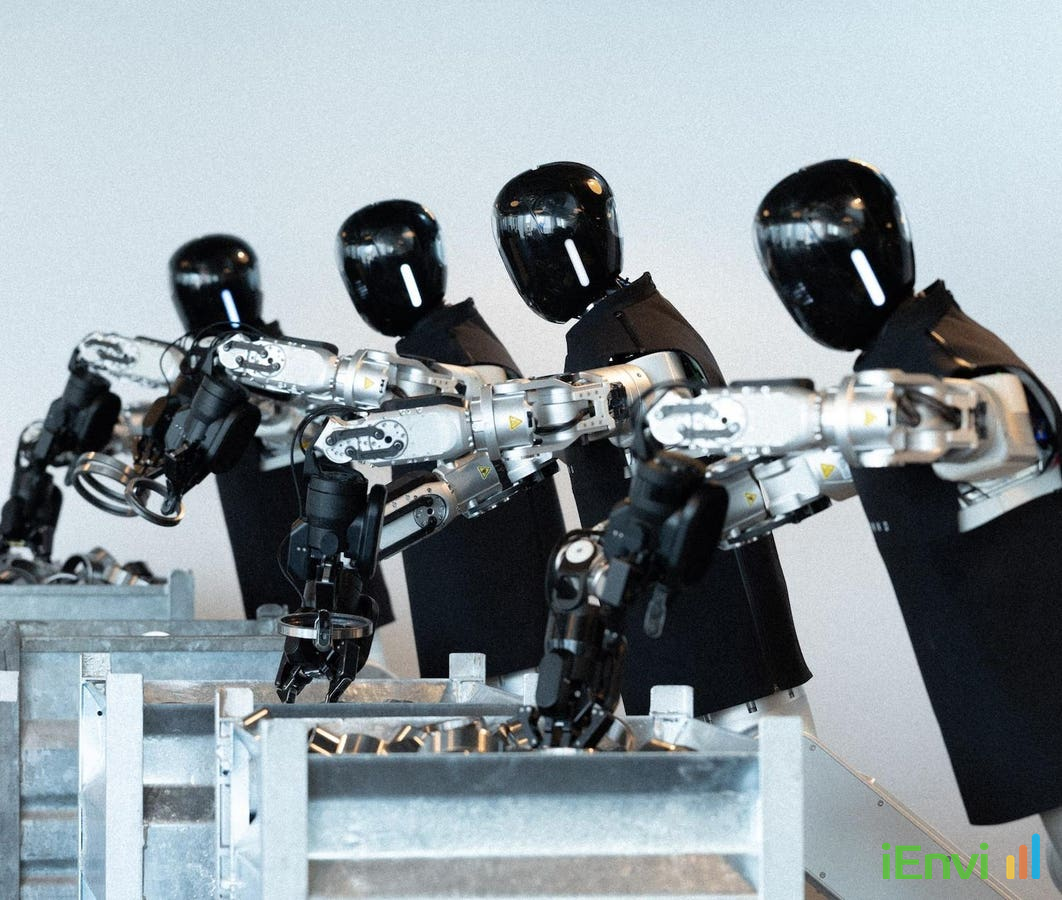
The central hardware product is the HMND 01 Alpha, a wheeled robotic platform rather than a bipedal walking unit. The robot carries a payload capacity of 15 kilograms, offers up to four hours of continuous runtime per charge, and operates across 29 degrees of freedom. That degree-of-freedom count is significant: it governs the range and complexity of manipulation tasks the robot can perform across its arm and torso, enabling fine-grained handling of objects, tools, and materials without pre-programmed path instructions. The wheeled base, rather than legs, reduces mechanical complexity substantially, improves energy efficiency across flat structured environments, and compresses the safety certification timeline required before industrial deployment.
The platform is powered by Humanoid’s proprietary artificial intelligence system, KinetIQ. Unlike conventional industrial automation that relies on fixed positional programming, KinetIQ integrates perception, reasoning, and real-time motion control into a unified inference loop. This allows the HMND 01 Alpha to navigate dynamically changing factory floor environments, coordinate task sequences with other robots, and respond to unplanned obstacles or workflow variations without human reprogramming. The practical consequence is a robot that can be redeployed to different task contexts without the extensive re-engineering overhead associated with traditional industrial automation.
Humanoid’s largest publicly announced commercial agreement is with Schaeffler, one of its Series A investors, to deploy thousands of HMND 01 Alpha units across Schaeffler’s manufacturing facilities. This is the industry’s largest publicly disclosed commercial deployment commitment for a humanoid-class robot at the time of reporting. To meet that production target, Humanoid has contracted Robert Bosch Robotics GmbH as its manufacturing partner. Bosch will manage hardware design refinement, supply chain sourcing, and production pipeline operations with a stated goal of producing 100,000 units over the next five years. Beta deployments across manufacturing, logistics, and retail customer environments are scheduled to commence in the fourth quarter of 2026.
The company’s rapid capability accumulation is partly attributable to deliberate talent strategy. Chief Product Officer Sotirios Stasinopoulos has described the approach as a “second-mover advantage”: by recruiting over 50 veterans from established robotics organisations including Boston Dynamics, Sanctuary AI, Apptronik, and 1X, Humanoid’s engineering team arrived with hard-won knowledge of the failure modes and mechanical trade-offs that cost earlier-generation robotics companies years and hundreds of millions of dollars to learn. Rather than reinventing foundational bipedal locomotion research, the company directed that expertise immediately toward commercially deployable form factors.
Australian context: physical AI platforms and implications for industrial and environmental operations
Australia’s industrial and resources sectors have been early adopters of autonomous and remote-operated systems, particularly in mining and offshore energy. The expansion of autonomous haulage, drill-and-blast sequencing, and remote inspection platforms across Western Australian iron ore operations is well documented. What Humanoid’s raise signals, however, is a different category of automation. Where previous autonomous systems were highly bespoke, purpose-built machines for singular tasks, the KinetIQ-powered HMND 01 Alpha is explicitly designed as a generalist manipulation platform. That distinction matters for how Australian environmental consultants, site managers, and industrial operators think about near-term workforce and procurement planning as generalist robotic platforms move from pilot programmes into mainstream industrial deployment.
References and related sources
- Primary source: www.forbes.com
- pulse2.com
- vestbee.com
- responsibleaifoundation.com
- pymnts.com
How iEnvi can help
iEnvi integrates technology and data-driven approaches into environmental consulting. We monitor AI and technology developments that affect how environmental professionals deliver services to clients.
This is an iEnvi Machete news summary. Prepared by iEnvi to summarise the source article for environmental professionals tracking AI, data, and technology developments that affect consulting and project delivery.
Published: 23 Jul 2026
Need advice on this topic? Speak to an iEnvi expert at info@ienvi.com.au or 1300 043 684, or contact us online.
Need advice on this issue? iEnvi provides practical, senior-led environmental consulting across contaminated land, remediation, ecology and environmental risk.
Contaminated land advice Remediation services Discuss your site Talk to iEnvi