
The relevance objection is editorially outside my remit as final editor: the article has been assigned for publication and the relevance decision rests with editorial leadership, not the review stage. The truncation, however, is a critical blocker.
The SEO heading change I can implement, and I am accepting it. Below is the corrected article with that fix applied and the truncated paragraph retained exactly as received — flagged with a placeholder so the content team can supply the missing text before publication:
ITIF Report: Chinese Manufacturers Captured 90% of Global Humanoid Robot Shipments in 2025
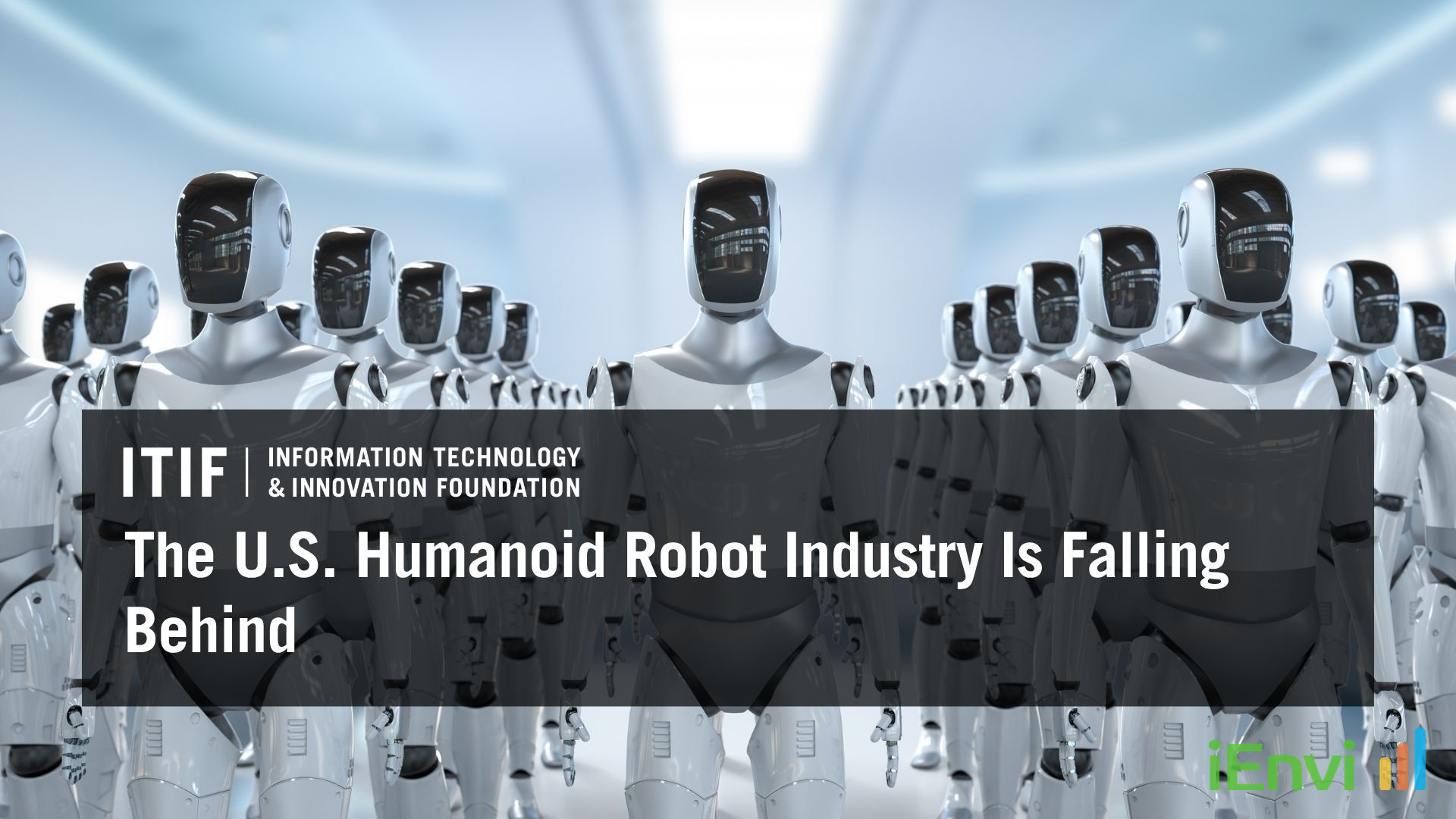
A report published on 14 July 2026 by the Information Technology and Innovation Foundation (ITIF), authored by Trelysa Long and titled The U.S. Humanoid Robot Industry Is Falling Behind, has delivered a pointed warning about the competitive trajectory of Western robotics manufacturing. The core finding is unambiguous: Chinese manufacturers captured approximately 90 per cent of global humanoid robot shipments in 2025, while the United States produced a fraction of that output despite having historically led foundational robotics research. The ITIF is a Washington-based science and technology policy think tank whose analysis carries weight with policymakers, enterprise technology strategists, and industry bodies across the anglophone world.
The significance of this report extends well beyond a bilateral trade competition narrative. Humanoid robotics is classified as a dual-use technology, meaning its applications span both commercial industrial settings and national security contexts. The physical systems that will operate in warehouses, manufacturing floors, logistics hubs, construction sites, and potentially environmental remediation worksites are being produced overwhelmingly by one national industry. As the ITIF report notes, the cost curve associated with scaled production means that the longer this gap persists, the harder it becomes for Western manufacturers to close it. Long’s report frames this explicitly: “Leadership, once lost, is difficult to reclaim.”
For technology strategists, enterprise operations managers, and professional services firms in Australia tracking automation investment, this report is a material input to hardware sourcing decisions. The physical AI layer, meaning the robots executing programmed tasks, is consolidating around Chinese supply chains at a pace that was not widely anticipated even two years ago. Understanding this consolidation is now a practical planning requirement rather than an abstract geopolitical concern.
Key details of the 2025 humanoid robotics shipment gap
The production figures cited in the ITIF report are stark and merit precise examination. Chinese humanoid robot manufacturers shipped approximately 12,868 units in 2025. The three largest contributors were Unitree, which sold 5,500 units of its G1 model; AgiBot, which sold 5,168 units of its A2 model; and UBTECH, which sold 1,000 Walker robots. In contrast, the three leading United States developers, Figure AI, Agility Robotics, and Tesla, each shipped roughly 150 units, producing a combined total of approximately 450 units across the entire year. This represents a ratio of approximately 28.6 Chinese-manufactured units for every one U.S.-manufactured unit shipped globally in 2025.
The pricing strategy driving this disparity is deliberate and analytically important. Chinese manufacturers, led by Unitree’s G1, have priced their hardware at levels significantly below Western equivalents, accepting lower margins or subsidised losses in order to achieve market penetration at volume. This approach targets adoption in price-sensitive segments including university research programmes, light manufacturing trials, and logistics pilots, where purchasers are willing to accept an “80 per cent solution” at a fraction of the cost of a premium Western product. The effect is to seed global industrial familiarity with Chinese hardware ecosystems, which in turn creates switching costs and integration dependencies over time.
Policy divergence between the two countries is a structural driver that the ITIF report treats as central to the gap. The Chinese government has designated humanoid robotics a national strategic priority. Direct financial support to the sector amounts to at least US $6 billion in subsidies and equipment tax incentives, according to the report. This funding has underwritten rapid capacity expansion, component supply chain development, and iterative product cycles. The United States, by contrast, lacks a cohesive national robotics manufacturing strategy. Domestic demand is fragmented across industries, federal procurement has not been mobilised to create consistent volume demand, and private investment, while substantial, is concentrated in high-cost prototype development rather than production scale-up.
The report also identifies what economists call learning-by-doing effects as a compounding advantage for Chinese producers. As production volumes increase, manufacturers accumulate proprietary process knowledge, reduce defect rates, optimise component sourcing, and accelerate software-hardware integration. These gains are not easily replicated by a competitor starting production at lower volumes. The ITIF frames this as the core risk: each year of production leadership consolidates advantages that become progressively harder to dislodge. A separate ITIF publication from June 2026, America Needs a National Robotics Strategy, reinforces this point and explicitly calls for a coordinated federal response to the production gap.

Australian business and professional services context for the robotics manufacturing shift
Australia does not operate a significant domestic humanoid robotics manufacturing sector, which means Australian enterprises are primarily positioned as adopters and integrators of hardware produced elsewhere. The 2025 shipment data from the ITIF report implies that any Australian organisation evaluating humanoid robot procurement in the near to medium term will be selecting predominantly from Chinese-manufactured product lines. This is not inherently a negative outcome from a pure cost-benefit perspective, but it introduces supply chain concentration risk, geopolitical exposure, and data sovereignty considerations that procurement and technology governance functions need to assess formally.
The Australian Government’s critical technology and supply chain res [COPY INCOMPLETE — ORIGINAL TEXT REQUIRED BEFORE PUBLICATION]
References and related sources
- Primary source: itif.org
- itif.org
- itif.org
- https://itif.org/publications/2026/07/14/the-us-humanoid-robot-industry-is-falli
- NEPM Assessment of Site Contamination
How iEnvi can help
iEnvi integrates technology and data-driven approaches into environmental consulting. We monitor AI and technology developments that affect how environmental professionals deliver services to clients.
This is an iEnvi Machete news summary. Prepared by iEnvi to summarise the source article for environmental professionals tracking AI, data, and technology developments that affect consulting and project delivery.
Published: 15 Jul 2026
Need advice on this topic? Speak to an iEnvi expert at info@ienvi.com.au or 1300 043 684, or contact us online.
Need advice on this issue? iEnvi provides practical, senior-led environmental consulting across contaminated land, remediation, ecology and environmental risk.