
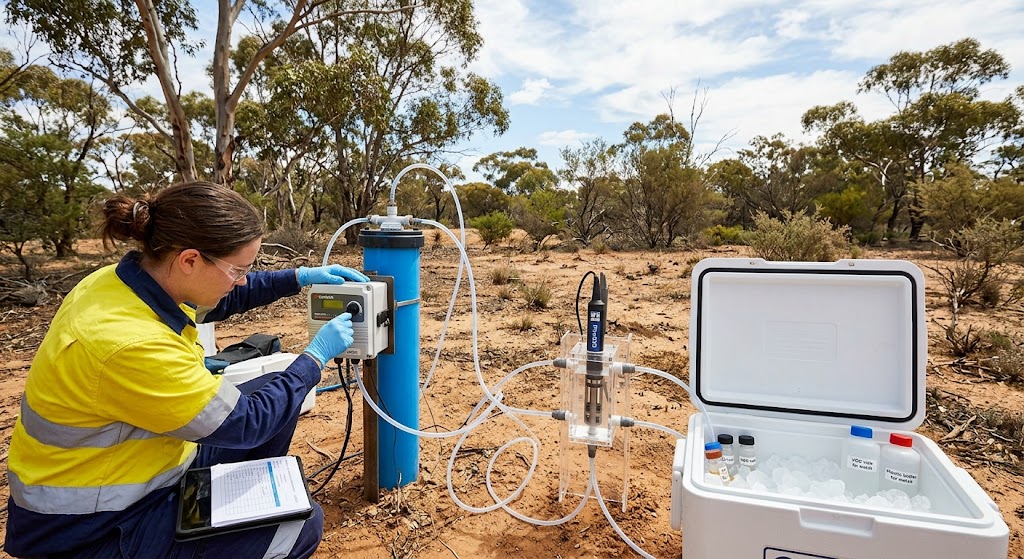
What is low-flow groundwater sampling and why is it used on contaminated sites in Australia?
Low-flow groundwater sampling purges monitoring wells at rates below 0.5 L/min to minimise drawdown and turbidity, producing dissolved-phase contaminant concentrations that accurately represent aquifer conditions. It is recommended as best practice by EPA Victoria (Publication 669.1), SA EPA, and NSW EPA, and is the standard method for contaminated land investigations, PFAS assessments, and hydrocarbon plume monitoring across all Australian states. Alongside low-flow, no-purge passive samplers — particularly the HydraSleeve and HydraSleeve SpeedBag — are now widely used for routine monitoring and due diligence work, where their speed and zero-purge-water profile deliver significant time and cost savings.
Why Traditional Purging Gives Inaccurate Results
For decades, Australian environmental practitioners relied on bailers and high-volume purging — extracting three to five well casing volumes with a disposable bailer or submersible pump before collecting a sample.
The logic seemed straightforward: flush out stagnant water and sample what is flowing from the aquifer. In practice, both approaches introduce serious problems.
Rapid bailer deployment causes surging within the well casing, aerating the water column, degassing volatile organic compounds (VOCs), and mobilising fine sediment.
Pumping at rates above 1 L/min creates similar turbulence, drawing in colloids and formation fines that adsorb metals and hydrophobic organics, artificially inflating analytical results. High-volume purging also depresses the water table around the well, potentially drawing water from a different part of the aquifer — or, in low-yielding bores, from near the surface. The result is a sample that reflects conditions inside the well bore, not the formation.
There is also the practical burden of purge water disposal. On a contaminated site, every litre of purge water requires classification, storage, and licensed disposal. A typical high-volume purge generates 50–200 litres of waste per well. Across a 12-well monitoring network sampled quarterly, the cost of waste disposal alone can reach $8,000–$15,000 per year — before laboratory fees are considered.
Low-flow sampling addresses these problems. By pumping at 100–500 mL/min from within the screened interval, field practitioners minimise drawdown, reduce turbidity, and collect samples that genuinely represent dissolved contaminants migrating through the aquifer.
The Science Behind Low-Flow Sampling
Low-flow sampling — also called micropurge sampling — draws on a simple principle: extracting water slowly from within the screened zone of a monitoring well creates minimal disturbance to the surrounding formation. The pump intake sits at mid-screen, sampling water from the most hydraulically active zone — the section most representative of the aquifer.
Rather than purging a fixed volume, low-flow sampling uses field parameter stabilisation as the trigger for sample collection. A flow-through cell connected to a multi-parameter probe continuously monitors six indicators:
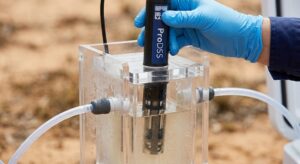
- pH — stabilisation criterion: ±0.1 units across three consecutive readings
- Electrical conductivity (EC) — ±3% across three consecutive readings
- Dissolved oxygen (DO) — ±0.3 mg/L across three consecutive readings
- Oxidation-reduction potential (ORP) — ±10 mV across three consecutive readings
- Turbidity — ≤10 NTU, or stabilised within ±10% across three consecutive readings
- Temperature — ±0.2°C across three consecutive readings
Once all parameters stabilise simultaneously — typically after purging as little as one well volume — sampling begins. This approach anchors sample collection to aquifer chemistry, not an arbitrary volume threshold, and produces data that is far more defensible under EPA scrutiny.
No-Purge Sampling: HydraSleeve and SpeedBag
Low-flow is not the only modern alternative to bailers and high-volume purging. Passive, no-purge samplers — the HydraSleeve and the HydraSleeve SpeedBag — are now widely used across Australia for routine monitoring and, increasingly, for due diligence investigations. Both are distributed locally by HydroTerra, Air-Met Scientific, Fieldtech, EcoEnvironmental, Enquip etc.
A standard HydraSleeve is a collapsible LDPE or HDPE sleeve with a self-sealing reed valve at the top. It is lowered empty into the screened interval, where hydrostatic pressure keeps it sealed. After the well has returned to ambient flow conditions, the sleeve is retrieved by a single upward pull — the valve opens, the sleeve fills with a “core” of formation water from the screened zone, and the valve re-seals at the surface. There is no pump, no purge water, no power, no flow cell, no probe calibration, and no decontamination of the sampler itself. It is single-use and disposable.
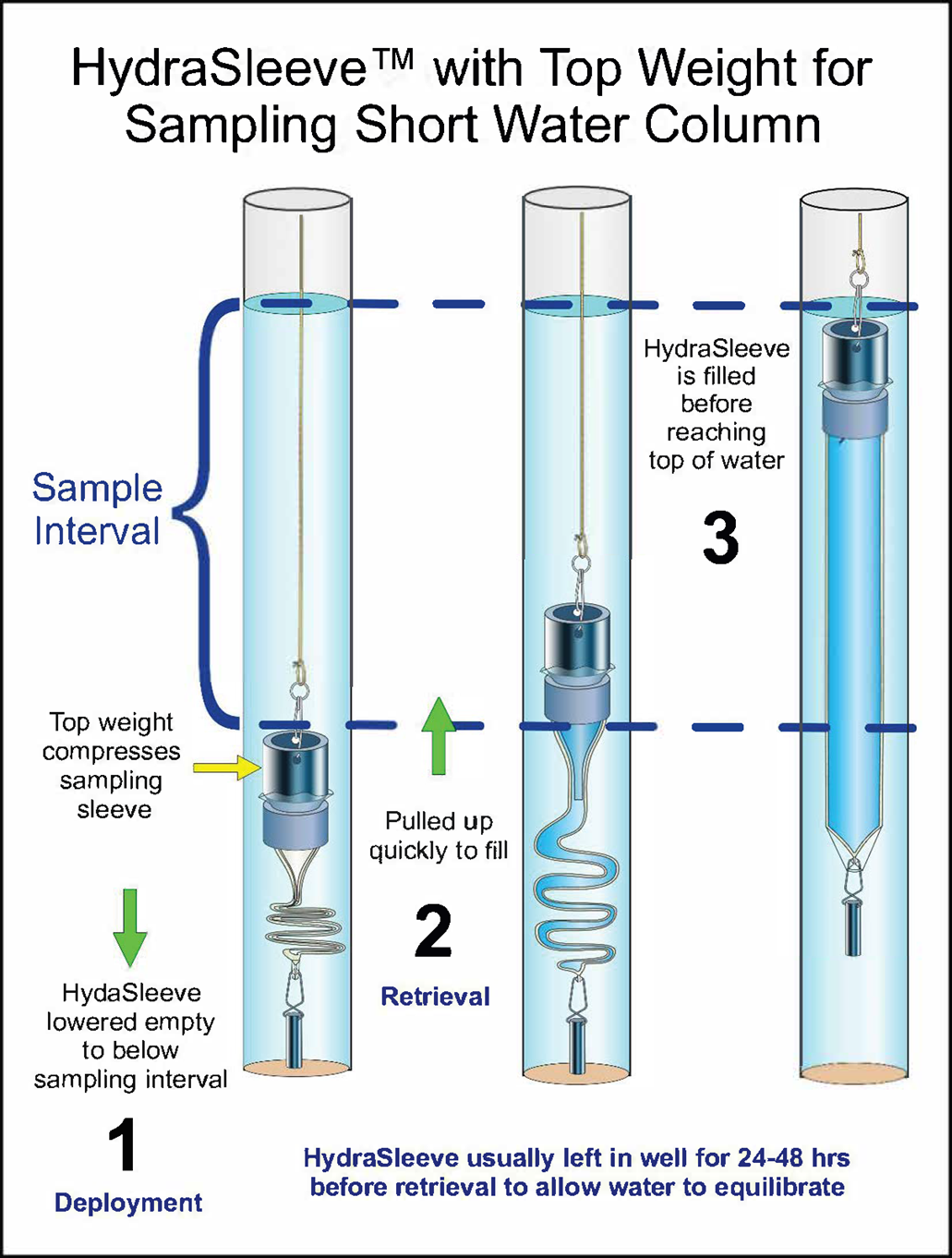
The HydraSleeve SpeedBag is a variant with two side ports above the check valve. Displacement water flushes through the ports during installation, which eliminates the equilibration wait and allows the SpeedBag to be deployed and retrieved on the same site visit — a 900 mL formation-quality sample from a 2-inch well, captured in minutes.
HDPE versions of both samplers contain no fluoropolymers, making them suitable for PFAS investigations under NEMP 3.0.
Speeding up routine and long-term monitoring
The strongest use case is routine compliance and post-remediation monitoring of established plumes. Dedicated standard HydraSleeves can be left permanently in each well between rounds, reducing each subsequent event to a simple retrieval and re-deployment. A 10-well monitoring round that previously took two field days with low-flow gear can typically be completed in a single morning by one person, with no purge water and no flow-cell setup.
Emerging application: due diligence
SpeedBags are increasingly used on Preliminary Site Investigations (PSI) and Detailed Site Investigations (DSI) where transaction timelines are tight and conventional sampling sits on the project’s critical path. Because there is no equilibration wait after sleeve installation, sampling can occur immediately after the well has been developed and allowed to clear of development turbidity — typically within the same field mobilisation rather than a return visit days later. For due diligence work, iEnvi’s standard practice is to pair the first SpeedBag round with a low-flow comparison event on a subset of wells, demonstrating method comparability up-front and satisfying auditor and EPA expectations under the NEPM (1999, as amended 2013) framework.
Eliminating the purge water disposal stack
Purge water disposal is one of the largest hidden costs on a contaminated site. A single low-flow event typically generates 5–20 litres of purge water per well, requiring containment, classification, and licensed offsite disposal at $0.80–$2.50 per litre. A 12-well quarterly programme can carry $8,000–$15,000 per year in disposal alone, before laboratory fees.
HydraSleeve and SpeedBag sampling generates no purge water. The only field waste is the disposable sleeve and any minor decontamination rinsate from the reusable weight. For contaminated sites where waste classification is part of the cost stack — and for ESG-reporting clients where the reduction in transport, treatment, and embodied energy is a defensible sustainability outcome — the saving is direct, measurable, and recurring.
Strengths and limitations
Strengths — minimal equipment, no purge water, no power requirements, well suited to remote, shallow, or low-yielding wells, very rapid field execution, dramatically lower per-event cost, smaller carbon footprint, repeatable depth-discrete grab sample, and (for SpeedBags) same-visit deployment and retrieval.
Limitations — no in-field stabilisation parameters collected during sampling, single grab rather than a flow-weighted average, unfiltered whole-water sample (turbidity must still be recorded separately for PFAS work), and careful sleeve placement is needed in stratified wells. For first-pass plume delineation events, where the data will define the conceptual site model, a paired low-flow round remains the more defensible baseline.
Equipment You Need in the Field
Choosing the right pump for your site conditions is critical.
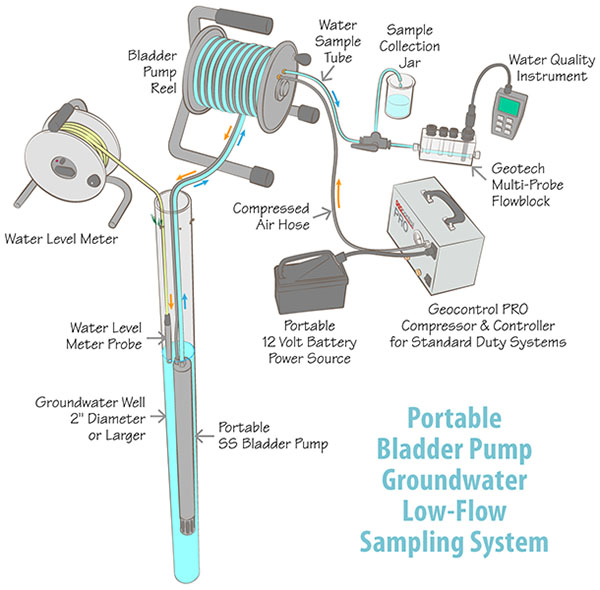
Bladder pumps are considered the gold standard for low-flow groundwater sampling. Compressed gas drives a flexible bladder that displaces water with minimal shear stress and no exposure to atmosphere. Bladder pumps handle volatile organic compounds (VOCs) without degassing, can operate at depths beyond 50 m, and are compatible with PFAS sampling because no pump materials contain fluoropolymers that could introduce contamination. Dedicated bladder pumps left permanently in each well eliminate cross-contamination risk and save significant setup time in the field. Budget $800–$1,500 per dedicated pump installation per well, plus installation costs.
Peristaltic pumps are suitable for shallow wells up to 8 m depth where negative suction can lift water to the surface. They are portable, straightforward to decontaminate, and cost-effective for small monitoring networks. However, peristaltic pumps are not appropriate for deep wells or for VOC sampling — the suction mechanism can cause degassing of volatile analytes, leading to underestimation of dissolved concentrations.
Supporting equipment includes: a flow-through cell (to hold the parameter probe sealed from atmosphere), a calibrated multi-parameter probe (e.g., YSI Pro Plus or In-Situ Aqua TROLL), silicone or PTFE tubing, Teflon-lined sample containers, a calibrated flow metre, and a field data sheet or electronic field tablet for real-time data capture.
Step-by-Step Low-Flow Sampling Procedure
- Pre-sampling preparation. Calibrate all probe sensors — pH, EC, DO, ORP, turbidity — using fresh calibration solutions before leaving for site. Confirm pump function, flow metre readings, and tubing integrity. Prepare the chain of custody (CoC) forms and confirm laboratory bottle requirements, preservatives, and maximum hold times for each analyte.
- Water level measurement. On arrival, measure depth to water in each well using a calibrated electronic water level metre before disturbing the well. Record water levels relative to the top of casing (TOC) datum. These pre-purge water levels contribute to groundwater flow mapping and are required for most EPA reporting formats.
- Pump installation. Lower the pump intake to approximately the midpoint of the screened interval. For a 1-metre screen between 5.0 m and 6.0 m below ground level (BGL), position the intake at 5.5 m BGL. Secure pump tubing at the surface to prevent displacement during pumping.
- Begin pumping at low flow rate. Start the pump at 100–200 mL/min. Verify the actual flow rate using a graduated cylinder and stopwatch — do not rely solely on pump dial settings, as hose wear and tubing resistance affect real output. Record the start time and initial parameter readings.
- Connect the flow cell and probe. Route the discharge tubing through the flow-through cell before the sample collection point. Ensure the cell is sealed from atmosphere to prevent CO₂ exchange, which otherwise distorts pH and DO readings. Record parameters at 3–5 minute intervals.
- Monitor parameter stabilisation. Continue monitoring until all six parameters meet the stabilisation criteria across three consecutive readings. Record all readings in the field log. If turbidity remains above 10 NTU after extended purging, reduce the pump rate further and document the condition — it may indicate a poorly developed or damaged well requiring remediation.
- Collect samples in the correct analytical sequence. Once parameters are stable, collect samples without delay in this order: (1) VOCs in preserved headspace vials — fill to the brim with zero headspace; (2) metals in acid-preserved polyethylene bottles; (3) anions, general chemistry, and other analytes. This sequence preserves sample integrity by minimising degassing and oxidation artefacts.
- Label, preserve, and ice samples. Label each container immediately with site code, well ID, sample depth interval, collection date, and time. Apply any field preservation specified by the laboratory. Place samples in an insulated icebox at 4°C within 30 minutes of collection.
- Record final water level and purge volume. Measure water level immediately after pumping ceases to document drawdown. Calculate total purge volume and record it for the site file and regulatory reporting.
- Decontaminate equipment. For portable pumps: triple-rinse all wetted components with deionised water between wells. On sites with cross-contamination risk — particularly where PFAS, chlorinated solvents, or heavy metals are present — use a laboratory-grade decontamination solution such as Liquinox, followed by deionised water rinse. Collect rinsate in a labelled container for disposal. Never skip decontamination between wells on a contaminated site.
- Complete the chain of custody. Sign and date the CoC form, record the number of containers per sample and their preservation method, then seal the icebox with tamper-evident tape. The CoC must accompany samples to the laboratory without interruption — any gap in custody weakens the evidentiary value of results.
What the Comparative Studies Show
The question of which method produces the “true” formation concentration has been studied extensively. The general findings:
Bailers vs pumps. Imbrigiotta et al. (1988), Tai et al. (1991), and Puls and Powell (1992) demonstrated that bailers tend to under-report VOCs (aeration and degassing losses) and over-report metals (turbidity from surging). These studies underpin the US EPA’s move away from bailers for compliance work and influence Australian state EPA guidance. A 1994–1995 Wisconsin landfill study did, however, find only small differences between carefully operated bailers and low-flow pumps for VOCs — operator skill matters.
Low-flow vs no-purge. Parker et al. (2002) ran spiked standpipe trials and found no-purge samplers (HydraSleeve included) produced statistically equivalent results to discharge-spigot samples taken at the same depth. The USGS Camp Edwards study (Massachusetts Military Reservation, 2009–2010) found HydraSleeve results comparable to low-flow pumping for ordnance-related compounds including RDX, HMX, and perchlorate. Britt et al. (2010) and Vroblesky et al. (2007) reported that passive samplers can return higher VOC concentrations than low-flow pumping in some settings, attributed to the absence of any pump-induced degassing.
All three methods compared. Montgomery & Associates compared 3-volume purge, low-flow, and HydraSleeve sampling across 35 wells at a closed western US mine site. Low-flow and HydraSleeve agreed closely. The 3-volume purge produced significantly higher arsenic concentrations — likely a drawdown-induced pyrite oxidation artefact rather than a true formation signal. The study is a useful demonstration that legacy high-volume purging can systematically over-report redox-sensitive metals.
Bottom line. For most analytes in most wells, low-flow and HydraSleeve produce statistically comparable, formation-representative results. Bailers and 3- to 5-volume purging both introduce method-specific biases that can mask or exaggerate real contamination. Method selection should be driven by analyte suite, well yield, regulatory context, and long-term monitoring economics; not by inertia.
Method VOCs Metals PFAS Field time Purge water EPA acceptance (AU) Bailer Poor (degassing) Poor (turbidity) Poor Fast Moderate Discouraged for compliance High-volume pump purge Variable Risk of bias Poor Slow High (50–200 L) Legacy only Low-flow bladder pump Excellent Excellent Excellent Moderate Low (5–20 L) Preferred / mandated Peristaltic pump (low-flow) Limited (suction degassing) Good (≤8 m only) Acceptable Moderate Low Accepted for shallow wells HydraSleeve / SpeedBag Good–excellent Good (whole-water) Good (HDPE) Very fast None Accepted on justified, site-specific basis
Regulatory Context in Australia
Low-flow groundwater sampling is mandated or strongly recommended across all Australian jurisdictions:
Victoria: EPA Victoria Publication 669.1 — Groundwater Sampling Guidelines — prescribes low-flow micropurge as the default methodology for contaminated land investigations. It specifies stabilisation criteria, equipment requirements, and documentation standards. Practitioners operating under Site Management Orders or audit certificates must demonstrate compliance with Publication 669.1 methodology.
South Australia: The SA EPA Guidelines for Regulatory Groundwater Sampling require low-flow technique for all compliance monitoring activities, with stabilisation criteria closely aligned with EPA Victoria 669.1.
New South Wales: The NSW EPA Sampling Design Guidelines and Guidelines for the Assessment and Management of Groundwater Contamination recommend low-flow as best practice, particularly for PFAS, chlorinated solvent, and LNAPL investigations.
PFAS NEMP 3.0 (March 2025): The PFAS National Environmental Management Plan Version 3.0 specifically addresses groundwater sampling quality assurance for PFAS investigations. It requires low-flow technique to minimise colloid-facilitated transport of PFAS compounds and mandates that turbidity be recorded alongside all PFAS groundwater results. Given that PFAS compounds bind strongly to colloids mobilised by turbulent pumping, low-flow sampling is non-negotiable for defensible PFAS data sets used in risk assessments or regulatory compliance reporting.
Common Questions
How long does low-flow purging actually take compared to traditional methods?
Most wells stabilise within 20–45 minutes of low-flow pumping, though highly responsive aquifers may stabilise in under 10 minutes. Poorly developed wells or those with fine-grained formation materials may take longer. If a well does not stabilise after 60 minutes, reduce the flow rate further and document the anomaly. In practice, a trained two-person field team can complete a 10-well monitoring round in a single day — comparable to, or faster than, high-volume purging once reduced purge water volumes and faster decontamination are factored in.
Do we need dedicated pumps installed in every well, or can portable equipment be shared?
Both approaches are valid. Dedicated pumps eliminate cross-contamination risk entirely, reduce field time, and are strongly preferred by EPA auditors in Victoria and South Australia. They are particularly important on sites with mixed contamination — for example, PFAS co-located with hydrocarbons — where decontamination between wells is complex. Portable pump setups are appropriate for lower-risk sites with homogeneous contamination, provided a rigorous, documented decontamination procedure is followed between each well and a rinsate blank is collected periodically to verify efficacy.
How do we manage purge water collected during low-flow sampling?
On contaminated sites, purge water is typically stockpiled in labelled, sealed containers for licensed disposal by a permitted waste contractor at approximately $0.80–$2.50 per litre depending on contamination type and location. On some sites with an approved site management plan, small volumes may be returned to ground. For monitoring wells where prior data consistently shows clean groundwater, discharge to trade waste or approved stormwater may be acceptable — but always confirm in writing with the relevant EPA before proceeding. Never assume purge water from a contaminated site is suitable for discharge without analytical evidence and regulatory sign-off.
When should we use HydraSleeve or SpeedBag instead of low-flow?
For routine and long-term monitoring of established plumes — particularly remote sites, low-yielding wells, and large monitoring networks — dedicated HydraSleeves typically deliver the best combination of data quality, field speed, and cost.
For due diligence PSI and DSI work on tight transaction timelines, SpeedBags allow same-mobilisation sampling and avoid the cost stack of purge water classification and disposal — particularly effective when paired with a single low-flow comparison round to demonstrate comparability for the auditor.
Low-flow remains preferable for first-pass plume delineation, regulatory baseline events, sites under audit where the auditor or EPA has specified low-flow methodology, and any programme where a defensible flow-weighted concentration with full stabilisation parameters is required.
How iEnvi Can Help
iEnvironmental Australia’s field teams conduct groundwater sampling across all Australian states, operating to EPA Victoria Publication 669.1 and equivalent state-specific guidelines. Our CEnvP-qualified environmental scientists select the right method for each site — low-flow bladder pumps for high-priority compliance wells, peristaltic low-flow for shallow networks, and HydraSleeve or SpeedBag passive samplers for remote, low-yielding, or cost-sensitive long-term monitoring programmes. On mixed-method programmes, we typically pair an initial low-flow event with subsequent passive rounds to demonstrate comparability and satisfy EPA expectations.
All samples are dispatched same-day to NATA-accredited laboratories with fully signed chain of custody documentation.
Contaminated land investigation | Groundwater remediation services | Talk to iEnvi
For innovative solutions that are focussed on giving you the very best outcome, contact our expert team of environmental consultants today.
Need advice on this issue? iEnvi provides practical, senior-led environmental consulting across contaminated land, remediation, ecology and environmental risk.
Contaminated land advice Remediation services Groundwater services Site investigation services Talk to iEnvi