
MDBA Water Quality Warning: Post-Fire Contamination and Algal Blooms
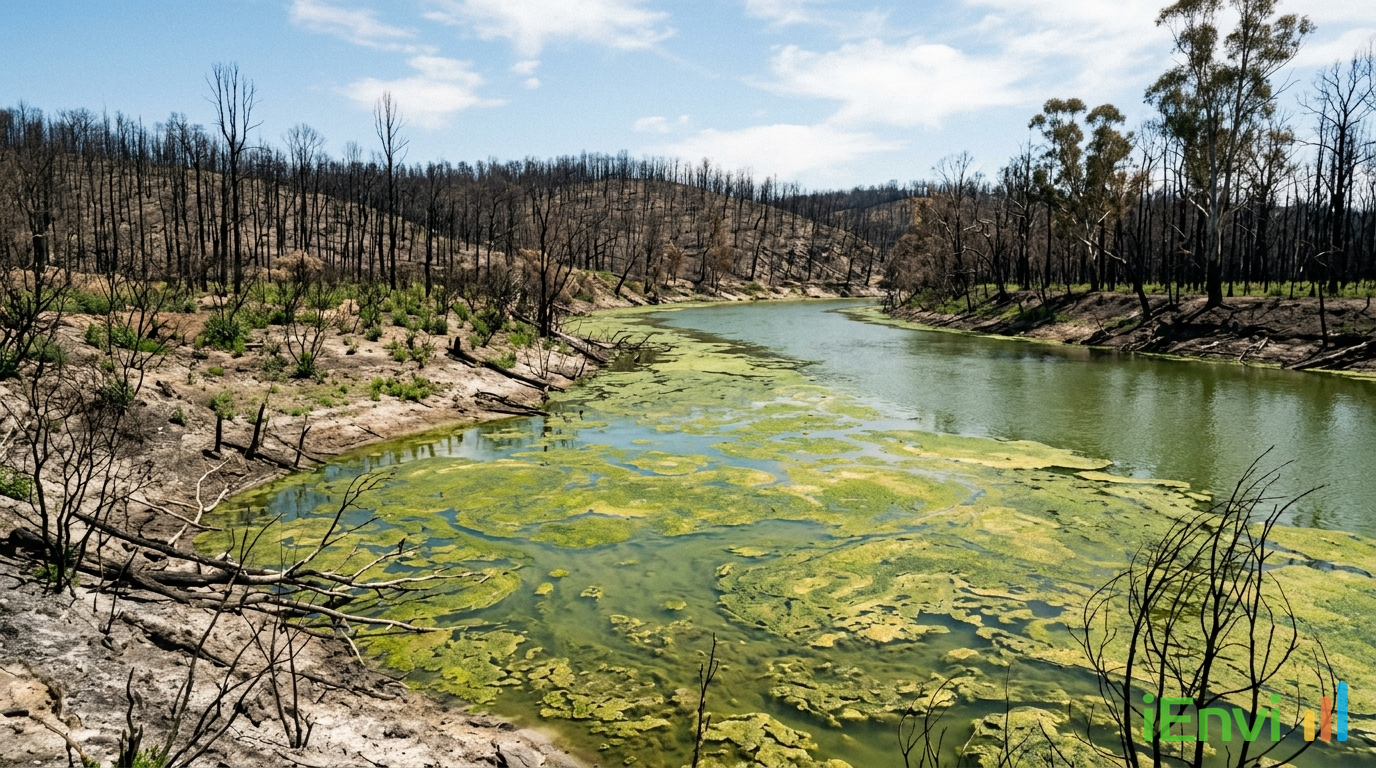
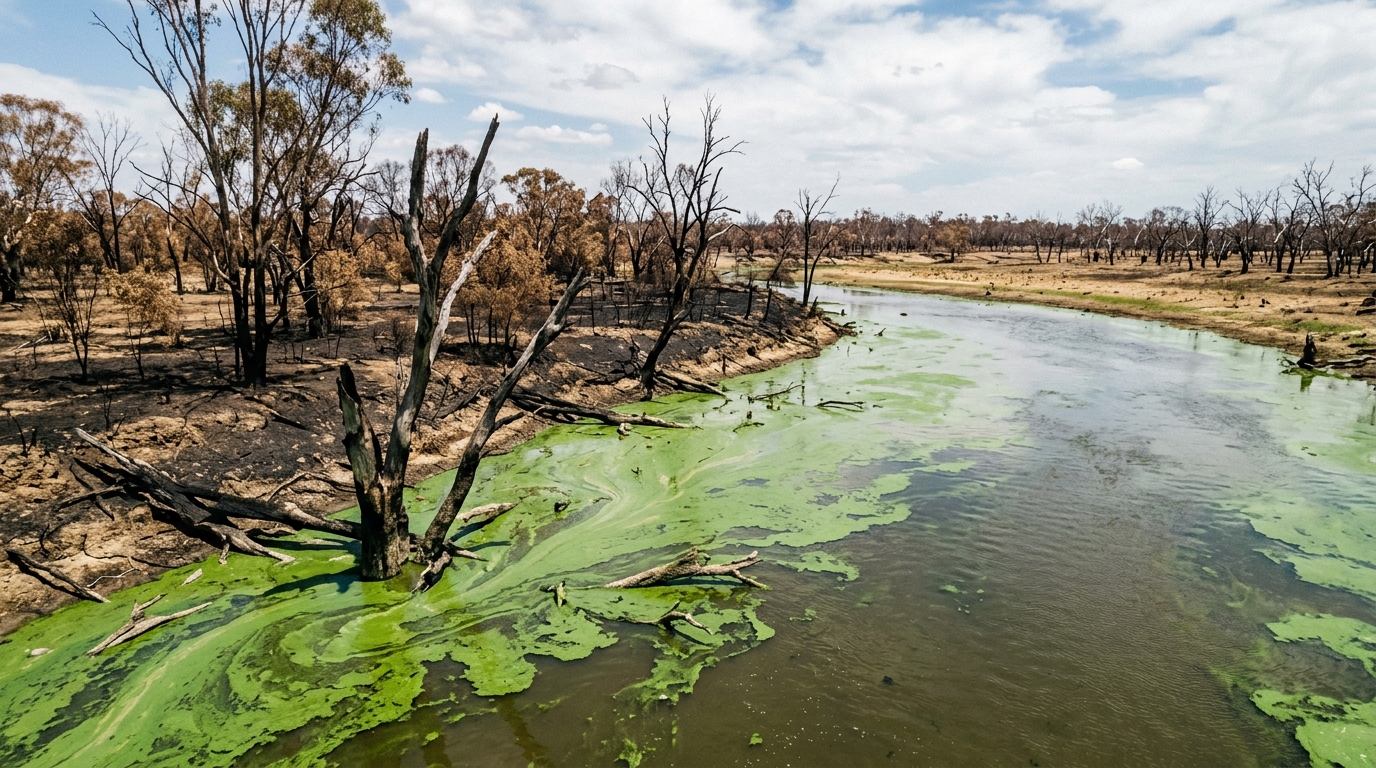
On 15 April 2026, the Murray-Darling Basin Authority (MDBA) released a basin-wide water quality update warning of severe, compounding threats to aquatic ecosystems across New South Wales and Victoria. The update flags two distinct but simultaneous hazards: acute post-fire contamination driven by rainfall-mobilised ash, debris, and topsoil entering the upper Murray and Mitta catchments, and dangerously elevated blue-green algae levels persisting across the NSW central-north, Menindee and lower Darling regions, mid-Murray, and Victorian central-north. Together, these events present a complex water quality challenge for the Basin, precisely because neither hazard is operating in isolation.
For environmental consultants, water quality specialists, and ecologists working in or adjacent to these catchments, the implications are immediate. Post-fire runoff does not simply carry sediment and carbon. Vegetation accumulates heavy metals, including lead, arsenic, and manganese, over decades of growth, and when burned, those metals concentrate into the residual ash. As elements rather than organic compounds, they cannot be destroyed by combustion; instead, they become far more bioavailable in ash form than they were in living vegetation. Rainfall then mobilises this ash as a highly concentrated, transient toxicant load. When this load reaches receiving waterways already stressed by elevated water temperatures and algal bloom conditions, the combined effect on aquatic ecosystem health is substantially worse than either stressor would produce independently.
Clients operating in or discharging to these catchments, whether they are irrigators, municipal water authorities, local councils, industrial operators, or infrastructure developers, face an immediate compliance risk that is not of their making but is nonetheless their responsibility to characterise and manage. Understanding the nature of these contamination events, and adjusting monitoring and assessment programmes accordingly, is not optional for those operating under environmental licences or development conditions that require surface water quality compliance.
Key details of the MDBA April 2026 water quality warning
The MDBA’s 15 April 2026 update specifically identifies the upper Murray and Mitta regions as the most acutely affected areas for post-fire contamination. Rainfall across recently burnt catchments is transporting ash, topsoil, and debris directly into these waterways. The concern is not just turbidity or sediment loading, which are themselves significant ecological stressors, but the acute delivery of heavy metals that have been chemically concentrated through the combustion process. Lead, arsenic, and manganese are specifically relevant because they accumulate in plant tissue over time and, as elemental metals, are not destroyed by fire. Instead, they become far more bioavailable in ash form than they were in living vegetation.
The ANZG 2018 guidelines, formally the Australian and New Zealand Guidelines for Fresh and Marine Water Quality, establish default guideline values (DGVs) for a range of physical, chemical, and toxicological parameters in aquatic ecosystems. These DGVs are typically expressed as trigger values for ecosystem protection at specified levels of protection, most commonly 80%, 90%, 95%, and 99% species protection. For freshwater ecosystems, the DGVs for metals such as arsenic, manganese, and lead vary with hardness and pH, meaning they are not single fixed numbers but values that shift with ambient water chemistry. Post-fire ash mobilisation introduces acute spikes in these parameters that can exceed even the 80% species protection DGVs within hours of a significant rainfall event, creating exceedances that are real but temporally brief and spatially concentrated near inflow points.
Simultaneously, the MDBA has confirmed that blue-green algae levels remain dangerously elevated across four distinct regions: NSW central-north, the Menindee and lower Darling areas, the mid-Murray, and Victorian central-north. Blue-green algae, more precisely cyanobacteria, proliferate under conditions of elevated water temperature, reduced flow velocity, and elevated nutrient availability. All three of those drivers are currently present. Warmer conditions reduce the thermal stratification that would otherwise limit bloom development, and post-fire nutrient loads, particularly phosphorus and nitrogen flushed from burnt catchments, provide exactly the fuel that cyanobacterial communities require to sustain and expand blooms. Some cyanobacterial species produce hepatotoxins and neurotoxins, including microcystins and cylindrospermopsin, that are acutely dangerous to livestock, wildlife, and humans at very low concentrations.
The compounding nature of these two hazards creates a monitoring challenge that goes beyond what either event would require independently. Sediment and ash loads increase turbidity, which can interfere with optical monitoring equipment used in continuous water quality logging. Algal biomass and associated organic matter can also affect metal speciation in the water column, influencing how dissolved metals behave relative to the ANZG 2018 DGVs, which are primarily expressed for dissolved fractions. Practitioners using total recoverable metal results without accounting for this speciation shift may overestimate or, in some cases, underestimate bioavailable metal concentrations relative to the applicable guideline values.
Australian regulatory context for post-fire catchment contamination and algal bloom management
Australian surface water quality management operates across a layered regulatory framework. At the national level, the ANZG 2018 guidelines provide the primary technical basis for setting water quality objectives and interpreting monitoring data for aquatic ecosystem protection. These guidelines replaced the earlier ANZECC/ARMCANZ 2000 framework and introduced a more risk-based approach to guideline application, explicitly recognising that DGVs are triggers for investigation rather than absolute standards. At the state level, legislation such as the NSW Water Management Act 2000 and the Victorian Water Act 1989 establishes the statutory obligations within which licence holders and approval conditions operate, with water quality provisions enforced by the NSW Environment Protection Authority and the Victorian Environment Protection Authority respectively. This layered structure means that a contamination event of the type currently unfolding across the Basin engages obligations at multiple regulatory levels simultaneously.
References and related sources
- Primary source: www.mdba.gov.au
- ANZG Water Quality Guidelines
How iEnvi can help
iEnvi provides specialist consulting services relevant to this topic. Our team includes CEnvP Site Contamination Specialists with experience across contaminated land, groundwater, remediation, ecology, and regulatory compliance.
- iEnvi contaminated land investigation services
- iEnvi remediation and validation services
- iEnvi expert services and independent review services
This is an iEnvi Machete news summary. Prepared by iEnvi to summarise the source article for contaminated land, groundwater, remediation, approvals and site risk professionals.
Published: 19 Apr 2026
Need advice on this topic? Speak to an iEnvi expert at info@ienvi.com.au or 1300 043 684, or contact us online.
Need advice on this issue? iEnvi provides practical, senior-led environmental consulting across contaminated land, remediation, ecology and environmental risk.
Team credentials Contaminated land services Remediation services Groundwater services Talk to iEnvi