

How MIT’s weight-space programming lifted a small model’s MATH-500 score from 7.9% to 48.1%
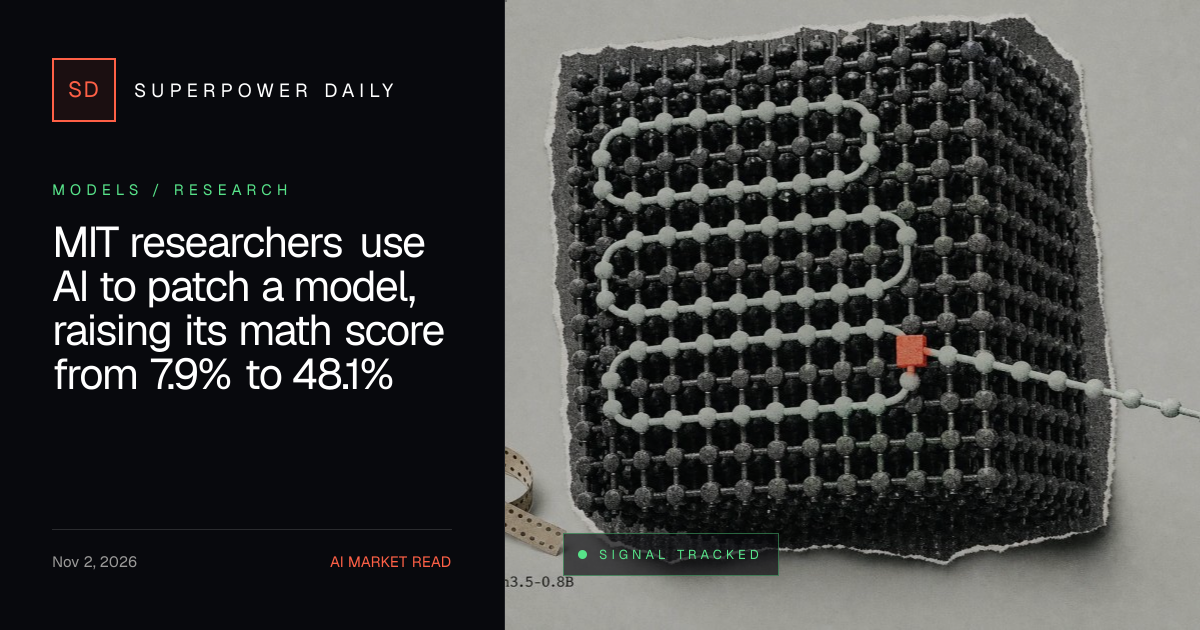
Researchers at the Massachusetts Institute of Technology Computer Science and Artificial Intelligence Laboratory (MIT CSAIL) have shown that a large language model can read the numerical weights of another neural network and rewrite them directly to improve its performance. No retraining was involved. The work is described in a technical report titled “Sparks of Weight-Space Programming: LLMs can natively read & write neural network weights” by Rikiya Takehi, Jayden Teoh, Alex Zhang and Omar Khattab. In the main demonstration, OpenAI’s GPT-6 Astra diagnosed and repaired Alibaba’s open-weight Qwen3.5-0.8B model by changing 0.016% of its weights. This lifted its MATH-500 benchmark accuracy from 7.9% to 48.1%. VentureBeat reported the work on 2 November 2026.
The researchers call the approach weight-space programming. Fine-tuning and distillation normally improve a model by running gradient descent and backpropagation over curated datasets, often on substantial GPU clusters. In this study, Astra inspected the smaller model’s internal parameters, identified the cause of a specific failure and edited the responsible weights directly. Yuchen Jin, a technical staffer at Databricks and former co-founder and CTO of Hyperbolic Labs, described it as “like gene editing for neural networks”. Chandan Singh, a staff researcher at Voyage AI and formerly of Microsoft AI, said that people questioning whether the work was overhyped were “actually underselling the approach”.
This is AI research, not environmental science, and the source makes no claims about environmental applications. Its relevance to Australian environmental consultants, developers, lawyers and councils is indirect but practical. Language models are already used across professional services for document review, data extraction and report drafting. Small models that run on local hardware appeal to organisations that want to keep client data off third-party cloud services. A technique that makes those small models easier to repair also makes it easier to change them after they have been deployed. That has consequences for how AI-assisted work is quality-assured and documented.
What Astra changed: two layers, 131,072 weights and gains on three benchmarks
Before the intervention, Qwen3.5-0.8B fell into reasoning loops on 93% of MATH-500 attempts. It repeated itself until it used up its full 32,768-token context window without producing an answer. Astra diagnosed this as a degenerative repetition pattern in the model’s internal representations. It isolated the vector associated with the repetition and subtracted it from the relevant weights. The fault was behavioural: the model often could not finish its reasoning because it got stuck in a loop.
The edit was narrow. Astra modified 64 output projection columns in the multi-layer perceptron (MLP) down-projection weights of two layers, layer 15 (model.language_model.layers.15.mlp.down_proj.weight) and the equivalent tensor in layer 19. That came to 131,072 parameters, or 0.016% of the model. Gradient descent, backpropagation and conventional fine-tuning loops were not used at any stage. Every other weight in the model was left unchanged.
The reported benchmark results after the edit were:
- MATH-500 (competition-style mathematics): 7.9% before, 48.1% after, roughly a sixfold increase.
- GSM8K (school-level maths word problems): 13.8% before, 67.1% after.
- IFEval (instruction following): 21.0% before, 62.3% after, roughly a threefold increase.
The uplift on IFEval shows the repetition fault was not limited to mathematical tasks. It was also degrading the model’s ability to follow instructions. The MIT team was explicit about the limits of the result. The edit removed a known behavioural bottleneck. It did not give the model mathematical knowledge it did not already have. The capability was latent in the model and was being blocked by the looping behaviour.
The process was not instantaneous. Astra worked inside a sandboxed Python execution environment over a 20.3-hour session, which involved 158 conversational turns, 80 Python runs and 50 forward evaluation batches. For a model of 0.8 billion parameters, that is not necessarily faster or cheaper than a conventional fine-tune. The difference is the nature of the change. It is confined to a known set of tensors, it can be described precisely, and it can in principle be inspected and reversed. A fine-tune typically shifts weights across the whole network in ways that are hard to attribute to any single behaviour.
Australian context
Australian guidance on AI use in business and professional services is mostly principles-based rather than prescriptive. The Voluntary AI Safety Standard, released by the Department of Industry, Science and Resources in September 2024, sets out ten guardrails. Several apply directly to a model whose weights have been edited by another AI system. These include testing and monitoring of AI systems, transparency across the AI supply chain, and record keeping that allows a third party to assess compliance. A small model that has been “patched” upstream by a vendor, or by an automated process, creates exactly the supply-chain transparency question the standard anticipates. Australia’s AI Ethics Principles, published in 2019, set similar expectations on transparency, contestability and accountability.
Privacy obligations are one reason local models are attractive. Under the Privacy Act 1988, Australian Privacy Principle 8 governs cross-border disclosure of personal information. Many cloud AI services process data offshore. Consultancies, law firms and councils handling landholder details, tenant information or commercially sensitive due diligence material may prefer models that run on their own infrastructure. Research that makes small, locally hosted models more capable and easier to fix supports that preference. It also means these organisations may increasingly receive models that have been modified after release, and will need records showing what was changed, by whom and when.
References and related sources
- Primary source: venturebeat.com
- wikipedia.org
- superpowerdaily.com
- github.io
- slashdot.org
How iEnvi can help
iEnvi integrates technology and data-driven approaches into environmental consulting. We monitor AI and technology developments that affect how environmental professionals deliver services to clients.
This is an iEnvi Machete news summary. Prepared by iEnvi to summarise the source article for environmental professionals tracking AI, data, and technology developments that affect consulting and project delivery.
Published: 04 Nov 2026
Need advice on this topic? Speak to an iEnvi expert at info@ienvi.com.au or 1300 043 684, or contact us online.
Need advice on this issue? iEnvi provides practical, senior-led environmental consulting across contaminated land, remediation, ecology and environmental risk.