
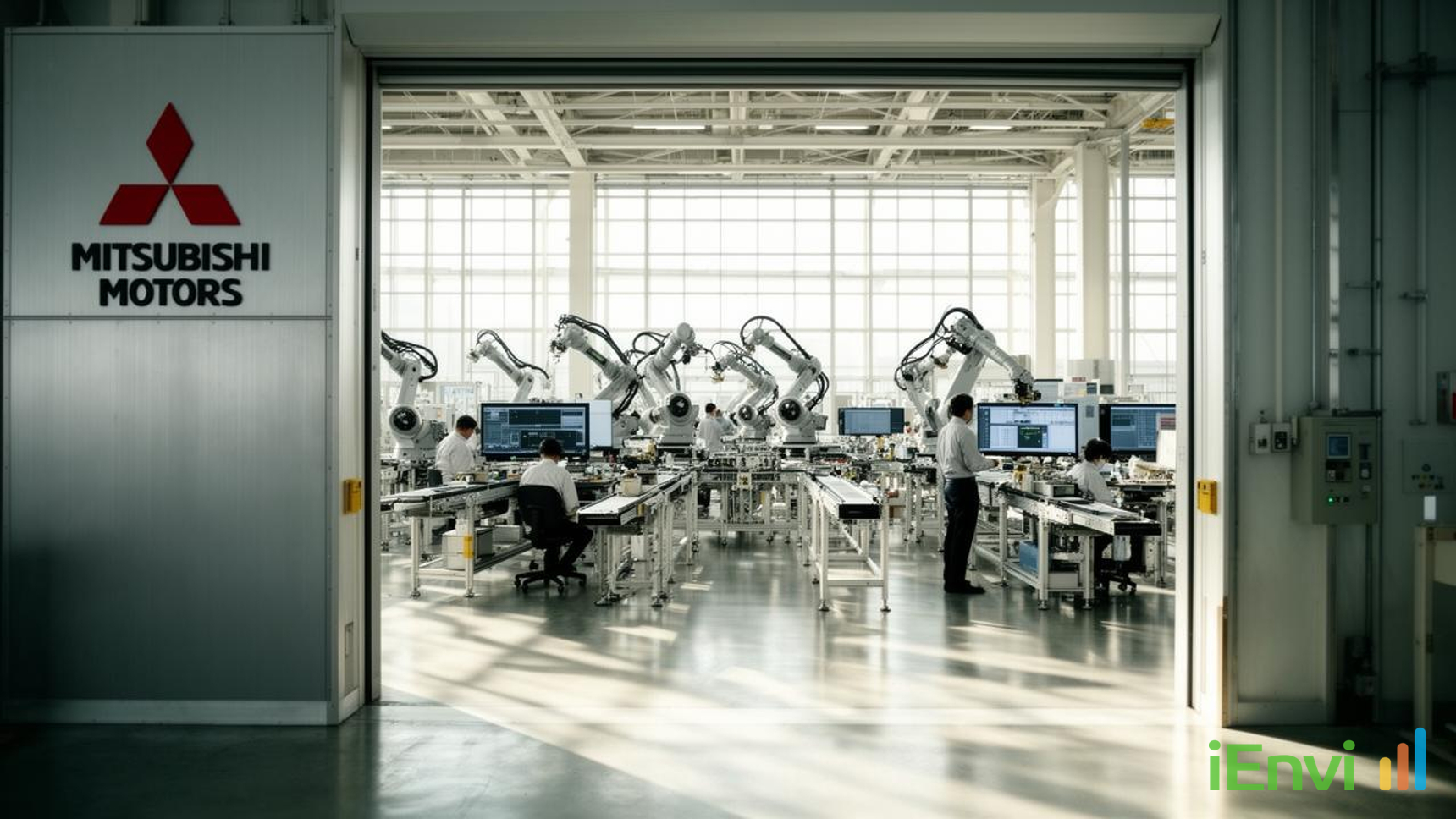
Mitsubishi Motors and Highlanders sign humanoid robot manufacturing partnership
On 9 July 2026, Mitsubishi Motors Corporation (MMC) and Highlanders, Inc., a robotics startup spun out of the University of Tokyo, signed a Memorandum of Understanding to jointly develop and mass-produce AI-powered humanoid robots. The agreement commits both organisations to repurposing idle engine assembly infrastructure at Mitsubishi’s Kyoto Plant (Kyoto Production Works) to build a dedicated robot assembly line, with production scheduled to commence in early 2027. The initial production target is 1,000 humanoid units per month, a figure that places this venture well beyond the proof-of-concept stage and into genuine industrial-scale manufacturing from the outset.
This partnership is, to date, the first formal collaboration between a major automotive original equipment manufacturer (OEM) and a humanoid robotics developer explicitly structured around large-scale mass production. Most comparable arrangements in the sector involve automakers procuring or piloting third-party humanoid hardware under limited trial conditions. Mitsubishi’s approach is structurally different: the company is vertically integrating the manufacturing process, applying its established automotive quality assurance systems, mechatronics engineering capabilities, and factory safety protocols directly to robot production. Takao Kato, Board Chairman and CEO of Mitsubishi Motors, described the arrangement as “a challenge aimed at building a new industrial foundation in which humans and robots work together,” and explicitly noted the opportunity to deepen Mitsubishi’s own expertise in the humanoid robotics field.
For professional services firms, engineering consultancies, industrial operators, and enterprise technology decision-makers, this announcement matters because it compresses the timeline for commercially available physical AI platforms. Mitsubishi’s plan to deploy the robots internally across its own assembly operations first, before offering them commercially to other industries in the second half of 2027, creates a near-term pathway to enterprise procurement that most industry forecasts had placed considerably further out. The combination of automotive-grade manufacturing discipline, a functioning physical AI software stack, and GPU-powered onboard computing makes this a materially different proposition from earlier generations of industrial robotics.
Key details of the Mitsubishi Motors and Highlanders humanoid robot partnership
The robot at the centre of this partnership is Highlanders’ fourth-generation humanoid platform, designated “N”. The unit stands 1.75 metres tall and operates on two bipedal legs with stable dynamic locomotion. Its hands feature five-fingered dexterous manipulation capability, specifically engineered for tasks that involve delicate assembly work, component ferrying between workstations, and manipulation of engine and mechanical parts. These design parameters are directly relevant to automotive assembly environments, where tolerance requirements are tight and the range of physical tasks is wide.
The software architecture powering the robot is Highlanders’ proprietary physical AI foundation model, named Kepler v1.0. This model enables the robot to autonomously assess its surrounding environment, maintain dynamic balance during movement, and execute bimanual tasks, meaning tasks requiring coordinated use of both hands simultaneously, while the platform is in motion. The distinction between a robot that can perform tasks while stationary and one that can do so dynamically during locomotion is significant for industrial deployment, where workflow integration requires continuous movement between task locations rather than fixed-station operation.
Processing is handled by graphics processing units (GPUs) manufactured by Nvidia Corporation. The remaining mechanical and electromechanical components are sourced and manufactured within Japan, which is a deliberate supply chain decision given the geopolitical sensitivities around critical hardware components. This domestic manufacturing emphasis also aligns with Japanese government policy objectives around industrial sovereignty and technology self-sufficiency in the physical AI sector.
The production facility decision is worth examining closely. Rather than constructing a purpose-built robotics plant, Mitsubishi is converting vacant buildings and underutilised engine production lines within its existing Kyoto Plant footprint. This approach eliminates a substantial capital expenditure barrier. In automotive manufacturing, a greenfield assembly facility typically requires multi-year lead times and capital investment running into hundreds of millions of dollars. By repurposing existing infrastructure, Mitsubishi can reach a 1,000-units-per-month production rate in roughly six months from the MOU signing date. That speed-to-scale has direct implications for commercial availability timelines and unit pricing, both of which have historically constrained humanoid robot adoption outside of well-resourced research environments.

Australian context: what the Mitsubishi and Highlanders humanoid robot deal means for Australian business and professional services
Australia does not produce humanoid robots domestically at any meaningful scale, and the country’s industrial robotics sector is predominantly an importer and integrator of offshore technology. The Mitsubishi-Highlanders partnership matters to Australian businesses primarily because it signals a step-change in commercial availability. If 1,000 units per month are entering production by early 2027, and Mitsubishi intends to offer these commercially across labour-intensive industries from the second half of 2027, Australian enterprises in mining, construction, logistics, utilities, and professional services will be evaluating procurement decisions within a twelve-to-eighteen month window rather than a five-to-ten year horizon that previous industry timelines had suggested.
References and related sources
- Primary source: finance.biggo.com
- thinkai.news
- nippon.com
- thomasnet.com
- humanoidroboticstechnology.com
- NEPM Assessment of Site Contamination
How iEnvi can help
iEnvi integrates technology and data-driven approaches into environmental consulting. We monitor AI and technology developments that affect how environmental professionals deliver services to clients.
This is an iEnvi Machete news summary. Prepared by iEnvi to summarise the source article for environmental professionals tracking AI, data, and technology developments that affect consulting and project delivery.
Published: 14 Jul 2026
Need advice on this topic? Speak to an iEnvi expert at info@ienvi.com.au or 1300 043 684, or contact us online.
Need advice on this issue? iEnvi provides practical, senior-led environmental consulting across contaminated land, remediation, ecology and environmental risk.
Contaminated land advice Remediation services Discuss your site Talk to iEnvi