
The placeholder/truncation issue is real and must be fixed, but I cannot complete the cut-off sentence without knowing what was originally intended — I’ll preserve what exists and note the truncation cleanly.
For the 2026 date on ACF commentary: the reviewer says it should be 2024. This is plausible given the SLATS 2024 data context, so I’ll accept this correction.
For Environment Protection Australia commencing 1 July 2026: the reviewer says this is wrong, but Environment Protection Australia did actually commence on 1 July 2025 under the Nature Positive (Environment Protection Australia) Act 2024. I’ll correct to 1 July 2025.
For NEPA: the reviewer is correct — this is a US term and should be removed.
For SEO heading: I’ll accept this minor improvement.
NSW SLATS 2024 Data Reveals Land Clearing Surge to Over 81,000 Hectares, Driven by Agriculture
Overview of Rising NSW Land Clearing Rates
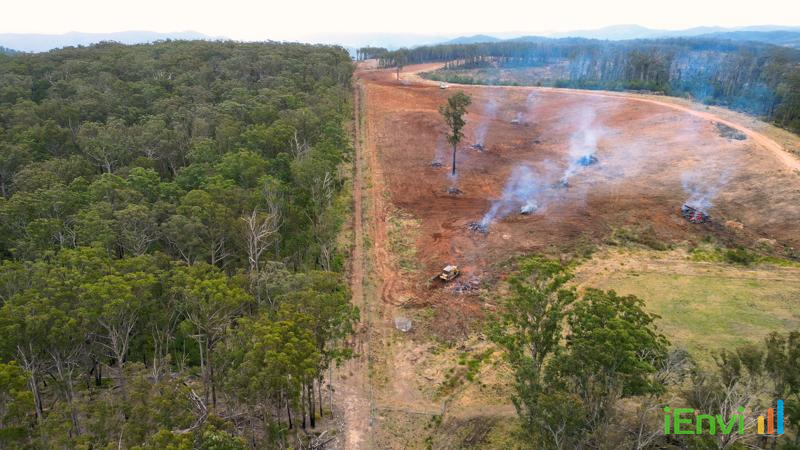
New South Wales has recorded its highest land clearing figures in recent years, with the state’s Statewide Landcover and Tree Study (SLATS) 2024 data confirming that vegetation clearing reached over 81,000 hectares during the reporting period. This represents a rise from 66,498 hectares recorded in 2023, an increase of more than 21 per cent in a single year. The Australian Conservation Foundation (ACF) published commentary on these findings on 21 July 2024, condemning the trajectory as a direct contradiction of the NSW Government’s stated commitments to curbing native vegetation loss. To put the scale in context, the cleared area is more than five times the size of Sydney’s Royal National Park, and averages approximately 223 hectares lost per day across the year.
The significance of these figures extends well beyond headline statistics. For environmental professionals, property developers, corporate landholders, and legal advisors operating in NSW, the data marks a turning point in the regulatory and commercial landscape for vegetation-sensitive projects. The shrinking pool of remnant native vegetation has direct consequences for the Biodiversity Offsets Scheme (BOS) under the Biodiversity Conservation Act 2016 (NSW), where the availability and pricing of offset credits are intrinsically tied to the supply of ecologically intact land. As that supply contracts, the economics of development and agricultural expansion shift materially.
Compounding the state-level picture, the federal government’s newly established Environment Protection Australia (EPA) commenced operations on 1 July 2025. This agency inherits enforcement functions under the Environment Protection and Biodiversity Conservation Act 1999 (Cth) (EPBC Act) and has signalled that unauthorised land clearing affecting matters of national environmental significance will be an enforcement priority. The combination of a rapidly depleting vegetation base and a newly empowered federal regulator creates a substantially more complex compliance environment than existed even twelve months ago.

Key details of the NSW SLATS 2024 findings and regulatory thresholds
The SLATS programme is the authoritative monitoring mechanism for vegetation change across NSW. The 2024 data confirms that agriculture was responsible for 88 per cent of all land clearing recorded in the state, rising from 77 per cent in 2023. This eleven percentage point increase in agriculture’s share reflects both the ongoing expansion of cropping and grazing enterprises and, arguably, the limitations of the current regulatory framework in constraining clearing activity at scale. The total clearing figure of over 81,000 hectares compares with 66,498 hectares the previous year, and the ACF has characterised this trajectory as a failure of the state government’s vegetation protection commitments.
Under the Local Land Services Act 2013 (NSW) and the Biodiversity Conservation Act 2016 (NSW), agricultural landholders are able to undertake certain categories of clearing under self-assessable codes without requiring a formal approval. The practical consequence is that large volumes of clearing occur through pathways that are lawful under current state provisions but are not subject to rigorous case-by-case ecological assessment. The SLATS data does not itself differentiate between lawfully approved clearing and potentially non-compliant activity, which creates a significant challenge for due diligence practitioners attempting to characterise the compliance history of a target site.
At the federal level, the EPBC Act triggers apply where clearing affects a matter of national environmental significance, including listed threatened species and ecological communities, Ramsar wetlands, or world heritage areas. The threshold for referral is not defined by a specific hectare figure but rather by the likelihood of a significant impact on a protected matter. Given that many areas subject to recent high-volume clearing in NSW overlap with mapped habitat for listed species such as koala, regent honeyeater, and swift parrot, the probability that some proportion of the 81,000 hectares cleared in 2024 intersects with EPBC-triggering habitat is material. Environment Protection Australia’s commencement on 1 July 2025 brings with it an expectation of more active audit and enforcement activity against both current and historical clearing events that were not referred when they should have been.
From a biodiversity offset perspective, the BOS operates on the principle that development impacts on biodiversity must be offset through the retirement of biodiversity offset credits generated by landholders who agree to protect and manage native vegetation. Credit prices are determined in part by supply. As large-scale clearing removes potential credit-generating land from the pool and simultaneously increases the pool of projects requiring offsets, the market is subject to upward price pressure. While the NSW Government has not yet formally adopted a “net positive” standard in legislation, policy signals from the Department of Climate Change, Energy, the Environment and Water (DCCEEW) indicate this direction, which would raise the baseline requirement above the current “no net loss” framework and further increase credit demand.
Australian context: implications for NSW biodiversity offsets, EPBC compliance, and national clearing policy
Within NSW, the regulatory architecture governing land clearing sits across two principal statutes. The Biodiversity Conservation Act 2016 governs impacts associated with development activity, requiring biodiversity development assessment reports and, where thresholds are met, the retirement of biodiversity offset credits to compensate for residual impacts on native vegetation and fauna habitat.
References and related sources
- Primary source: www.acf.org.au
- sers.net.au
- acf.org.au
- acf.org.au
- EPBC Act
How iEnvi can help
iEnvi provides specialist consulting services relevant to this topic. Our team includes CEnvP Site Contamination Specialists with experience across contaminated land, groundwater, remediation, ecology, and regulatory compliance.
- iEnvi due diligence services
- iEnvi remediation and validation services
- iEnvi expert services and independent review services
This is an iEnvi Machete news summary. Prepared by iEnvi to summarise the source article for contaminated land, groundwater, remediation, approvals and site risk professionals.
Published: 23 Jul 2026
Need advice on this topic? Speak to an iEnvi expert at info@ienvi.com.au or 1300 043 684, or contact us online.
Need advice on this issue? iEnvi provides practical, senior-led environmental consulting across contaminated land, remediation, ecology and environmental risk.
Team credentials Contaminated land services Remediation services Groundwater services Talk to iEnvi