
Overview
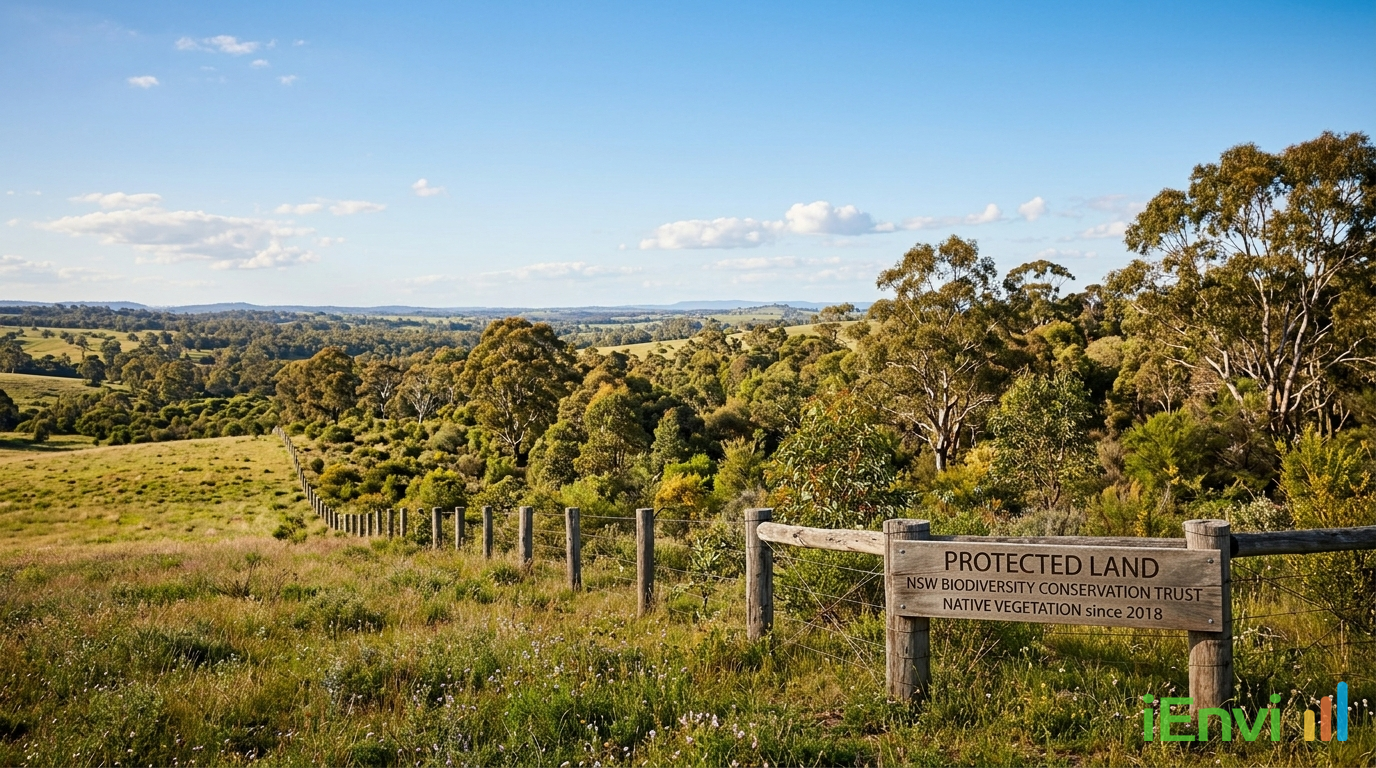
The NSW Biodiversity Conservation Trust (BCT) released its Biodiversity Impact Report: Conservation on Private Land (2018–2025) on 22 May 2026, presenting seven years of empirical data on the outcomes delivered through conservation agreements with private landholders across New South Wales. The report marks a notable milestone for ecological planning in the state, confirming that private land conservation has become a structural component of NSW’s protected area network rather than an ancillary policy measure. For environmental professionals working on development approvals, biodiversity offsetting, and environmental impact assessments, the report provides a data-backed benchmark that regulators and courts are increasingly likely to reference.
The scale of the findings is notable. Since 2018, conservation agreements administered by the BCT have prevented the loss of approximately 35,000 hectares of native vegetation across NSW. Nearly 3,000 permanent biodiversity monitoring sites have been established to track ecological condition, and at least 304 threatened species and 41 threatened ecological communities now have habitat formally protected under these agreements. Private land conservation now accounts for nearly 40% of the total area added to NSW’s protected area network since 2018, a proportion that reflects how central private landholder participation has become to the state meeting its conservation targets.
The report arrives at a time when the regulatory architecture foundational to biodiversity offsetting in NSW is actively evolving. The Biodiversity Conservation Act 2016 (NSW) provides the legislative foundation for the offsets scheme and the conservation agreements the BCT administers. Concurrently, the federal Nature Repair Market Act 2023 (Cth) is creating a new class of biodiversity certificates, though as at May 2026, those certificates cannot yet be used for environmental offsetting purposes under Commonwealth approval frameworks. The BCT report therefore serves as both a performance record and a preview of the evidentiary standards that will shape future credit valuations, baseline assessments, and offset negotiations across the state.
Key details from the BCT Biodiversity Impact Report 2018–2025
The headline figure from the report is the protection of approximately 35,000 hectares of native vegetation that would otherwise have been at risk of clearing or degradation. This protection has been achieved through voluntary conservation agreements between the BCT and private landholders, binding those properties to ongoing management obligations in exchange for financial support and technical assistance. The agreements are administered under the Biodiversity Conservation Act 2016 (NSW), and the properties covered form part of the state’s formally recognised protected area network, alongside national parks and other Crown reserves.
The establishment of nearly 3,000 permanent biodiversity monitoring sites is arguably the most technically significant outcome described in the report. Permanent monitoring sites generate longitudinal ecological datasets that document changes in vegetation structure, species presence, and habitat condition over time. This type of long-run empirical record is precisely what is required to assess habitat condition scores under the Biodiversity Assessment Method (BAM), which underpins the calculation of biodiversity credits under the NSW offsets scheme. The accumulation of seven years of monitoring data across thousands of sites substantially improves the reliability of condition assessments in regions where BCT-managed properties are located, and creates a reference dataset against which development-related biodiversity losses can be more rigorously compared.
The report confirms that habitat protection under the BCT’s agreements extends to at least 304 threatened species and 41 threatened ecological communities. These numbers carry direct regulatory weight. Species listed under the Biodiversity Conservation Act 2016 (NSW) and the Environment Protection and Biodiversity Conservation Act 1999 (Cth) trigger specific assessment and offsetting obligations when development proposals affect their habitat. The BCT dataset effectively maps where critical habitat for these listed entities is located and, importantly, where it is being actively managed and monitored. For impact assessment practitioners, this is a material input to determining likely significance of impact and to identifying credible offset options.
The statistic that private land now accounts for nearly 40% of all new protected area additions in NSW since 2018 reflects the strategic reality that the public reserve system alone cannot accommodate the scale of conservation required. Approximately 80% of land in NSW is privately managed, meaning the long-term viability of landscape-scale conservation outcomes depends almost entirely on what happens on private properties. The BCT’s model, which combines financial incentives, binding legal agreements, and structured monitoring, has demonstrably translated that landholder participation into measurable ecological gains. This is the model against which future market mechanisms, including the Nature Repair Market, will need to demonstrate comparable rigour.
Australian context: NSW biodiversity offsetting, the Nature Repair Market, and what this means for regulatory practice
The BCT report sits within a regulatory framework that is simultaneously well-established in NSW and subject to significant federal-level reform. The Biodiversity Conservation Act 2016 (NSW) established the Biodiversity Offsets Scheme, which requires developers to offset residual biodiversity impacts through the retirement of biodiversity credits. Credits are generated by landholders who enter Biodiversity Stewardship Agreements with the BCT, co
References and related sources
- Primary source: www.miragenews.com
- EPBC Act
How iEnvi can help
iEnvi provides specialist consulting services relevant to this topic. Our team includes CEnvP Site Contamination Specialists with experience across contaminated land, groundwater, remediation, ecology, and regulatory compliance.
- iEnvi contaminated land investigation services
- iEnvi remediation and validation services
- iEnvi expert services and independent review services
This is an iEnvi Machete news summary. Prepared by iEnvi to summarise the source article for contaminated land, groundwater, remediation, approvals and site risk professionals.
Published: 23 May 2026
Need advice on this topic? Speak to an iEnvi expert at info@ienvi.com.au or 1300 043 684, or contact us online.
Need advice on this issue? iEnvi provides practical, senior-led environmental consulting across contaminated land, remediation, ecology and environmental risk.
Team credentials Contaminated land services Remediation services Groundwater services Talk to iEnvi