

Overview
On 23 July 2026, the independent NSW Net Zero Commission released its 2026 Annual Progress Report, delivering one of the most consequential climate policy warnings in the state’s recent history. The report confirms that New South Wales is no longer on track to meet its legally mandated emissions reduction targets under the Climate Change (Net Zero Future) Act 2023, and the scale of the gap is significant. For environmental consultants, planners, developers, and their legal advisers, this report is not a background policy document. It is a direct signal that the approvals landscape for major projects in NSW is about to become materially more demanding.
The Commission’s findings carry statutory weight. Established under the Climate Change (Net Zero Future) Act 2023, the NSW Net Zero Commission is an independent body tasked with monitoring the state’s progress against its legislated emissions milestones and providing annual assessments to government. Its recommendations are formally considered by the NSW Government, which is required to respond publicly. The 2026 report’s eight key recommendations span planning reform, methane abatement, renewable energy sourcing requirements, and First Nations-led adaptation governance. Collectively, they represent the most detailed blueprint for tightening climate obligations within the NSW planning and approvals system that the Commission has yet produced.
For environmental professionals advising on development applications, environmental impact statements, or major project approvals, the core message is straightforward: the methods and assumptions that have underpinned greenhouse gas assessments in NSW to date are no longer adequate. Planning authorities will be under explicit pressure to evaluate projects against the state’s legislated targets, not merely against project-level mitigation commitments. That shift has direct consequences for EIS methodology, project scheduling, and the commercial viability of certain project types.
Key details from the NSW Net Zero Commission 2026 Annual Progress Report
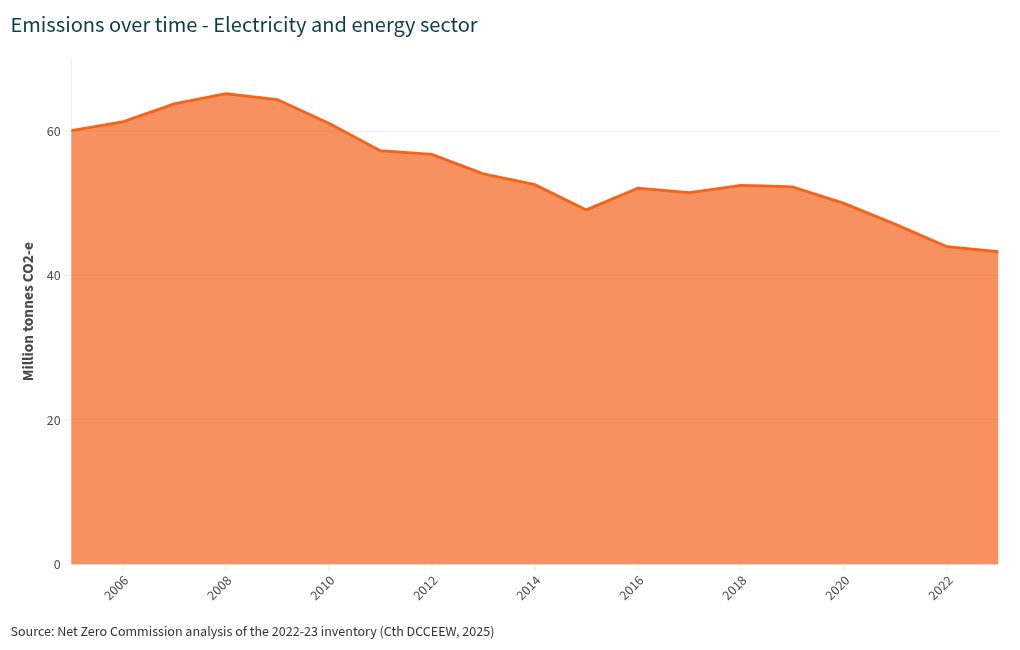
The numbers at the centre of the 2026 report are unambiguous. Under the Climate Change (Net Zero Future) Act 2023, NSW is legally required to reduce net greenhouse gas emissions by 50% by 2030 and 70% by 2035, measured against 2005 baseline levels. The Commission’s analysis finds that the state now faces a projected shortfall of 10 to 20 million tonnes of carbon dioxide equivalent (MtCO2-e) against the 2030 target, and a shortfall of 21 to 24 MtCO2-e against the 2035 target. To close these gaps, NSW must accelerate its rate of decarbonisation by 2.5 times, achieving average annual reductions of 5.5 MtCO2-e from 2023 onwards. This compares to a historical average reduction rate of just 2.1 MtCO2-e per year since 2005. The gap between what has been achieved and what is now required is not marginal.
The Commission’s recommendations on planning reform are among the most operationally significant for the development sector. The report explicitly states that proposed coal mine extensions and expansions are “not consistent” with the state’s legislated climate targets. This is a direct challenge to current planning practice under the Environmental Planning and Assessment Act 1979 (NSW), which has historically assessed resource projects against project-level criteria and environmental offsets rather than against whole-of-state emissions budgets. The recommendation calls for government and planning decisions to explicitly align with the legislated targets, which, if adopted, would fundamentally change the basis on which State Significant Development applications for coal and other fossil fuel projects are assessed.
Data centres represent a specific and growing emissions risk identified in the report. The Commission projects that energy-intensive data centre operations will add 8 terawatt hours (TWh) to annual NSW electricity demand by 2035. To contextualise that figure, 8 TWh is equivalent to approximately 13% of the state’s current total annual electricity demand. The Commission’s recommended response is that new large industrial loads, including data centres, be required to source power from additional, newly built renewable energy capacity from the outset of operations. This is a more stringent requirement than relying on existing renewable certificates or grid-average emissions factors, because it requires genuine additionality. It means the renewable energy sourced must represent new capacity brought onto the grid specifically to meet that demand, rather than drawing on existing supply.
Methane abatement receives dedicated attention in the report. Methane currently accounts for 30% of NSW’s total greenhouse gas emissions, drawing from livestock agriculture, landfill, and coal mine operations. The Commission urges immediate practical action across all three sectors, including scaling the deployment of feed additives in livestock production, increasing landfill gas capture rates, and mandating on-site methane abatement at operating coal mines. While some of these measures are already encouraged under current frameworks, the Commission’s language around mandating abatement at coal mines signals that voluntary compliance is no longer considered sufficient to meet the pace of emissions reduction required.
Australian context: how this report intersects with national and state frameworks for major project assessment
The NSW report does not exist in isolation. Across Australia, the integration of climate targets into statutory planning and environmental assessment frameworks has been accelerating. At the federal level, the Environment Protection and Biodiversity Conservation Act 1999 (Cth) is under reform, with climate impacts being considered as a potential trigger for federal assessment. The Australian Government’s ongoing review of federal environmental law reflects growing pressure to ensure that major project approvals at the national level are evaluated against Australia’s emissions reduction commitments under the Climate Change Act 2022 (Cth), which legislates a 43% reduction in emissions by 2030 and net zero by 2050. For proponents of projects that require both state and federal approvals, this dual-track pressure is becoming a central factor in project feasibility assessments and approval risk analysis.
References and related sources
- Primary source: www.netzerocommission.nsw.gov.au
- hunternewenergy.com.au
- nsw.gov.au
- nsw.gov.au
- argusmedia.com
How iEnvi can help
iEnvi provides specialist consulting services relevant to this topic. Our team includes CEnvP Site Contamination Specialists with experience across contaminated land, groundwater, remediation, ecology, and regulatory compliance.
- iEnvi contaminated land investigation services
- iEnvi remediation and validation services
- iEnvi expert services and independent review services
This is an iEnvi Machete news summary. Prepared by iEnvi to summarise the source article for contaminated land, groundwater, remediation, approvals and site risk professionals.
Published: 24 Jul 2026
Need advice on this topic? Speak to an iEnvi expert at info@ienvi.com.au or 1300 043 684, or contact us online.
Need advice on this issue? iEnvi provides practical, senior-led environmental consulting across contaminated land, remediation, ecology and environmental risk.
Team credentials Contaminated land services Remediation services Groundwater services Talk to iEnvi