

The truncation is a real formatting issue and must be fixed. The SEO heading suggestion is a minor guideline note — acceptable to implement.
NSW Net Zero Commission 2026 Annual Progress Report: State Off-Track for Legislated Climate Targets
Is NSW on Track to Meet Its Emissions Targets?
The NSW Net Zero Commission released its 2026 Annual Progress Report on 23 July 2026, delivering an unambiguous finding that New South Wales is not on track to meet its legislated greenhouse gas emissions reduction targets. The report represents the Commission’s most comprehensive independent audit of the state’s decarbonisation trajectory to date, and its conclusions carry direct legal and regulatory weight given the statutory framework underpinning the targets. For environmental professionals, planning lawyers, and project developers operating in NSW, this report is not background reading. It is a forward signal of regulatory tightening that will reshape how major development applications and environmental impact assessments are prepared and assessed.
Under the Climate Change (Net Zero Future) Act 2023 (NSW), the state is legally committed to a 50 per cent reduction in greenhouse gas emissions below 2005 levels by 2030, and a 70 per cent reduction by 2035, with net zero by 2050. These are not aspirational targets. They are legislated obligations against which the Commission is mandated to report. The 2026 report confirms that the trajectory required to meet these milestones is not being achieved at the current rate of decarbonisation, and it names specific sectors and project types as material contributors to the growing shortfall.
Commission Chair Nick Rowley framed the planning policy dimension directly: “Planning assessments can have real impact with clear and predictable rules helping investment flow into projects that will support, rather than hinder, progress towards the state’s legislated targets.” That statement is consequential for any professional involved in preparing or assessing Environmental Impact Statements, development applications, or strategic planning instruments. It signals that emissions performance is moving from a secondary consideration in planning decisions to a central, enforceable criterion.
Key details: emissions shortfall, sector drivers, and the required acceleration
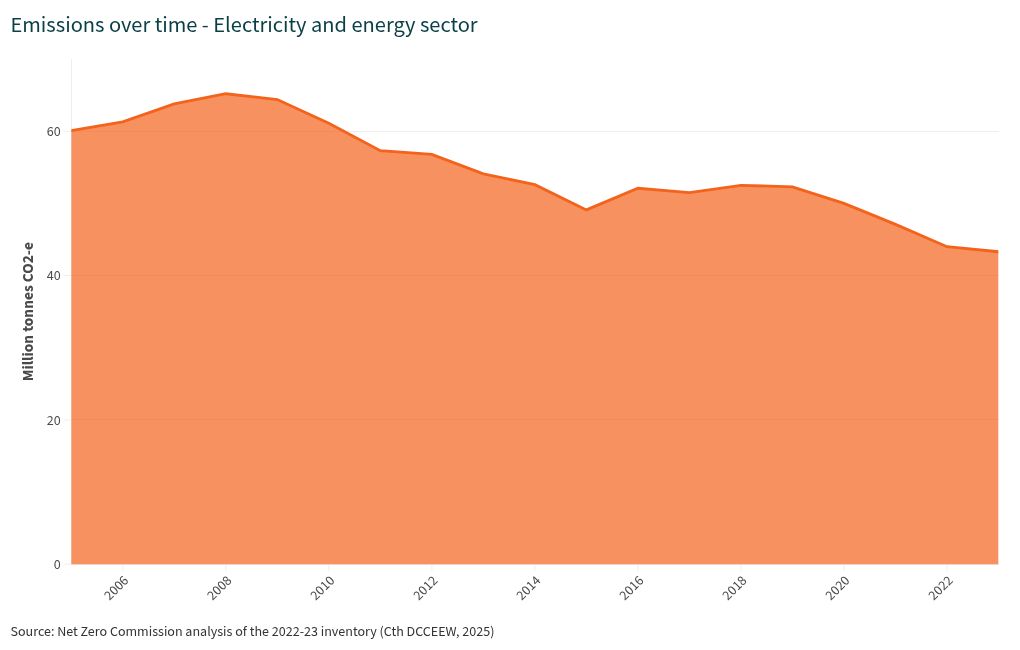
The 2026 Annual Progress Report quantifies the emissions gap with precision. NSW faces a projected shortfall of 10 to 20 million tonnes of carbon dioxide equivalent (MtCO2-e) against its 2030 target, widening to a shortfall of 21 to 24 MtCO2-e against its 2035 target. These are not rounding errors. They represent a structural divergence between current decarbonisation rates and what is legally required. To close the gap, the state must achieve an annual emissions reduction rate of 5.5 MtCO2-e per year. The average reduction rate achieved since 2005 has been 2.1 MtCO2-e per year. This means the required acceleration is approximately 2.5 times the historical average, a step-change rather than an incremental improvement.
Methane is identified as a particularly urgent priority. The Commission’s report notes that methane accounts for approximately 30 per cent of NSW’s current total greenhouse gas emissions. This proportion makes methane the single largest lever available for near-term emissions reduction, given that methane’s global warming potential over a 20-year horizon is approximately 80 times that of carbon dioxide. The primary methane-emitting sectors in NSW are waste and landfill, coal mining, and agriculture. The report urges immediate policy action across all three, with waste management and landfill operators specifically flagged as facing increased regulatory pressure to capture and mitigate fugitive emissions. For landfill operators, this is a direct precursor to more stringent licence conditions and expanded monitoring obligations.
Coal mine extensions and expansions are explicitly called out by the Commission as projects that directly threaten the state’s legislated targets. This is a significant shift in the framing of coal approvals under NSW planning law. Previously, greenhouse gas emissions from coal projects were assessed largely through project-level EIS processes with mitigation and offset mechanisms available to address residual impacts. The Commission’s recommendation that planning assessments be strictly aligned with legislated targets raises the threshold substantially. An extension that generates scope 3 emissions inconsistent with a 2.5 times acceleration in decarbonisation rate will face a far more contested approval pathway than has historically been the case.
Data centres have also been identified as an emerging structural risk to the emissions trajectory. The Commission specifically flagged the rapid and uncoordinated rollout of energy-intensive data centres as a strain on the electricity grid and a direct threat to emissions targets. This is consistent with broader national trends. Data centre electricity demand in Australia is projected to grow substantially through the late 2020s, driven by artificial intelligence infrastructure investment and cloud computing expansion. The Commission’s report signals that data centre developers in NSW should anticipate requirements for renewable energy procurement, on-site energy efficiency standards, and explicit demonstration of grid impact alignment within their planning applications.
Australian context: how this report intersects with national and state frameworks
The Climate Change (Net Zero Future) Act 2023 (NSW) is one of the most prescriptive subnational climate statutes in Australia. It is structurally different from the Commonwealth’s Climate Change Act 2022, which sets a national 43 per cent emissions reduction target by 2030 but does not carry the same planning-integration mechanism that the NSW Commission is now explicitly recommending be enforced. Queensland, Victoria, and South Australia each have their own emissions reduction legislation and net zero commitments, but none have yet embedded the same degree of statutory reporting and planning-alignment obligation that NSW has legislated. The Commission’s 2026 report reinforces that NSW’s framework is the most operationally demanding in the country, and that its conclusions about planning alignment are likely to set a precedent that other jurisdictions watch closely.
References and related sources
- Primary source: www.netzerocommission.nsw.gov.au
- nsw.gov.au
- reneweconomy.com.au
- greens.org.au
How iEnvi can help
iEnvi provides specialist consulting services relevant to this topic. Our team includes CEnvP Site Contamination Specialists with experience across contaminated land, groundwater, remediation, ecology, and regulatory compliance.
- iEnvi contaminated land investigation services
- iEnvi remediation and validation services
- iEnvi expert services and independent review services
This is an iEnvi Machete news summary. Prepared by iEnvi to summarise the source article for contaminated land, groundwater, remediation, approvals and site risk professionals.
Published: 23 Jul 2026
Need advice on this topic? Speak to an iEnvi expert at info@ienvi.com.au or 1300 043 684, or contact us online.
Need advice on this issue? iEnvi provides practical, senior-led environmental consulting across contaminated land, remediation, ecology and environmental risk.
Team credentials Contaminated land services Remediation services Groundwater services Talk to iEnvi