
NVIDIA and LangChain Unveil NemoClaw Blueprint for Secure, Sovereign Enterprise AI Agent Deployment
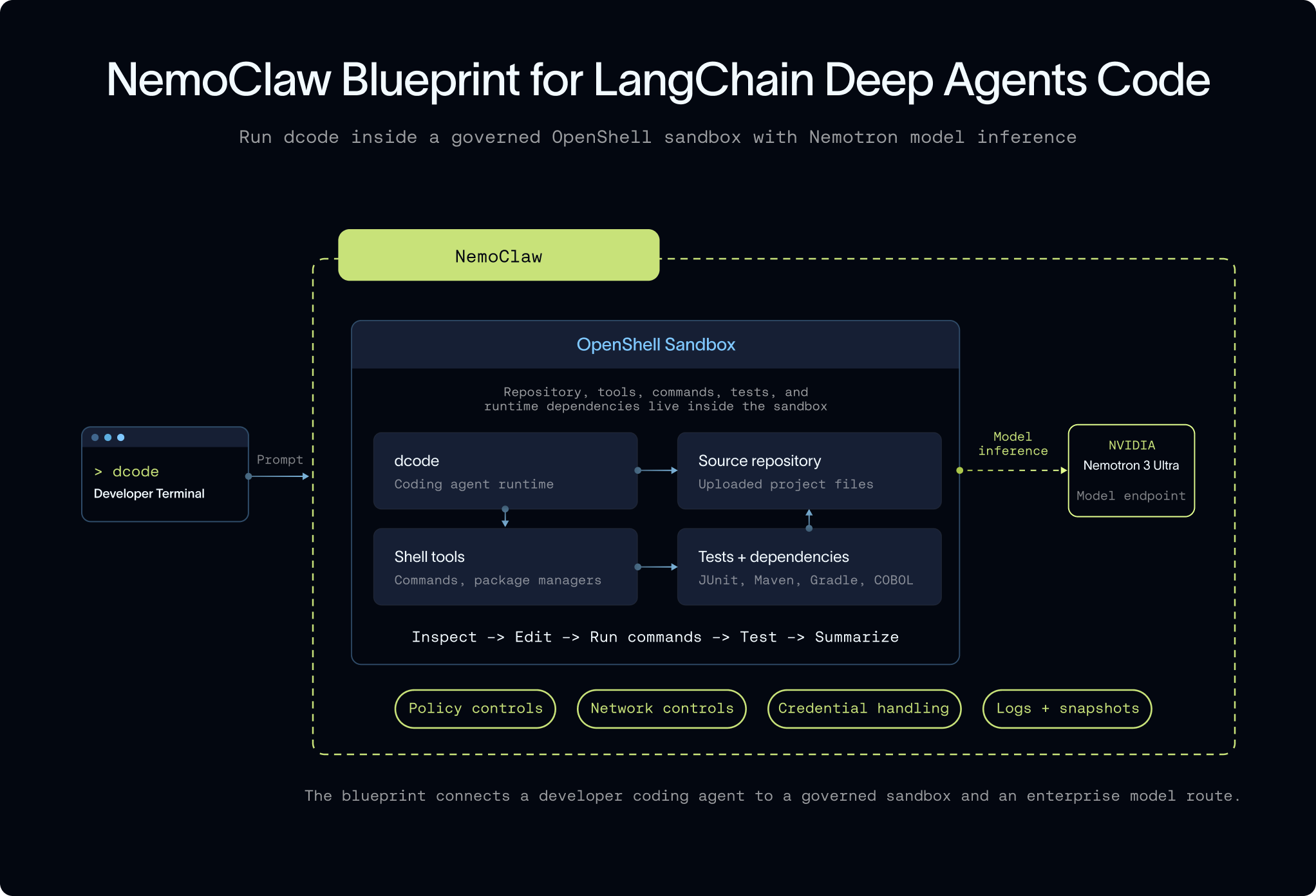
On 10 July 2026, NVIDIA and LangChain jointly unveiled the NemoClaw for LangChain Deep Agents blueprint, an open reference architecture designed to allow enterprises to deploy autonomous AI agents at scale without surrendering control of sensitive data or intellectual property to external, proprietary API providers. The announcement was made by NVIDIA CEO Jensen Huang and LangChain founder Harrison Chase, positioning NemoClaw as a direct response to the two most cited barriers to enterprise AI adoption: unacceptable security exposure and prohibitive inference costs. The blueprint integrates three distinct technology layers into a single governed framework, combining NVIDIA’s Nemotron 3 Ultra open-weight language model, LangChain’s Deep Agents Code orchestration harness, and the NVIDIA OpenShell secure runtime environment.
For professional services firms operating in regulated industries, this development carries immediate operational relevance. Organisations that handle confidential client data, proprietary workflows, or legally sensitive records have largely been unable to integrate frontier-level AI agents into their internal systems because doing so would require routing that data through external cloud APIs owned by third-party vendors. NemoClaw addresses this directly by allowing the entire agentic stack to run on-premises or within a sovereign cloud environment chosen by the organisation itself. This means the model, the orchestration logic, the agent memory, and all execution traces remain entirely within the organisation’s own infrastructure boundary.
The significance of this for Australian professional services firms, including those in environmental consulting, engineering, legal, and financial services, is substantial. Australian Privacy Act obligations, state-based confidentiality requirements, and the sensitivity of client site data have all contributed to a cautious posture toward public API-based AI tools. NemoClaw’s architecture removes the core technical reason for that caution, making it the most significant enterprise AI infrastructure announcement of 2026 for organisations that have been waiting for a secure, cost-effective pathway to autonomous agent deployment.
Key details of the NemoClaw architecture and benchmark performance
The NemoClaw blueprint operates across three distinct and complementary layers. At the model layer sits Nemotron 3 Ultra, a 550-billion-parameter open-weight language model developed by NVIDIA. The model uses a hybrid Latent Mixture-of-Experts (LatentMoE) architecture, which means that although the total parameter count is 550 billion, only 55 billion parameters are activated per token during inference. This design delivers frontier-level reasoning capability while reducing compute overhead by approximately 90 per cent compared to a dense model of equivalent total parameter count. The model also incorporates native speculative decoding through Multi-Token Prediction (MTP), which increases output throughput by generating multiple tokens simultaneously rather than sequentially, reducing end-to-end latency for complex multi-step tasks.
At the orchestration layer, LangChain’s Deep Agents Code (dcode) manages the full execution loop. This includes task planning, tool invocation, intermediate result handling, and context compaction. Context compaction is a particularly important feature for long-running agentic tasks: when an agent’s conversation history approaches the model’s context window limit, dcode automatically summarises or trims older exchanges to preserve working memory without losing task continuity. This allows agents to operate across extended workflows involving hundreds of intermediate steps, such as analysing large legacy codebases or processing multi-document archives, without degrading performance or exceeding memory constraints.
The runtime layer is provided by NVIDIA OpenShell, a secure containerised sandbox environment that enforces a deny-by-default networking policy. All agent actions, including file reads and writes, package installations, and code execution, occur within this isolated boundary. Sensitive operations require explicit human-approval gates before they can proceed, providing a zero-trust governance model for autonomous agent behaviour. This is directly relevant for use cases involving legacy system modernisation, such as migrating COBOL, .NET, or database code, where the risk of inadvertent data exposure or unverified code modification is significant.
The cost performance data published alongside the launch is striking. In LangChain’s standardised evaluation benchmarks, the Nemotron 3 Ultra model running within the NemoClaw framework achieved an aggregate task-completion score of 0.86 at an inference cost of USD 4.48 (approximately AUD 6.90 at current exchange rates) per evaluated task set. The closest performing closed-model alternative achieved a comparable score at a cost of USD 43.48 (approximately AUD 67.00), representing a cost differential of approximately 90 per cent. For organisations running high-volume agentic workflows, this cost structure fundamentally changes the economics of AI deployment.
Australian context: enterprise AI governance, data sovereignty, and professional services implications
The NemoClaw announcement is directly relevant to the Australian enterprise technology environment, particularly in the context of the Privacy Act 1988 (Cth) and its Australian Privacy Principles (APPs), which impose strict obligations on how personal information and sensitive client data are handled and transferred. Many Australian firms in regulated sectors have been unable to adopt public-API-based AI agents because routing client data through a third-party API would constitute a disclosure of that data to an overseas entity, triggering APP 8 cross-border disclosure obligations and, in some cases, requiring client consent or contractual safeguards that are difficult to obtain at scale. By keeping the entire agentic stack within an organisation’s own infrastructure, NemoClaw eliminates this compliance exposure entirely, removing the primary legal and regulatory obstacle that has prevented widespread adoption of autonomous AI agents across Australia’s professional services sector.
References and related sources
- Primary source: www.langchain.com
- 4sysops.com
- opensourceforu.com
- langchain.com
- prnewswire.com
How iEnvi can help
iEnvi integrates technology and data-driven approaches into environmental consulting. We monitor AI and technology developments that affect how environmental professionals deliver services to clients.
This is an iEnvi Machete news summary. Prepared by iEnvi to summarise the source article for environmental professionals tracking AI, data, and technology developments that affect consulting and project delivery.
Published: 14 Jul 2026
Need advice on this topic? Speak to an iEnvi expert at info@ienvi.com.au or 1300 043 684, or contact us online.
Need advice on this issue? iEnvi provides practical, senior-led environmental consulting across contaminated land, remediation, ecology and environmental risk.
Contaminated land advice Remediation services Discuss your site Talk to iEnvi