

Overview
A pointed analysis published on GeekWire on 5 July 2026 by Oren Etzioni, founding Chief Executive Officer of the Allen Institute for AI (AI2) and one of the most credible voices in applied artificial intelligence research, puts forward an uncomfortable argument for Western technology optimists: China has already won the first round of the physical AI race, and the United States is still at the starting blocks. Etzioni’s commentary draws a direct contrast between the prototype-driven narrative dominating American robotics coverage and the commercially oriented, high-volume delivery model that Chinese manufacturers have quietly built over the past two years.
The distinction Etzioni draws is not merely about speed. It reflects a structural difference in how physical AI is being financed, developed, and deployed across the two economies. In the United States, capital markets reward anticipation. Share prices and valuation multiples are built on the promise of a future where humanoid robots operate at scale with near-perfect reliability. In China, the incentive structure is inverted: robotics firms are rewarded for units shipped, contracts signed, and corridors patrolled. That difference in incentive architecture is producing measurably different outcomes in the real world.
For enterprise technology leaders, operations managers, professional services firms, and government agencies thinking seriously about workforce automation, this analysis represents a significant recalibration point. The timeline for commercially viable physical AI deployment is not a decade away. For organisations in logistics, facility management, border operations, and field services, decisions about capital expenditure, workforce planning, and technology adoption strategies may need to move forward considerably.
Key details
The most striking data point in Etzioni’s analysis comes from Barclays, which estimates that China accounted for 85 per cent of global humanoid robot installations in the preceding year. That figure alone reframes the entire conversation about who is leading in physical AI. Beijing currently hosts more than 140 domestic robotics companies actively selling products, with the collective catalogue exceeding 330 distinct models. This is not a research pipeline. These are commercially available, commercially deployed systems operating in real environments.
UBTech provides the clearest case study in Etzioni’s argument. On 30 June 2026, UBTech officially launched its UWORLD U1 hyper-bionic companion robot at an event in Shenzhen, recording more than 13,000 pre-orders on the first day of availability. Separately, the company secured a 37 million United States dollar contract to deploy its Walker S2 humanoid robots at the Fangchenggang border crossing between China and Vietnam, where the robots are tasked with patrolling corridors and conducting cargo inspections. These are not pilot programmes. They are contracted, revenue-generating deployments in live operational environments.
The performance trajectory of Chinese humanoid hardware is equally instructive. Honor’s “Lightning” humanoid robot completed a half marathon in Beijing’s E-Town district in 50 minutes and 26 seconds. That distance is 21.1 kilometres. The significance of that result lies not in the absolute time but in the year-on-year comparison: at the inaugural running of the same event the previous year, the majority of competing robots either fell over or took longer than two and a half hours to finish. A performance improvement of that magnitude across a 12-month development cycle is an indicator of iteration velocity that Western manufacturers have not matched.
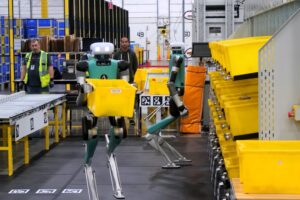
Tesla’s Optimus programme illustrates the contrasting American experience. Despite the company committing approximately 20 billion United States dollars in capital expenditure this year to retool its Fremont assembly lines, production has been severely constrained by the complexity of managing roughly 10,000 unique parts required for each Optimus unit. Elon Musk has publicly acknowledged that initial production volumes “will be extremely slow at first,” a significant retreat from earlier projections that had suggested tens of thousands of units by the end of the year. The bottleneck is not software or artificial intelligence capability. It is hardware supply chain management at scale, an area where Chinese manufacturers have a structural and decades-long advantage.
Australian context: physical AI commercialisation and implications for Australian business and professional services
Australia does not have a domestic humanoid robotics manufacturing industry of any comparable scale, which means the developments Etzioni describes are relevant here primarily as an adoption and procurement story rather than a production one. Australian organisations in logistics, mining services, aged care, construction, and government operations are potential end-users of the commercial-grade physical AI systems now entering the market at volume from Chinese manufacturers. The speed at which those systems are becoming cost-competitive will determine how quickly Australian operational planners need to revise their workforce and capital expenditure assumptions.
The aged care sector is a particularly relevant case for Australia. With an ageing population and persistent workforce shortages in residential and in-home care, the kind of companion and assistance robotics that UBTech is commercialising in China directly addresses a challenge that Australian policy makers and providers have been struggling with for years. The National Disability Insurance Scheme and aged care reform agendas have both grappled with the cost of human-delivered support at scale. If companion and mobility-assistance humanoids reach commercially viable price points within the next two to four years, driven by the production volumes now being established in China, Australian providers and regulators will need to engage with procurement, safety, and workforce transition questions well ahead of that curve.
References and related sources
- Primary source: www.geekwire.com
- youtube.com
- electrek.co
- NEPM Assessment of Site Contamination
How iEnvi can help
iEnvi integrates technology and data-driven approaches into environmental consulting. We monitor AI and technology developments that affect how environmental professionals deliver services to clients.
This is an iEnvi Machete news summary. Prepared by iEnvi to summarise the source article for environmental professionals tracking AI, data, and technology developments that affect consulting and project delivery.
Published: 06 Jul 2026
Need advice on this topic? Speak to an iEnvi expert at info@ienvi.com.au or 1300 043 684, or contact us online.
Need advice on this issue? iEnvi provides practical, senior-led environmental consulting across contaminated land, remediation, ecology and environmental risk.
Contaminated land advice Remediation services Discuss your site Talk to iEnvi