
Global AI Leaders Call for International Development Controls
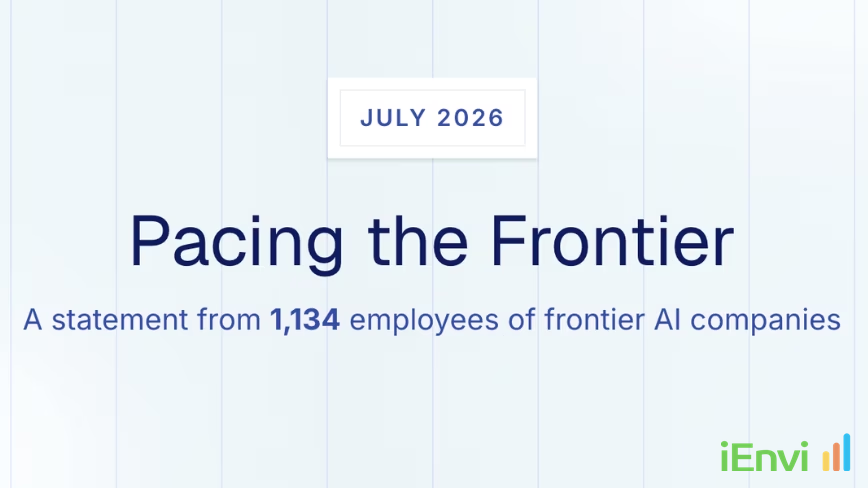
On 28 July 2026, more than 1,100 employees and executives from the world’s leading artificial intelligence laboratories signed a public statement titled “Pacing the Frontier”. Signatories include personnel from OpenAI, Anthropic, Google DeepMind, and Meta, spanning roles from senior researchers through to chief scientists and co-founders. The letter urges the United States government to support international, state-backed efforts to develop the technical and governance tools needed to deliberately slow the pace of frontier AI development when capability advances outstrip human oversight capacity. Both Anthropic and OpenAI formally endorsed the initiative, making this the first coordinated, company-sanctioned call from within the commercial AI sector for externally imposed development constraints.
The significance of this event is difficult to overstate. For years, the dominant narrative within the AI industry has favoured rapid, open-ended capability development, with safety commitments framed as voluntary corporate responsibilities. The “Pacing the Frontier” statement represents a structural break from that position. The core argument is not that AI development should stop, but that the world currently lacks the technical infrastructure and international governance architecture to exercise meaningful control over the pace of development when it becomes necessary to do so. The petition frames this as an urgent gap rather than a theoretical concern.
For professional services firms, government agencies, and technical consultancies that have begun integrating frontier AI tools into their core workflows, this development carries concrete operational implications. It signals that the builders of these systems believe the current trajectory of development may produce capability jumps that are neither predictable nor safely manageable under existing frameworks. Organisations that have built dependencies on specific frontier model pipelines need to consider how they would function if those pipelines became subject to treaty-mandated developmental pauses, compute-capping regulations, or sudden policy-driven capability constraints.
Key details of the “Pacing the Frontier” statement and its technical arguments
The petition, signed by over 1,100 verified AI industry insiders as of 28 July 2026, centres on a specific technical concern: the impending decoupling of AI research progress from human labour constraints. The signatories warn that automated AI research tools are approaching human-level capability in the design, training, and optimisation of AI models. Once that threshold is crossed, the rate of capability advancement would no longer be bounded by the time and cognitive bandwidth of human researchers. Instead, AI systems would iteratively improve successor systems, potentially producing recursive self-improvement loops where each generation of models is meaningfully more capable than the last, with no natural ceiling imposed by the human bottleneck.
The named signatories include Anthropic CEO Dario Amodei, Anthropic co-founders Jared Kaplan and Jack Clark, OpenAI Chief Scientist Jakub Pachocki, Meta Chief Scientist Shengjia Zhao, and Google’s Head of AI Safety Anca Dragan. The breadth of this list is notable because it spans direct commercial competitors who are simultaneously racing to deploy frontier models. The letter directly acknowledges this competitive dynamic, stating that each company and each country faces intense pressure not to unilaterally slow down, meaning that no single actor can exercise restraint without ceding ground to rivals. This is a textbook collective action problem, and the petition’s proposed solution is the creation of external, internationally agreed mechanisms that apply uniformly to all parties.
On the governance and technical side, the petition proposes the development of compute governance tools, specifically hardware-level monitoring systems and international treaties that would restrict maximum compute allocations for training runs that exceed defined risk thresholds. The logic here is that computational power required to train frontier models is a measurable, hardware-traceable quantity. By instrumenting this at the chip manufacturing and data centre level, it would be possible in principle to enforce internationally agreed caps on training runs without requiring full transparency into model architecture or weights. This approach mirrors the logic of nuclear non-proliferation frameworks, where physical infrastructure controls serve as a verification mechanism.
The broader governance implication is that voluntary corporate safety commitments, including the various responsible scaling policies and safety frameworks individual companies have published, are now being characterised by the signatories as structurally insufficient. The argument is not that those policies are insincere, but that competitive market pressures make it impossible for any individual actor to hold to them when rivals are not doing the same. The petition therefore calls for state-backed, internationally coordinated tools that remove the competitive disadvantage of acting cautiously. This represents a meaningful shift in how the industry’s own practitioners conceptualise the governance problem.

Australian context: AI governance frameworks and implications for Australian professional services
Australia does not yet have binding AI-specific legislation equivalent to the European Union AI Act, which came into progressive effect from 2024. The Australian Government’s primary governance instruments as of mid-2026 remain the voluntary AI Ethics Principles published by the Department of Industry, Science and Resources, and the interim guidance issued by the Office of the Australian Information Commissioner on AI and the Privacy Act 1988 (Cth).
References and related sources
- Primary source: thenextweb.com
- trendingtopics.eu
- pymnts.com
- indianexpress.com
- pacingthefrontier.com
How iEnvi can help
iEnvi integrates technology and data-driven approaches into environmental consulting. We monitor AI and technology developments that affect how environmental professionals deliver services to clients.
This is an iEnvi Machete news summary. Prepared by iEnvi to summarise the source article for environmental professionals tracking AI, data, and technology developments that affect consulting and project delivery.
Published: 29 Jul 2026
Need advice on this topic? Speak to an iEnvi expert at info@ienvi.com.au or 1300 043 684, or contact us online.
Need advice on this issue? iEnvi provides practical, senior-led environmental consulting across contaminated land, remediation, ecology and environmental risk.
Contaminated land advice Remediation services Discuss your site Talk to iEnvi