
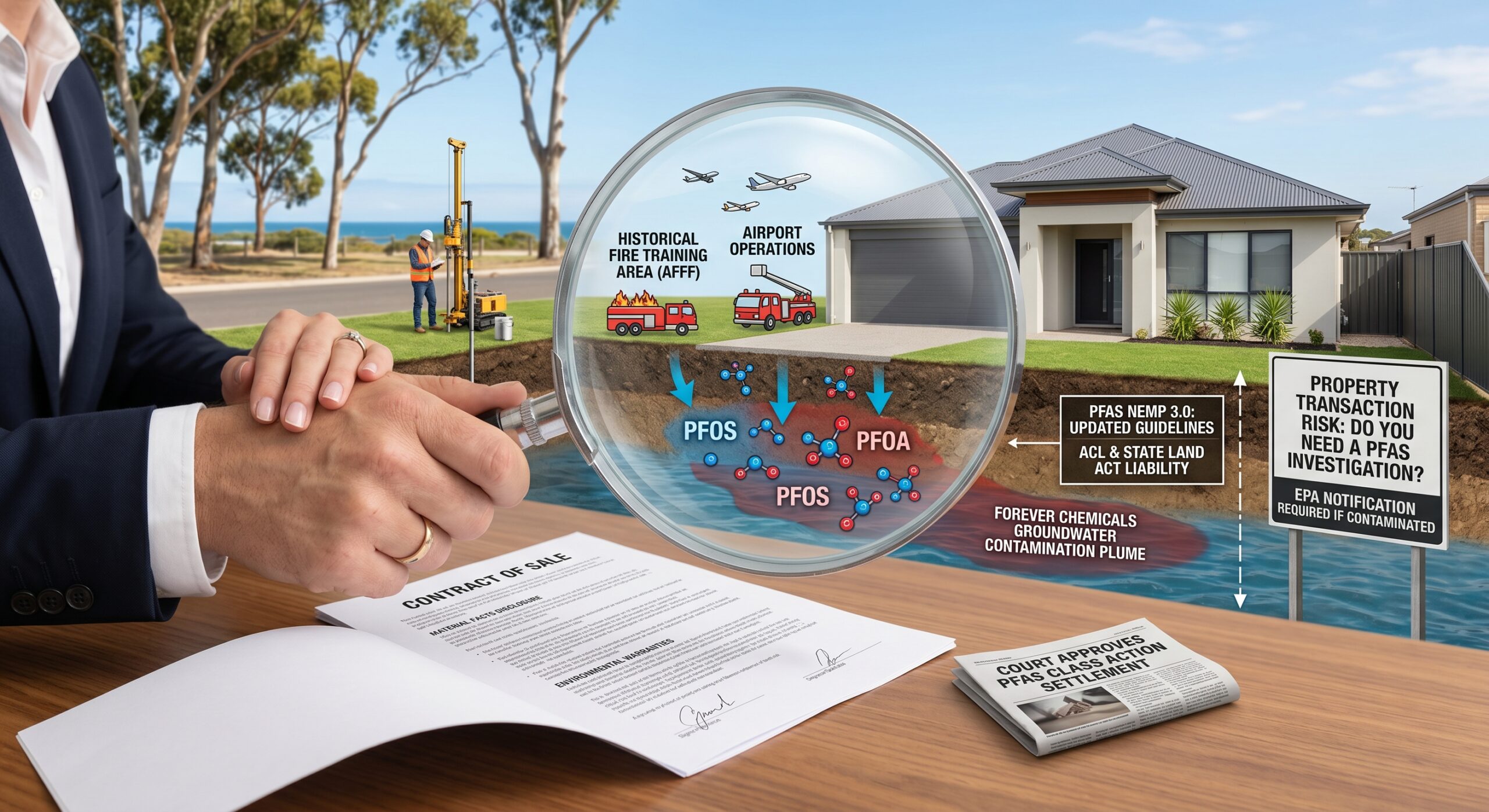
Does PFAS contamination need to be disclosed when selling property in Australia?
Yes. If a vendor knows about PFAS contamination affecting their property, failure to disclose it will likely breach general material fact obligations under the Australian Consumer Law and state sale of land legislation. While there is no single national PFAS-specific disclosure statute, PFAS contamination is now routinely investigated during commercial property due diligence, and confirmed contamination may also trigger mandatory EPA notification obligations under state environment protection laws.
Why PFAS Has Become a Property Transaction Risk
A decade ago, per- and polyfluoroalkyl substances (PFAS) barely featured in Australian property due diligence. Today, they are one of the most consequential environmental liabilities a buyer, developer, or financier can encounter. The Federal Court’s approval of a $132.7 million class action settlement against the Department of Defence in August 2023—covering residents at Williamtown, Oakey, Tindal, and five other locations—signalled unambiguously that PFAS contamination carries real legal and financial consequences.
More recently, the first consumer-led PFAS class action against 3M Australia Pty Ltd was filed in the Supreme Court of Victoria in December 2024, alleging misleading or deceptive conduct and breach of duty of care. Regulatory momentum has accelerated in step: from 1 July 2025, the Industrial Chemicals Environmental Management Standard (IChEMS) bans the manufacture, import, export, and use of PFOS, PFOA, and PFHxS under Schedule 7, the highest level of regulatory concern. The PFAS National Environmental Management Plan 3.0 (NEMP 3.0), endorsed by Environment Ministers in March 2025, replaces Version 2.0 and delivers updated investigation levels and ecological guidelines.
For property professionals: solicitors, conveyancers, buyers, developers, and their financiers; understanding when PFAS becomes a transactional issue is no longer optional.
What PFAS Is and How It Gets Into Land
PFAS is a broad family of thousands of synthetic chemicals valued historically for their resistance to heat, water, and oil. They do not break down in the environment, earning the label “forever chemicals.” The most regulated variants, PFOS and PFOA, were widely used in aqueous film-forming foam (AFFF) used at airports, defence bases, fire training facilities, and oil refineries from the 1970s through to the early 2000s. They also appear in industrial processes involving chrome plating, semiconductor manufacture, and certain coatings and textile treatments.
PFAS contamination typically reaches land through:
- Historical fire training exercises using AFFF (the dominant source at defence sites and commercial airports)
- Accidental spills during firefighting responses at industrial facilities
- Industrial wastewater discharge or sludge application to agricultural land
- Landfill leachate from sites accepting historical industrial waste
Once in soil, PFAS compounds migrate rapidly to groundwater and can travel considerable distances in the subsurface. They are extremely resistant to conventional remediation methods, which is what makes PFAS contamination so commercially significant: remediation is expensive, slow, and technically challenging.
Disclosure Obligations: What Vendors and Their Solicitors Must Understand
Australia does not yet have a single statutory provision requiring explicit PFAS disclosure on the sale of land. However, the general legal framework still imposes meaningful obligations.
Australian Consumer Law (ACL): Vendors and their agents are prohibited from engaging in misleading or deceptive conduct or making false representations in trade or commerce. If a vendor knows that PFAS contamination affects their property and withholds that information, they risk ACL liability. Courts have consistently held that environmental contamination is a “material fact” that a reasonable purchaser would want to know.
State sale of land legislation: In Victoria, section 32 of the Sale of Land Act 1962 requires disclosure of material facts affecting the property. New South Wales, Queensland, and South Australia have analogous vendor disclosure regimes. PFAS contamination known to the vendor is very likely a disclosable fact under these frameworks, and solicitors advising vendors should treat it as such.
Mandatory EPA notification: Independent of the property transaction, confirmed PFAS contamination often triggers mandatory reporting to the relevant state EPA:
- South Australia: Section 83A of the Environment Protection Act 1993 requires notification where contamination affects or threatens groundwater.
- Victoria: A duty to notify EPA Victoria exists for “notifiable contamination” at land under your control.
- NSW, QLD, WA, TAS: Each has EPA-administered notification requirements once a contamination threshold is triggered. PFAS exceeding NEMP 3.0 guideline values will typically meet those thresholds.
The practical implication: a vendor who has previously had environmental investigations conducted that returned elevated PFAS results has, in most jurisdictions, both a disclosure obligation to the buyer and a potential notification obligation to the EPA. Solicitors should request copies of all previous environmental reports as a standard matter in any commercial transaction.
What Triggers a PFAS Investigation in a Property Deal
Not every property requires PFAS testing. A risk-based approach is appropriate, and a preliminary site investigation (PSI) is the standard starting point. PFAS investigations are typically triggered where the property or an adjoining site has a history of:
- Military or defence use (RAAF or Army bases, training areas)
- Commercial airport or airfield operations
- Fire stations or emergency services training facilities
- Petroleum refining, chemical manufacturing, or chrome electroplating
- Waste management or landfill operations receiving industrial inputs
- Firefighting foam use during an industrial incident
Where the PSI identifies potential PFAS source linkages, a targeted Phase II investigation is warranted. This typically involves soil sampling to assess NEMP 3.0 soil investigation levels (SILs), groundwater sampling from installed monitoring wells, and surface water assessment where relevant waterways are nearby.
Under NEMP 3.0, the key soil screening levels are land-use-dependent. Residential (including public open space) settings attract lower SILs than commercial or industrial settings, which means the intended end use of a property—particularly for brownfield redevelopment—directly affects the regulatory threshold against which results are assessed.
Costs for a targeted PFAS investigation on a small-to-medium commercial site typically range from $20,000 to $120,000, depending on site size, number of sampling locations, and laboratory turnaround requirements. For large or complex sites (former refineries, airports, defence facilities), investigation costs can reach $250,000 or more.
Remediation Costs and Liability Allocation in Contracts
PFAS remediation is technically difficult because conventional approaches—soil washing, bioventing, natural attenuation—are largely ineffective against PFAS compounds. Emerging technologies include granular activated carbon (GAC) filtration for groundwater, in-situ chemical reduction using zero-valent iron, and ozone nanobubble treatment (recently the subject of Monash University research published in April 2026). Thermal destruction methods such as high-temperature incineration can destroy PFAS in soil but at very high cost.
Indicative remediation cost ranges for PFAS-impacted sites in Australia:
- Groundwater treatment system (pump and treat with GAC): $500,000–$2 million capital, plus $50,000–$250,000 per year in ongoing operating and maintenance costs
- Soil excavation and offsite disposal to a licensed facility: $300–$800 per tonne, plus transport
- Full site remediation (large contaminated industrial property): $2 million–$10 million+
- Long-term groundwater monitoring only (MNA approach): $30,000–$100,000 per year
In commercial transactions, liability allocation for PFAS is increasingly negotiated explicitly. Buyers should consider:
- Conditions precedent requiring Phase II investigation before exchange
- Price adjustments or escrow arrangements tied to remediation cost estimates
- Environmental indemnities covering pre-settlement contamination
- Vendor “as is where is” clauses (which courts have shown a willingness to look through where the vendor had actual knowledge)
PFAS NEMP 3.0: The National Framework Your Consultant Should Be Working From
Endorsed by Environment Ministers in March 2025, NEMP 3.0 is the key technical and regulatory reference for PFAS investigations across Australia. It supersedes NEMP 2.0 (2020) and reflects updated science on ecological toxicology and exposure pathways.
Key features of NEMP 3.0 relevant to property transactions:
- Revised soil investigation levels (SILs): Updated human health-based screening values for residential, recreational, commercial, and industrial land uses
- Ecological guidelines: New guidance on assessing PFAS risk to aquatic and terrestrial ecosystems, relevant for properties near waterways
- Groundwater investigation levels: Guidance on when PFAS groundwater results trigger further action
- Waste management: Guidance on classifying and disposing of PFAS-impacted soil and groundwater as regulated waste
Not all states have formally adopted NEMP 3.0 in their regulatory frameworks, and NSW EPA has published a specific position statement noting where its own guidance differs. Experienced consultants will know the jurisdiction-specific overlay and will apply the appropriate framework for your site and state.
Common Questions
Is PFAS contamination always a problem if found near a defence base?
Not necessarily. Proximity to a known PFAS source does not automatically mean a specific property is contaminated above investigation thresholds. A targeted investigation is needed to assess actual concentrations against NEMP 3.0 screening levels for the intended land use. Defence has completed investigations at all 28 impacted bases and has published risk management plans for each; your consultant can use that data to frame an efficient targeted investigation rather than starting from scratch.
Can finance be secured on a PFAS-impacted property?
Financiers are increasingly risk-aware on environmental contamination. Many lenders will require a Phase I Environmental Site Assessment before advancing funds on commercial property, and a Phase II where PFAS risk is identified. Where PFAS contamination is confirmed, lenders may require a remediation action plan (RAP), a cost estimate, and potentially a condition that remediation is underway before drawdown. Some lenders apply blanket policies against lending on known contaminated land until a validation report demonstrates compliance with NEMP 3.0 SILs.
What should a solicitor do when a vendor has prior environmental reports showing PFAS?
Advise your client to disclose. The risk of ACL liability for non-disclosure substantially outweighs the transactional inconvenience of disclosure. Obtain a copy of the reports, have them reviewed by a competent environmental consultant (ideally a Certified Environmental Practitioner, CEnvP), and understand whether the results exceed applicable NEMP 3.0 SILs and what remediation liability they imply. Depending on the jurisdiction, there may also be an obligation to notify the EPA; your consultant can advise on that threshold and manage the notification process.
How iEnvi Can Help
iEnvironmental Australia provides independent, expert contaminated land assessment and PFAS investigation services to property buyers, vendors, developers, solicitors, and financiers across Australia. Our team of Certified Environmental Practitioners (CEnvP) applies the PFAS NEMP 3.0 framework and jurisdiction-specific guidance to deliver clear, actionable findings that allow property transactions to proceed with confidence.
Our PFAS services include preliminary site investigation scoping, Phase II investigation design and field work, groundwater monitoring well installation and sampling, NEMP 3.0 risk assessment, remediation action plan preparation, and liaison with state EPAs on notification requirements.
Contaminated land assessment | Remediation services | Ecology and approvals | Talk to iEnvi
For innovative solutions that are focussed on giving you the very best outcome, contact our expert team of environmental consultants today.
Need advice on this issue? iEnvi provides practical, senior-led environmental consulting across contaminated land, remediation, ecology and environmental risk.
Contaminated land advice Remediation services Groundwater services Ecological assessment Talk to iEnvi