
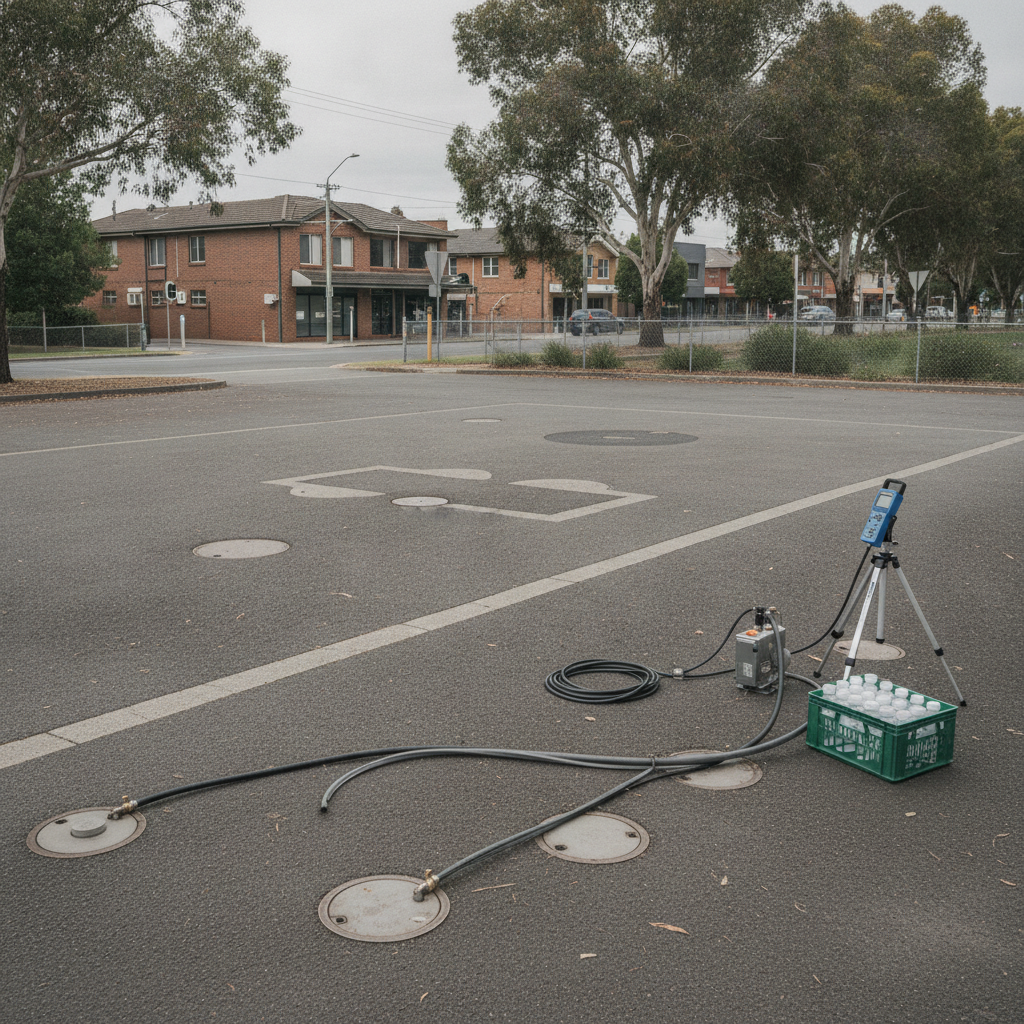
iEnvi completed the latest groundwater monitoring event (GME) at an active service station in Melbourne’s western suburbs, Victoria. The monitoring is required under the site’s Long Term Environmental Management Plan (LTEMP), which followed removal of the former underground petroleum storage system (UPSS), soil remediation and targeted multi-phase extraction (MPE).
Why monitoring continues after remediation
Historical data show an overall reduction in contaminant concentrations since the former UPSS and impacted soils were removed and the MPE events were completed. That is progress, not closure. Concentrations in the source zone and central plume remain elevated, and the LTEMP still requires scheduled gauging and sampling to protect commercial and industrial receptors while the site stays in fuel retail use.
Latest monitoring results
- Long-term trends remain consistent with a single historical UPSS release. Nothing in the monitoring well network pointed to a new leak.
- At one historically affected well, light non-aqueous phase liquid (LNAPL) has gone from a continuous measurable thickness over several years to no measurable thickness.
- About 0.030 m of petrol LNAPL was still gauged at the source well. This is above the LTEMP LNAPL remediation criterion of 0.003 m, although the overall trend since the most recent peak is decreasing.
- In the central plume well, total recoverable hydrocarbons (TRH) F1 remained above the adopted onsite health screening level for commercial and industrial land use (HSL D). Benzene at the same well was below the onsite HSL D value and lower than the previous round’s result.
- One well sample was lost in transit, so that location needs to be resampled next round.
- Natural attenuation parameters were not included in this round’s analytical suite.
Recommended next steps
Continue the LTEMP Stage 2 program, including the next scheduled GME, with continued focus on the source well, central plume and extraction wells. If LNAPL thickness trends rise again over the longer term, further MPE may be required. The next round should also:
- reinstate natural attenuation parameters
- keep naphthalene limits of reporting (LORs) below the LTEMP screening value
- include at least one offsite or downgradient boundary well
Practical takeaways for operators and landlords
- Post-remediation service station sites often need years of consistent groundwater monitoring, not a single clean round.
- LNAPL thickness can move up and down from one round to the next. Read the long-term trend, not a single spike or dip.
- Data gaps such as lost samples, raised LORs or missing boundary wells should be fixed in the next event, not explained away.
Related iEnvi services
- Groundwater and water
- UPSS validation requirements (NSW and QLD)
- Groundwater monitoring that keeps risk low
Need UPSS remediation monitoring or an LTEMP groundwater monitoring event in Victoria? Call 1300 043 684 or visit ienvi.com.au/contact/.
Related services for this project. iEnvi links delivered project work back to the service pathways clients use for similar sites — investigation, remediation, ecology and environmental management.
UPSS investigation and validation Soil remediation Environmental management plans Groundwater services Talk to iEnvi