

Project snapshot
Location: former commercial site with historical petroleum impacts. Context: site is managed under a Long Term Environmental Management Plan (EMP). Brief: complete the 2025 quarterly monitoring rounds safely and efficiently, provide evidence that natural attenuation remains protective, and set up a robust transition to biannual monitoring from 2026 in line with the EMP.
What iEnvi delivered
- Two quarterly groundwater rounds in 2025 at a selected network of existing monitoring wells.
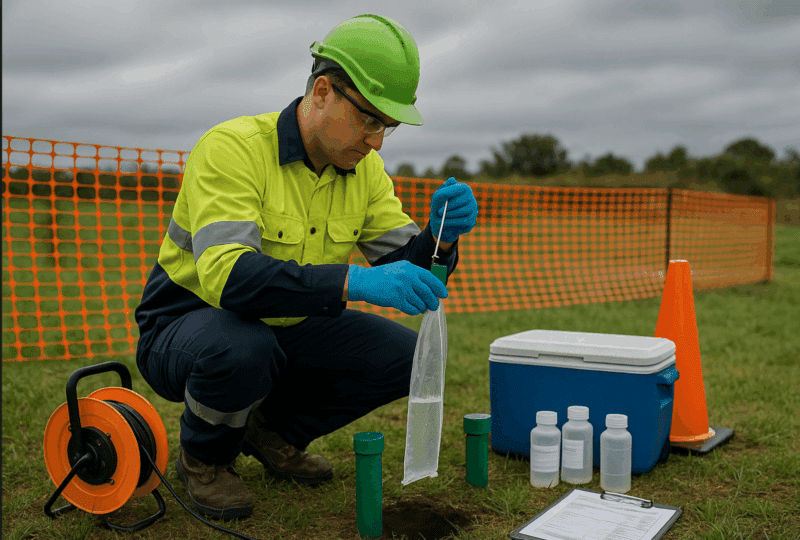
- Field program: well gauging, field parameters (temperature, pH, electrical conductivity, dissolved oxygen/ORP where relevant), followed by Hydrasleeve discrete-zone sampling to minimise well disturbance and avoid cross-contamination.
- Laboratory analysis (NATA‑accredited laboratory): VOC oxygenated compounds, TRH C6–C16, BTEXN and monitored natural attenuation (MNA) parameters (dissolved oxygen, nitrate, sulfate, iron/manganese where applicable, alkalinity and dissolved methane where relevant).
- Quality control: trip blank, rinsate blank and standard chain of custody procedures.
- Reporting: concise groundwater monitoring and evaluation report that includes time‑series trend analysis, plume behaviour notes, and comparison against a BIOSCREEN screening model to track progress toward long‑term objectives.
Key technical points
- Sampling method: Hydrasleeve sampling reduces purging bias and preserves representative dissolved-phase chemistry from discrete screened intervals.
- MNA parameters: measured to confirm biodegradation potential and electron acceptor availability — essential when relying on natural attenuation as a management approach.
- Trend analysis and model comparison: short-term trends from 2025 rounds were used to validate the conceptual site model (CSM) and screen timeframes with BIOSCREEN; this supported a controlled shift to biannual sampling in 2026.
Why this approach reduces risk and cost
- Evidence-based frequency reduction: reducing sampling frequency only when data show stable concentrations, predictable seasonal behaviour and defined trigger levels means fewer site visits while preserving early warning capability.
- Regulatory alignment: the program documents trigger levels and a contingency plan so the site remains complaint-ready and the pathway to a future Clean‑Up‑to‑the‑Extent‑Practicable (CUTEP) or equivalent review remains open.
- Commercial benefit: lower recurring sampling and mobilisation costs, less operational disruption and clearer information for asset teams and buyers without increasing environmental or human‑health risk.
Practical takeaways for asset owners and project managers
- Keep monitoring proportional and focussed — sample key wells and parameters that provide early warning of plume rebound or migration.
- Define clear trigger levels and a contingency plan up front — these must be actionable and auditable.
- Use a NATA‑accredited laboratory and rigorous QC (trip and rinsate blanks) so results are defensible for regulators and audits.
- When modelling with BIOSCREEN or similar tools, make the model assumptions transparent and cross‑check model outputs against monitoring trends.
Services delivered
Groundwater investigation, environmental sampling, contaminated‑land investigation and petroleum‑focused analysis — with practical reporting that balances technical rigour and decision‑useful outcomes.
Related services for this project. iEnvi links delivered project work back to the service pathways clients use for similar sites — investigation, remediation, ecology and environmental management.
Groundwater investigation Environmental management Environmental management plans Petroleum and UPSS services Talk to iEnvi