
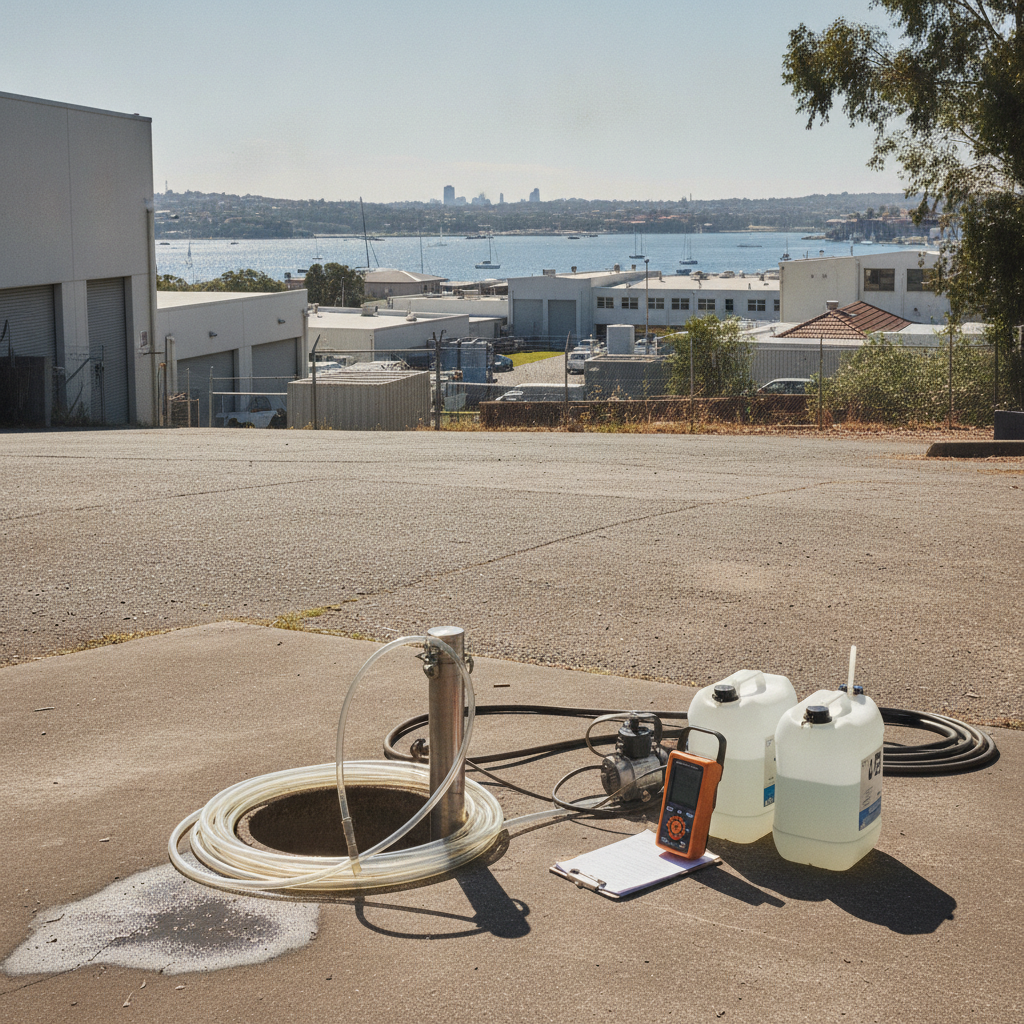
iEnvi completed the latest groundwater monitoring event (GME) for a commercial workshop site on Sydney’s North Shore. This round tested for hydrocarbons only. It forms part of a Stage 2 Long Term Environmental Management Plan (LTEMP), which uses monitored natural attenuation (MNA) and responds to a Clean-Up Notice issued by the local council.
Site context
The site has a history of underground petroleum storage and a well-established conceptual site model. Earlier investigations showed that the clay aquifer has low hydraulic conductivity. They also found low vapour intrusion risk for commercial workers on a Tier 1 basis. The LTEMP tracks dissolved hydrocarbons against attenuation targets set for 2028. Solubility-based boundary markers act as conservative progress checks. They are not immediate exposure thresholds.
Latest monitoring results
- Fieldwork was completed in a single day.
- No measurable light non-aqueous phase liquid (LNAPL) was gauged in the accessible wells. One well cover could not be opened, so that location remains a data gap for the next round.
- Dissolved BTEX (benzene, toluene, ethylbenzene and xylenes) stayed below the onsite HSL D (commercial/industrial) benzene criterion in all sampled wells. On a Tier 1 basis, onsite vapour intrusion risk for commercial workers remains negligible.
- Benzene still exceeded the offsite HSL A/B (residential) criterion in several source and downgradient wells. MW05, a former exceedance well, is now below that offsite criterion.
- BTEX and F1 (the lighter petroleum hydrocarbon fraction) were lower than in the previous round in most wells. A small number of exceptions still need tracking.
- The upgradient reference well again recorded the lowest dissolved hydrocarbon concentrations in the network.
What it means commercially
The latest results support continuing the Stage 2 LTEMP program. They do not support closing out the site. Dissolved hydrocarbons remain elevated in source and downgradient wells, so long-term monitoring should continue towards the 2028 LTEMP targets. The next laboratory MNA round is due in the first half of 2027. The annual reporting pack for council is due early 2027.
Practical takeaways
- Once free product is gone and vapour risk is under control, council Clean-Up Notice sites often move into a steady, long-term MNA program.
- Hydrocarbons-only rounds work well between full MNA suites. Field oxidation-reduction potential (ORP) and dissolved oxygen (DO) readings should still be read against the latest laboratory MNA dataset.
- Well access matters. If a single cover can’t be opened, a historical LNAPL location goes unchecked for that round.
Related iEnvi services
- Groundwater and water
- Low-flow groundwater sampling guide
- From Clean-Up Notice to a clear path forward
Need groundwater monitoring or an LTEMP pack in NSW? Call 1300 043 684 or visit ienvi.com.au/contact/.
Related services for this project. iEnvi links delivered project work back to the service pathways clients use for similar sites — investigation, remediation, ecology and environmental management.
Environmental management plans Groundwater services Environmental management Petroleum and UPSS services Talk to iEnvi