
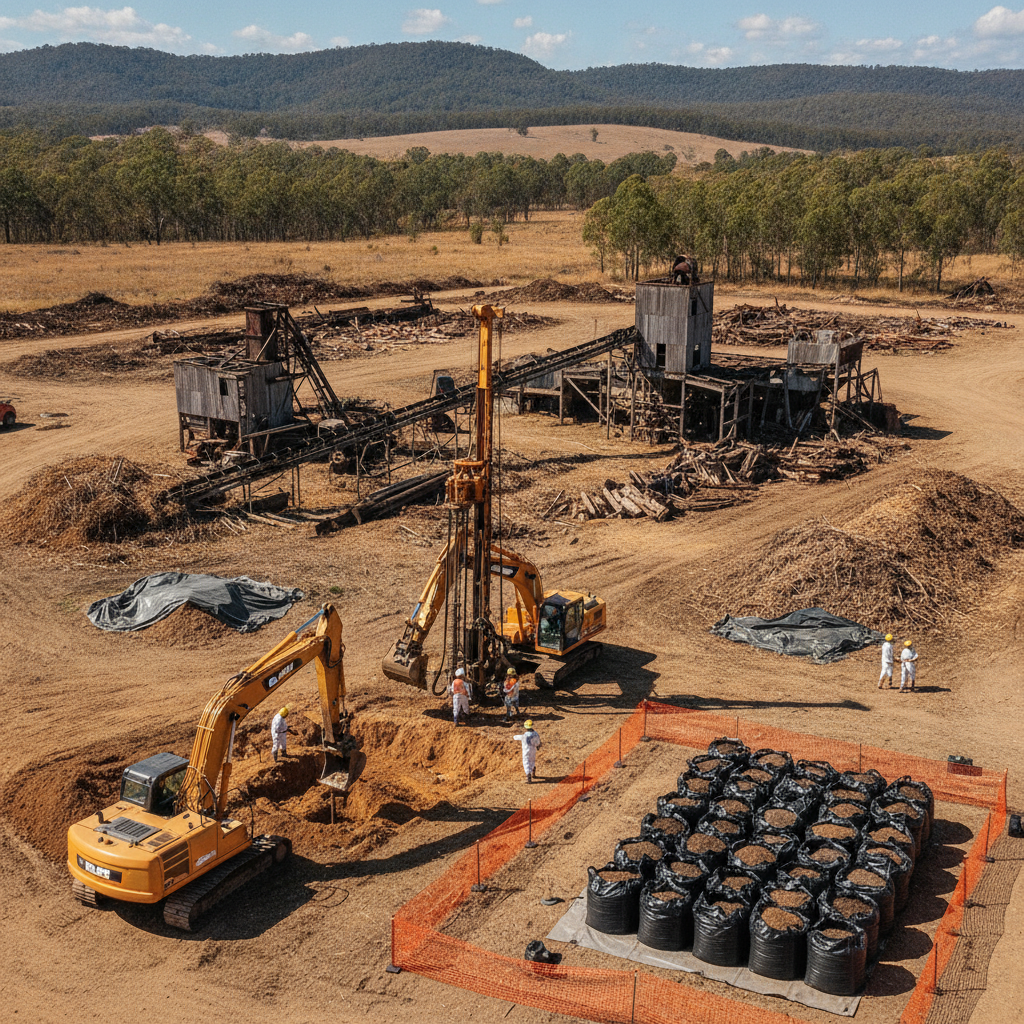
Can a former timber yard stay in commercial use without remediation?
Often, yes. At this Gympie site, iEnvi’s soil investigation and an independent Tier 3 ecological risk assessment found every soil result below the commercial and industrial human health criteria (HIL-D) and ecological risk low and acceptable, so no remediation was required for the current use.
Timber treatment leaves a chemical footprint that buyers, lenders and councils want explained in plain language. Copper chrome arsenate (CCA) was the workhorse preservative for decades, so arsenic usually leads the conversation, with copper, chromium and zinc close behind. The useful answer is not “detect” or “not detect”. It is whether the land is suitable for the use you actually want, and what changes if that use changes.
The Problem
A commercial and industrial property in Gympie, Queensland carried a history of timber processing. Early assessment pointed to arsenic as the primary contaminant of concern in soil, with copper and zinc also relevant through ecological pathways. The landowner needed a clear position on four questions: is the site suitable for its current use, could it support future open space or sporting use, does anything require listing on the Environmental Management Register (EMR), and is remediation required?
Project Summary
iEnvi began with a Preliminary Site Investigation (PSI): a desktop review of site history, inspection, and targeted soil sampling. A delineation and risk-based stage followed, adding further soil, surface water and leachability testing. Impacts were generally shallow and consistent with historical processing areas and drainage pathways. Other analytes screened along the way (asbestos, hexavalent chromium, petroleum hydrocarbons, PAHs and pesticides) sat below the adopted criteria and did not drive further assessment.
Final rounds of groundwater and surface water sampling supported a Tier 3 ecological risk assessment by Environmental Risk Sciences (enRiskS). That assessment concluded risks were low and acceptable for terrestrial ecosystems under the current commercial and industrial use, for potential future sporting or open space use (from an ecological perspective), and for aquatic receptors in Gympie Creek and the Mary River via groundwater and leaching pathways. Site-specific leachability testing showed arsenic, copper and zinc were strongly retained in the site soils, which limits movement towards those waterways.
On the human health side, every soil result sat below the commercial and industrial health investigation level (HIL-D). Some arsenic results, and one lead result, exceeded the more conservative recreational and public open space criteria (HIL-C). That matters only if the land use changes. The site was not listed on the EMR or the Contaminated Land Register (CLR), and the investigation did not identify contamination triggering a duty to notify the Department of the Environment, Tourism, Science and Innovation (DETSI) under the Environmental Protection Act 1994.
Solution & Benefit
The landowner received a close-out position they can hand to a bank, a buyer or council: the site is suitable for continuing commercial and industrial use, no remediation is triggered for that use, and there is one defined next step (a site-specific human health risk assessment and management plan) only if recreational sporting use proceeds. Contamination questions rarely need a dramatic answer. They need sound data, the right assessment tier, and a conclusion tied to land use.
Related services
Contaminated land advice | Remediation services | Talk to iEnvi
Buying, selling or financing land with a timber treatment history? Talk to iEnvi or call 1300 043 684.
Need advice on this issue? iEnvi provides practical, senior-led environmental consulting across contaminated land, remediation, ecology and environmental risk.
PSI services Contamination risk assessment Contaminated land services Remediation services Talk to iEnvi