
UK Humanoid Robotics Funding and Industrial Transition
On 21 July 2026, London-based AI and robotics company Humanoid (legally incorporated as SKL Robotics Ltd.) announced a USD $152 million (approximately AUD $233 million) Series A funding round, valuing the firm at USD $1.35 billion (approximately AUD $2.07 billion) post-money. The round was led by Prime Movers Lab, an early backer of US humanoid robotics firm Figure AI, with strategic participation from German industrial giants Bosch and Schaeffler, French luxury conglomerate LVMH chief Bernard Arnault’s investment vehicle Aglaé Ventures, and Taiwan’s Fubon Financial Holding Venture Capital. The announcement positions Humanoid as Europe’s first pure-play humanoid robotics unicorn, a milestone that marks a meaningful shift in a race that has, until now, been dominated almost entirely by United States and Chinese capital and capability.
What distinguishes this funding round from others in the physical AI space is the depth of industrial commitment behind it. Bosch and Schaeffler are not passive financial investors; they are operational partners with specific manufacturing and deployment commitments attached to their participation. This structure transforms the announcement from a venture capital event into something closer to a supply chain integration agreement. For environmental professionals, engineers, facility managers, and the clients who engage them, the relevance lies in understanding how rapidly physical AI is moving from controlled laboratory demonstrations into live industrial environments, and what that operational transition means for workforce planning, site risk management, and regulatory compliance obligations in the near term.
The funding round also reveals the scale of commercial appetite already present in the market. Humanoid has secured 34,000 pre-orders valued at USD $2.4 billion before delivering a single commercial unit. That level of forward commitment from industrial buyers is not speculative enthusiasm; it reflects a calculated response to well-documented labour shortages and the rising cost of repetitive manual task execution across manufacturing, logistics, and retail sectors globally, including in Australia.
Key details of the Humanoid Series A funding and HMND 01 deployment
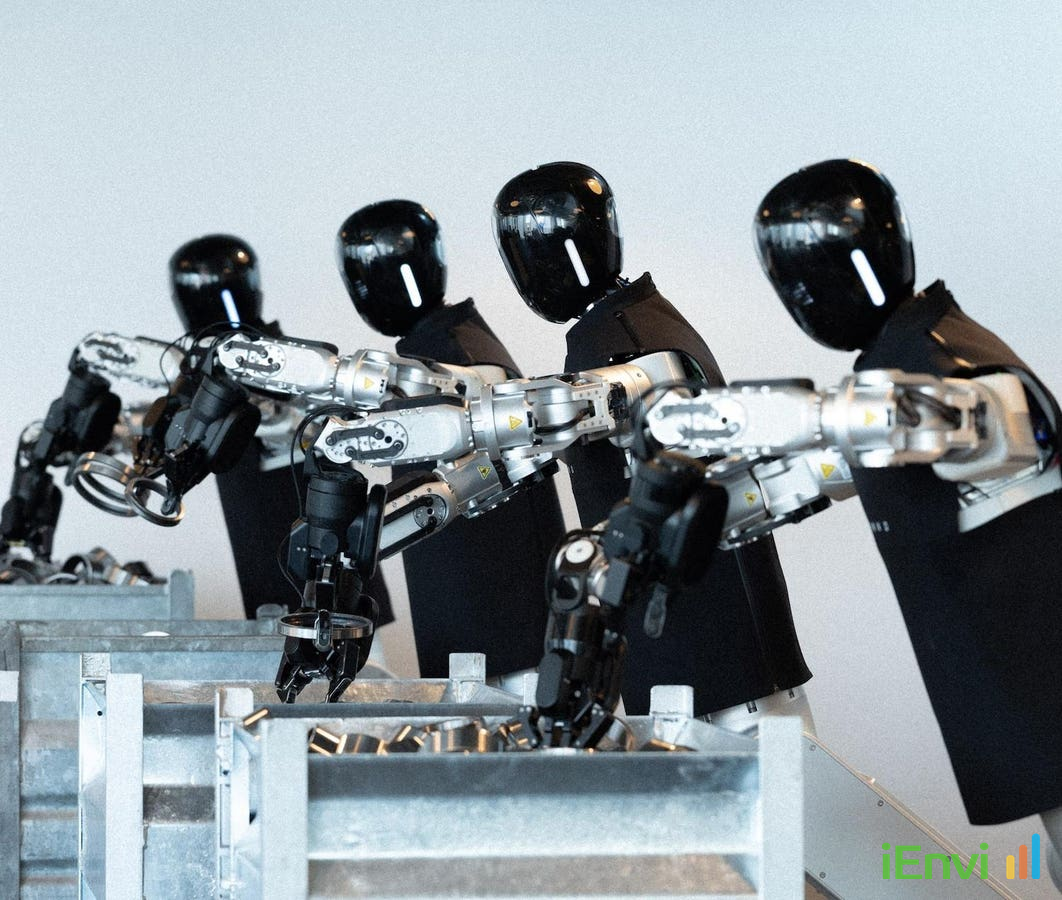
The HMND 01 is Humanoid’s flagship robot model and is powered by a proprietary AI architecture called KinetIQ. This is a four-layer AI framework designed to handle multimodal perception, natural language instruction parsing, and real-world physical task execution simultaneously in unstructured industrial settings. The four-layer structure allows the system to receive verbal or text-based instructions from human operators, interpret its physical environment through sensor arrays, and execute tasks in environments that have not been pre-mapped or specially modified for robotic use. This is a materially different capability from earlier generations of industrial robots, which required highly structured, predictable environments and explicit programmatic instruction for every discrete action.
The HMND 01 uses a wheeled chassis rather than bipedal (two-legged) locomotion. This is a deliberate engineering and commercial decision. Bipedal humanoid robots, such as those being developed by US competitors Figure AI and Apptronik, face significant technical challenges around dynamic balance, joint complexity, energy consumption, and fall-risk management in shared human workspaces. Wheeled systems avoid the majority of these constraints. On flat warehouse and factory floors, a wheeled base delivers reliable, energy-efficient movement without the mechanical overhead of replicating the human gait cycle. Critically for commercial deployment, wheeled machinery integrates more readily into existing occupational health and safety risk frameworks and regulatory classification systems, accelerating the path to safety certification in European and, by extension, comparable international jurisdictions.
The manufacturing commitments underpinning this round are specific and time-bound. Bosch has agreed to provide contract manufacturing capacity to produce up to 100,000 HMND 01 units over a five-year period. Schaeffler has entered into an offtake agreement to deploy thousands of units directly on its live factory floors. These are not letters of intent or memoranda of understanding; they are structural commercial agreements that give Humanoid a defined production pathway and an immediate real-world testing environment at industrial scale. Beta deployments at customer facilities across the manufacturing, logistics, and retail sectors are scheduled to commence in Q4 2026, meaning the transition from prototype to operational tool is measured in months, not years.
The USD $1.35 billion valuation achieved at Series A is notable by any measure, but particularly so given the company’s age. Artem Sokolov, Founder and CEO of Humanoid, stated that reaching this valuation in two years would typically take a decade under conventional technology development timelines. The 34,000 pre-orders valued at USD $2.4 billion represent a pre-revenue order book that substantially exceeds the capital raised, providing a degree of commercial validation that is unusual at this stage of a hardware company’s development cycle. Hardware businesses, unlike software companies, carry significant capital intensity in tooling, component sourcing, quality assurance, and logistics, making the Bosch manufacturing partnership a particularly strategic asset for managing those cost structures.
Australian context: physical AI adoption, workforce implications, and professional services relevance
Australia’s industrial sector faces labour market conditions that closely mirror the dynamics driving humanoid robotics adoption in Europe and North America. Persistent skills shortages in logistics, mining services, construction materials handling, and light manufacturing have created sustained pressure on operators to identify alternatives to manual labour for repetitive, physically demanding, or hazardous tasks. The pace at which Humanoid and comparable firms are moving from prototype to commercial deployment means that Australian facility managers, environmental consultants, and site engineers are likely to encounter these systems in operational settings within the next two to three years, well ahead of the regulatory and workforce planning frameworks that would typically precede such transitions.
For environmental and engineering professionals specifically, the near-term implications are practical. Humanoid robots operating in industrial environments introduce new variables into site risk assessments, emergency response planning, and environmental compliance monitoring. Questions around machine accountability in the event of a spill, release, or site incident, and how existing environmental licences and duty-of-care obligations apply when autonomous systems are executing tasks previously performed by trained human workers, are not yet resolved in Australian jurisdiction. Professionals advising industrial clients on site management, contamination risk, or regulatory compliance will increasingly need to account for the presence of autonomous physical systems as a standard feature of the operating environment rather than an edge case.
The commercial trajectory of Humanoid’s Series A, and the broader humanoid robotics sector it represents, signals that the question for Australian industry is no longer whether physical AI will enter operational environments, but how quickly and under what conditions. The combination of pre-committed manufacturing volume, structured industrial partnerships, and a pre-revenue order book exceeding USD $2.4 billion suggests the sector has moved beyond the demonstration phase. For professionals whose work touches industrial site operations, the time to develop an informed position on physical AI integration is now, before deployment decisions are made by clients without adequate technical or regulatory guidance.
References and related sources
- Primary source: www.forbes.com
- euronext.com
- trendingtopics.eu
- eu-startups.com
- pulse2.com
How iEnvi can help
iEnvi integrates technology and data-driven approaches into environmental consulting. We monitor AI and technology developments that affect how environmental professionals deliver services to clients.
This is an iEnvi Machete news summary. Prepared by iEnvi to summarise the source article for environmental professionals tracking AI, data, and technology developments that affect consulting and project delivery.
Published: 23 Jul 2026
Need advice on this topic? Speak to an iEnvi expert at info@ienvi.com.au or 1300 043 684, or contact us online.
Need advice on this issue? iEnvi provides practical, senior-led environmental consulting across contaminated land, remediation, ecology and environmental risk.