
Overview
The establishment of the EarthSure soil washing facility at Taylors Road in Dandenong South, Victoria, represents a significant milestone for the Australian contaminated land and resource recovery industries. Developed as a joint venture between environmental service providers Veolia and Ventia, and backed by funding and support from Sustainability Victoria, this newly opened facility introduces a highly sophisticated technical pathway for managing contaminated soils. With the capability to process up to 160,000 tonnes of Category C contaminated soil annually, the facility addresses a major bottleneck in the state’s environmental management infrastructure. This annual capacity represents approximately twenty-five percent of the total volume of contaminated soil generated across Victoria each year, providing a scalable and highly viable alternative to traditional landfill disposal.
For environmental consultants, property developers, infrastructure delivery authorities, and legal advisors, this development shifts the landscape of site remediation and waste management. Historically, the remediation of contaminated land in Victoria has relied heavily on excavation and direct landfill disposal, commonly referred to as dig and dump. This approach has exposed project owners to escalating landfill levies, high transport costs, and long term environmental liabilities. The launch of a high capacity soil washing plant offers a practical commercial option that aligns with the circular economy, transforming what was once classified as priority waste into reusable civil construction materials.
This technical advancement arrives at a critical juncture, as Victoria undergoes a major infrastructure boom. Projects such as the Suburban Rail Loop, the Metro Tunnel, and extensive level crossing removals generate vast volumes of surplus soil, much of which contains low to moderate levels of chemical contamination. By providing an off site treatment pathway that validates and recovers clean aggregates, the EarthSure facility supports the delivery of major infrastructure while preserving dwindling landfill capacity. This initiative establishes a benchmark for modern waste management, demonstrating how advanced physical processing can reconcile the demands of urban development with rigorous environmental protection standards.
Key details
The technical core of the EarthSure soil washing facility is a physical separation process designed to partition contaminants from the soil matrix. The scientific foundation of this methodology relies on the tendency of most organic and inorganic contaminants to adsorb preferentially to the finer fractions of soil, specifically the silts, clays, and organic matter. Contaminants such as heavy metals, polycyclic aromatic hydrocarbons, and total petroleum hydrocarbons exhibit a high affinity for these fine particles due to their large surface area and chemical charge. By systematically separating these fine particles from the larger, coarser fractions, the process isolates the contamination into a highly concentrated, low volume waste stream.
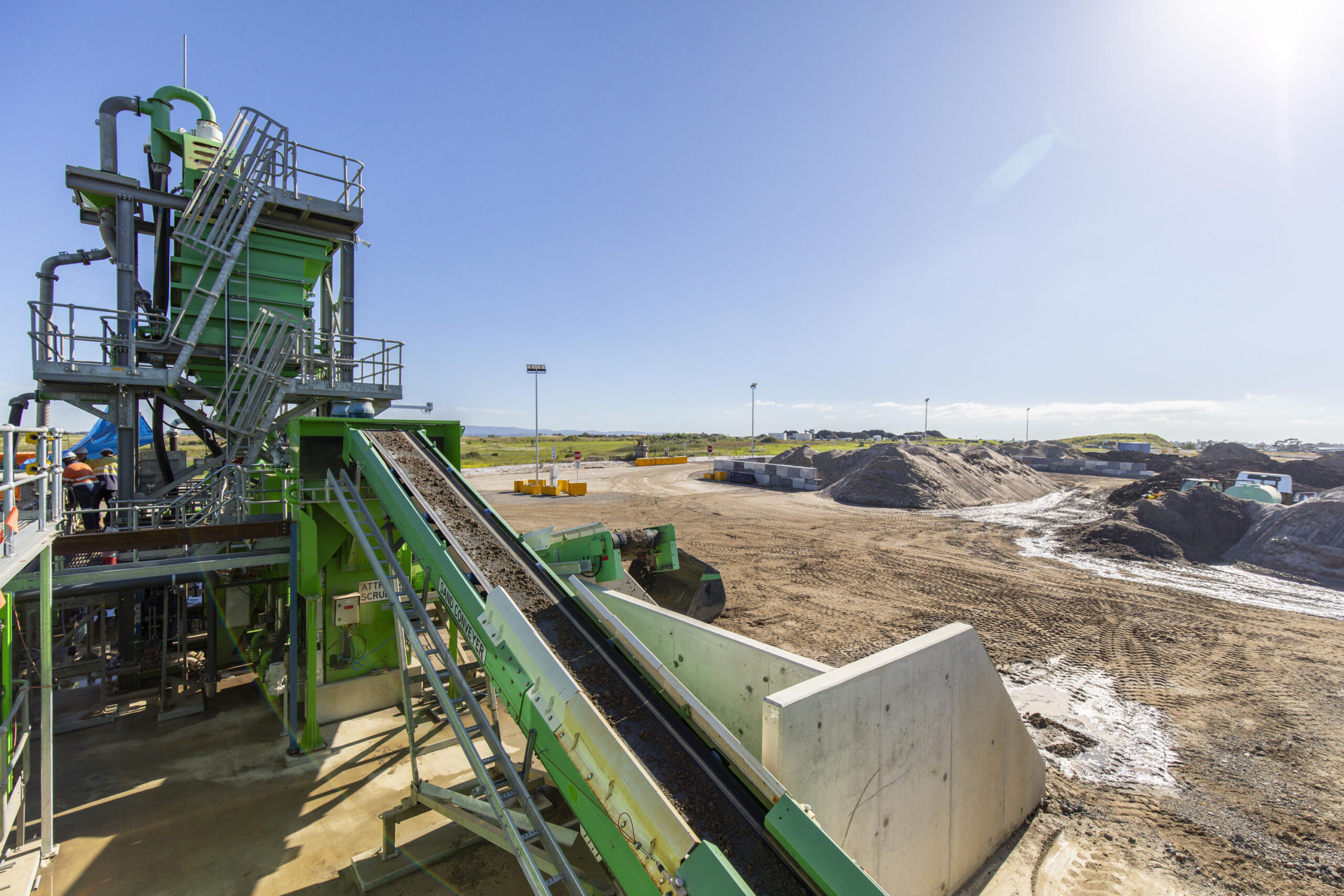
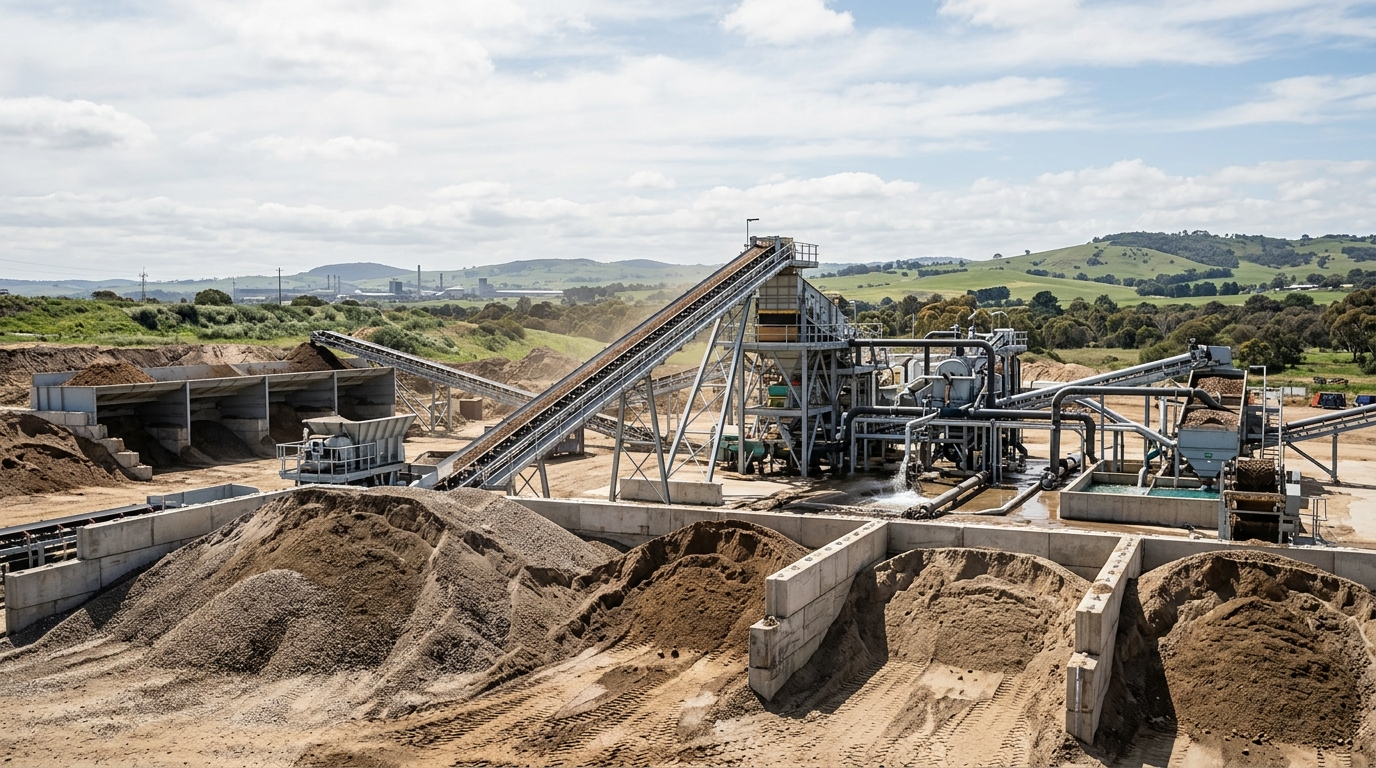
Operationally, the soil washing plant employs a series of mechanical and chemical stages to achieve this separation. Incoming Category C soil is first screened to remove large debris and is then subjected to high energy attrition scrubbing. This process uses water and mechanical agitation to break down soil agglomerates and strip adhered contaminants from the surfaces of sand and gravel grains. The resulting slurry is passed through a sequence of hydro-cyclones and density separators that segregate the material by particle size and density. The coarse sand and gravel fractions, which are typically free of significant chemical contamination after washing, are dewatered and stockpiled for environmental and geotechnical validation. The contaminated fines are treated with polymers, flocculated, and dewatered using high pressure filter presses, resulting in a dense, low volume filter cake that represents the concentrated waste residue.
A key operational advantage of the Taylors Road facility is its strategic co-location with the existing EarthSure thermal desorption unit. While the soil washing plant is designed to handle large volumes of Category C priority waste, the thermal desorption unit is engineered to treat highly contaminated Category A and Category B organic wastes. This co-location creates a single, integrated receiving facility capable of accepting and processing multiple waste classifications from a single project site. This capability simplifies project logistics, as complex sites with heterogeneous contamination profiles can direct diverse waste streams to a single licensed facility, thereby reducing tracking and transport complexity.
The output of the soil washing process is divided into distinct streams. The recovered aggregate, sand, and coarser soil fractions are validated against strict environmental guidelines to ensure they meet the criteria for reuse in civil engineering applications. Once validated, these materials can be safely diverted into backfilling, road base construction, and asphalt production. This closed loop process substantially reduces the demand for virgin quarried resources and prevents thousands of tonnes of priority waste from entering landfills, directly supporting Victoria’s circular economy objectives.
Australian context
The development of the EarthSure soil washing facility is deeply intertwined with the regulatory framework established under the Victorian Environment Protection Act 2017, which took effect on 1 July 2021. This legislation introduced the General Environmental Duty, which legally requires any person or business conducting activities that pose a risk to human health or the environment to minimise those risks so far as reasonably practicable. Crucially, the Act also enforces a strict waste hierarchy that legally obliges duty holders to avoid, reuse, and recycle waste before resorting to landfill disposal. The availability of a commercial scale soil washing facility provides Victorian developers and consultants with a defensible, audited pathway to demonstrate active compliance with this waste hierarchy when managing contaminated site soils.
In the national context, this facility represents a practical application of the remediation hierarchy outlined in the National Environment Protection (Assessment of Site Contamination) Measure 2013, commonly referred to as the NEPM. The NEPM outlines a clear preference for on site or off site treatment and reuse of contaminated soils over direct landfilling. Previously, the absence of high capacity, commercially viable soil treatment facilities in Australia meant that landfilling was often selected as the default remediation option due to a lack of practical alternatives. The EarthSure facility sets a new operational precedent, proving that off site soil treatment is feasible at a scale that can support major capital works. This shifting dynamic is likely to influence regulatory discussions and guidelines in other jurisdictions, such as New South Wales, Queensland, and South Australia.
In New South Wales, where the EPA’s Waste Classification Guidelines place tight restrictions on the reuse of excavated materials, and where the waste levy imposes a heavy financial burden on project budgets, there is growing interest in establishing similar physical separation infrastructure. Similarly, in Queensland, under the Environmental Protection Act 1994 and the state’s waste reduction strategies, the transition toward circular economy solutions is gaining regulatory support. By demonstrating the commercial viability and regulatory compliance of soil washing under Victoria’s stringent Environment Protection Regulations 2021, the EarthSure facility serves as a valuable model for other Australian states looking to reduce their reliance on landfill and encourage resource recovery in the civil and construction sectors.
Practical implications
For environmental consultants and principal contractors, the introduction of the EarthSure facility necessitates an immediate re-evaluation of sampling methodologies and remediation design. Traditionally, site investigations have focused primarily on chemical characterisation to determine waste classification categories for landfill disposal. Under the new paradigm, consultants must design sampling programmes that incorporate physical soil characterisation. This includes conducting detailed particle size distribution testing and clay content analysis during the Detailed Site Investigation stage. Understanding the physical composition of the soil is essential to predicting the recovery rate and financial feasibility of soil washing, as soils with high sand and gravel content are much better suited to physical separation than those dominated by cohesive silts and clays.
This development also has substantial implications for project risk management and financial planning. Property developers and infrastructure authorities must incorporate soil washing feasibility studies into their Remediation Action Plans. While the cost of soil washing must be weighed against direct landfill tipping fees, the escalation of landfill levies and the potential to avoid levies on the recovered, validated portion of the soil make soil washing an increasingly competitive option. Furthermore, utilising a certified treatment pathway protects site owners from long term environmental liabilities. Landfilled waste remains a liability on corporate balance sheets, whereas verified destruction or treatment and subsequent reuse of soil fractions provides a clean break, reducing future regulatory and legal risks.
From an operational and logistical perspective, the integrated nature of the Taylors Road hub significantly mitigates transport compliance risks. Under Victoria’s electronic Waste Tracker system, tracking multiple soil classifications from a single development site to different disposal locations is a complex and error prone process. The ability to transport mixed stockpiles containing Category A, B, and C soils to a single co-located facility simplifies logistics, reduces transport emissions, and minimises the administrative burden of waste tracking compliance. Project managers should update their Construction Environmental Management Plans and soil management protocols to incorporate these integrated logistics, ensuring that transport contractors are aligned with the streamlined disposal pathways now available.
Article Summary
From our perspective, the opening of this 160,000-tonne facility is a game-changer that should immediately alter how we structure environmental due diligence and Remediation Action Plans across southeastern Australia. In our experience, developers and consultants commonly miss the financial and legal risks of relying solely on landfilling, particularly under Victoria’s General Environmental Duty and escalating waste levies. For any mid-to-large urban renewal project in Victoria, and even those with cross-border implications in New South Wales or South Australia, the standard approach to waste classification must change. We should no longer design sampling programmes merely to tick the box for landfill disposal. Instead, sampling designs must incorporate particle size distribution testing during the Detailed Site Investigation stage to actively assess a soil’s suitability for washing. This facility elevates the feasibility of soil washing from a theoretical exercise to a standard commercial pathway. By integrating this option into the Remediation Action Plan, we can mitigate long-term liability, reduce transport logistics, and provide defensible waste hierarchy compliance that stands up to auditor scrutiny. Relying on dig-and-dump is no longer a defensible or cost-effective default.
References and related sources
- Primary source: www.anz.veolia.com
- EPA Victoria
How iEnvi can help
iEnvi provides specialist consulting services relevant to this topic. Our team includes CEnvP Site Contamination Specialists with experience across contaminated land, groundwater, remediation, ecology, and regulatory compliance.
- iEnvi contaminated land investigation services
- iEnvi remediation and validation services
- iEnvi expert services and independent review services
This is an iEnvi Machete news summary. Prepared by iEnvi to summarise the source article for contaminated land, groundwater, remediation, approvals and site risk professionals.
Published: 21 May 2026
Need advice on this topic? Speak to an iEnvi expert at info@ienvi.com.au or 1300 043 684, or contact us online.
Need advice on this issue? iEnvi provides practical, senior-led environmental consulting across contaminated land, remediation, ecology and environmental risk.
DSI services Team credentials Site remediation Environmental management plans Talk to iEnvi