
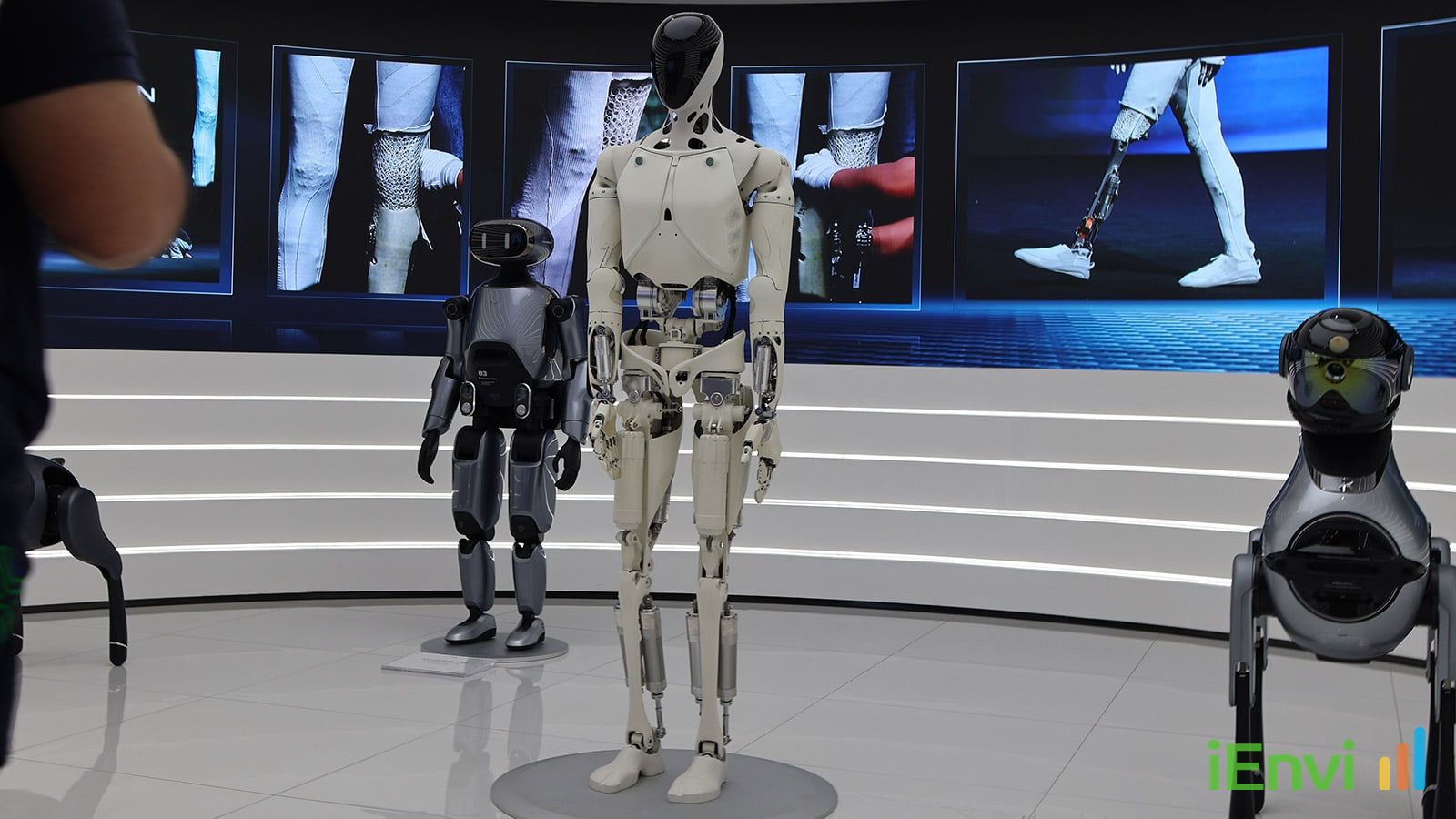
XPeng Humanoid Robot Global Rollout
Chinese electric vehicle manufacturer XPeng Motors has confirmed plans to scale monthly production of its IRON humanoid robot to more than 1,000 units by the end of 2026, ahead of a planned global commercial rollout beginning in 2027. The announcement, reported by The Wall Street Journal and confirmed by multiple industry sources in July 2026, marks one of the most concrete production commitments made by any automaker transitioning into what the company describes as “physical AI.” For professional services firms, including engineering consultancies, environmental practices, and industrial operators, the pace of this development is faster than most workforce and technology planning cycles have anticipated.
XPeng’s strategy is built on a straightforward but powerful insight: the hardware and software stack developed for Level 4 autonomous driving, including sensor suites, compute chips, vision-language models, and battery systems, transfers directly to bipedal robotics. Rather than building a humanoid programme from scratch, XPeng is repurposing an automotive-grade supply chain and AI model architecture that already operates at scale. This gives the company a structural cost advantage over dedicated robotics startups that are still navigating early-stage manufacturing bottlenecks.
The immediate deployment target is XPeng’s own retail network in China, where the IRON robot will serve as a showroom assistant and shopping guide from Q1 2027. International expansion is planned for later that year. However, the broader significance for professional and industrial sectors lies in the hardware maturity now being demonstrated. A robot with genuine dexterity, substantial onboard compute, and solid-state power is a qualitatively different proposition from the proof-of-concept machines that have dominated robotics media coverage for the past decade.
Key details: IRON robot specifications and production infrastructure
The XPeng IRON humanoid robot stands 178 centimetres tall and weighs 70 kilograms, placing it within normal adult human dimensions. It has 82 total degrees of freedom across its body, with 22 of those concentrated in its hands alone. The hand design uses the industry’s smallest harmonic joints at a 1:1 human hand scale, giving the robot sufficient dexterity to handle fragile objects, unscrew bottle caps, and perform tasks that require fine motor control. This level of hand dexterity is relevant to any application involving object manipulation in unstructured environments.
The compute architecture is equally notable. The IRON robot is powered by three proprietary Turing AI chips developed in-house by XPeng, delivering a combined 2,250 TOPS (tera-operations per second) of effective edge-computing power. This onboard compute capacity allows the robot to process environmental data and make decisions locally, without requiring continuous cloud connectivity. The robot operates on XPeng’s second-generation Vision-Language-Action (VLA) foundation model, which is the same model architecture used in the company’s autonomous driving and robotaxi platforms. The VLA model enables the robot to interpret verbal instructions, perceive its environment visually, and translate those inputs into physical actions in real time.
On the power systems side, the IRON robot is the first humanoid platform to use all-solid-state batteries. XPeng reports that this technology reduces overall battery weight by 30 per cent compared to conventional lithium-ion configurations, while simultaneously increasing power density by 30 per cent. These figures are significant for operational endurance and payload capacity in field deployment scenarios. The transition to solid-state battery chemistry in a humanoid robot also signals that the technology is sufficiently mature for volume manufacturing, which has implications well beyond robotics.
To support the production ramp to more than 1,000 units per month, XPeng commenced construction in Q1 2026 on a dedicated humanoid robot production facility in Guangzhou covering 110,000 square metres. The facility is designed to integrate the full product lifecycle, from research and development validation through small-batch trial production to scaled commercial manufacturing. Morgan Stanley raised its forecast for China’s total humanoid robot shipments in 2026 to 50,000 units, with that figure expected to double to approximately 100,000 units in 2027. XPeng’s production target positions the company as a significant contributor to that national output, and as a direct competitor to Western robotics firms that have not yet achieved comparable manufacturing scale.
Australian context: physical AI and its implications for professional and industrial services
Australia does not yet have a domestic humanoid robot manufacturing sector, but Australian professional services firms, industrial operators, and government agencies are directly in the path of this technology’s commercial trajectory. The 2027 international rollout timeline XPeng has announced is not a distant horizon for Australian business planning. Asset owners in the resources, utilities, infrastructure, and property sectors are already evaluating automation roadmaps that extend to 2030 and beyond. The emergence of commercially available humanoid robots at automotive manufacturing scale should be a concrete input into those planning exercises, not a speculative footnote.
For Australian engineering consultancies and industrial operators, the relevance is practical. Structured and semi-structured industrial environments — including warehousing, manufacturing facilities, and utilities infrastructure — present near-term deployment opportunities for platforms with the IRON robot’s specification profile. Robots with 82 degrees of freedom, 2,250 TOPS of onboard compute, and solid-state battery power are a categorically different proposition from earlier-generation automation equipment. Australian firms involved in technology procurement, workforce planning, and asset management would be well placed to monitor XPeng’s 2027 commercial rollout closely, as it will provide the first large-scale real-world performance data for this class of humanoid platform outside of controlled manufacturing settings.
References and related sources
- Primary source: cnevpost.com
- investing.com
- themesetfs.com
- youtube.com
- itif.org
How iEnvi can help
iEnvi integrates technology and data-driven approaches into environmental consulting. We monitor AI and technology developments that affect how environmental professionals deliver services to clients.
This is an iEnvi Machete news summary. Prepared by iEnvi to summarise the source article for environmental professionals tracking AI, data, and technology developments that affect consulting and project delivery.
Published: 16 Jul 2026
Need advice on this topic? Speak to an iEnvi expert at info@ienvi.com.au or 1300 043 684, or contact us online.
Need advice on this issue? iEnvi provides practical, senior-led environmental consulting across contaminated land, remediation, ecology and environmental risk.
Contaminated land advice Remediation services Discuss your site Talk to iEnvi