

Overview
Researchers from the Australian Institute of Marine Science (AIMS) have published findings from a pioneering field study at Ningaloo Reef, Western Australia, quantifying the volume and composition of groundwater discharging from terrestrial aquifers directly into a World Heritage marine ecosystem. Published on 18 June 2024, the research was led by AIMS Research Scientist Dr Kay Davis and included master’s student Frederike Kunz and field researcher Michael Heldsinger. The study represents one of the most rigorous attempts yet to map groundwater-ocean connectivity along the Ningaloo Coast and to evaluate what that connectivity means for blue carbon storage potential in marine sediments.
The research matters because it closes a critical gap in coastal environmental science: we have long understood that groundwater discharges nutrients and dissolved carbon to coastal waters, but the rates, volumes, and ecological consequences of that exchange at Ningaloo have been poorly constrained. By quantifying those flows, the AIMS team has provided the baseline data needed to evaluate whether marine soils in this system are functioning as long-term carbon sinks, locking carbon away for hundreds to thousands of years. That finding carries direct relevance for climate commitments, nature-based solutions, and the legal obligations of landholders, developers, and resource companies operating near Australia’s coastal margins.
For environmental professionals advising clients on coastal developments, groundwater extraction projects, or carbon offset strategies, this research shifts the conversation in a practical direction. It demonstrates that terrestrial aquifer management is not a self-contained discipline. Decisions made about land use, dewatering, agricultural runoff, or contaminant plume management can propagate through the shallow groundwater system and produce measurable changes in the chemistry and ecology of adjacent marine parks. That is a compliance and liability exposure that many project proponents have not yet fully priced into their risk assessments.
Key details of the AIMS Ningaloo groundwater-ocean connectivity study
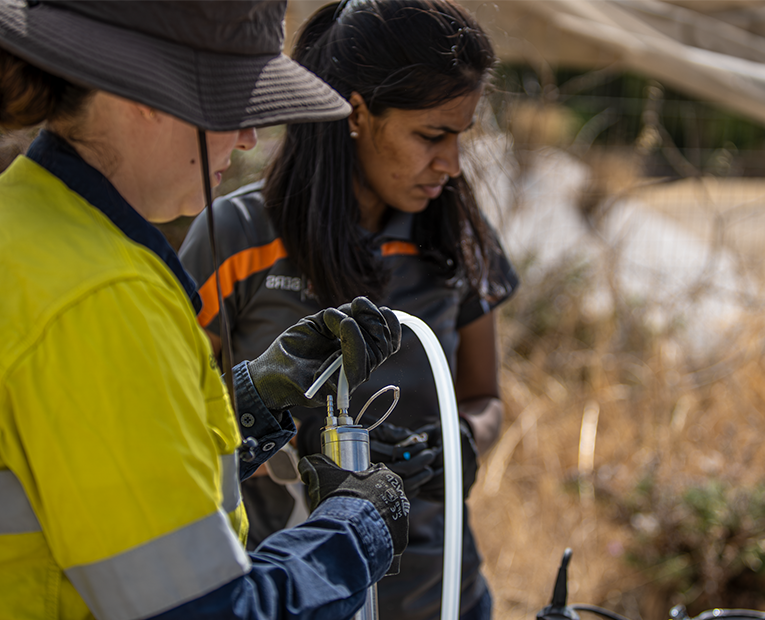
The AIMS field team collected samples from 33 groundwater sources across the Ningaloo Coast, comprising a mix of bores, beach groundwater monitoring points, and open springs. They paired those samples with 54 ocean surface samples collected across two distinct tracts: Cape Range and Coral Bay. The sampling design was built around radon as a natural hydrogeological tracer. Radon is a naturally occurring radioactive gas produced by the decay of uranium in soils and rock. Because radon concentrations are consistently elevated in groundwater relative to surface water, its presence in ocean surface waters provides a direct and quantifiable signal of submarine groundwater discharge. Measuring radon concentrations across the reef surface allowed the team to map the spatial distribution of discharge zones and estimate volumetric flow rates without invasive drilling or disruption to the marine environment.
A significant and unplanned variable during the fieldwork was the arrival of Cyclone Narelle, which delivered a large rainfall event mid-study. Rather than halting the programme, the team resampled the bore network before and after the cyclone, creating a pre-event and post-event dataset that is scientifically valuable in its own right. The pre- and post-cyclone data captured how a major precipitation event rapidly recharged and then flushed coastal aquifers, accelerating the transport of dissolved nutrients and carbon to the marine system. This kind of before-and-after extreme weather dataset is rarely available in hydrogeological studies of this type, and it provides direct evidence of the mechanism by which climate-driven rainfall variability translates into short-term spikes in terrestrial-marine nutrient loading.
The carbon storage dimension of the study centres on seaweed growth and decay cycles. Groundwater delivers dissolved nutrients to nearshore waters, stimulating macroalgae and seagrass productivity. When that organic material dies and is buried in marine sediments, the carbon it contains can be sequestered for very long periods, subject to sediment stability and the absence of remineralisation pathways. This is the core mechanism of blue carbon sequestration, and it depends critically on nutrient supply rates, which this study is helping to quantify for the first time at Ningaloo. The AIMS research therefore provides a foundational dataset for any future blue carbon accounting or offset methodology applied to this World Heritage Area.
The regulatory context for the study site is significant. Ningaloo Reef is inscribed on the UNESCO World Heritage List and falls within the Ningaloo Marine Park, which is jointly managed under Commonwealth and Western Australian jurisdiction. Any action that has, or is likely to have, a significant impact on a World Heritage property triggers assessment obligations under the Environment Protection and Biodiversity Conservation Act 1999 (Cth). Groundwater extraction that measurably alters the discharge volume, nutrient profile, or salinity of water entering the reef system could, in principle, constitute a triggerable action under that Act. The AIMS data provides the kind of quantified baseline against which such impacts would ultimately be assessed.
Australian context: groundwater-ocean connectivity within Australian coastal environmental frameworks
Australia’s coastal groundwater management frameworks were not designed with submarine groundwater discharge in mind. In Western Australia, the Rights in Water and Irrigation Act 1914 (WA) governs the allocation and extraction of groundwater, and the Department of Water and Environmental Regulation administers licences for bore extraction and aquifer management. However, licensing decisions under that Act have historically focused on terrestrial water supply, irrigation demand, and aquifer sustainability in isolation from marine receiving environments. The AIMS findings at Ningaloo make a compelling case that this framing is incomplete. Where a coastal aquifer discharges measurably into a marine park or World Heritage Area, the downstream ecological consequences of extraction decisions cannot be treated as outside the scope of the licensing assessment. Environmental professionals and project proponents operating in the Ningaloo Coast region should be aware that the quantified connectivity data now in the public record materially strengthens the evidentiary basis for regulatory scrutiny of any proposal that would alter groundwater volumes or chemistry in the catchments draining to the reef.
References and related sources
- Primary source: www.aims.gov.au
- piaille.fr
- environment.qld.gov.au
- sers.net.au
- ienvi.com.au
- ANZG Water Quality Guidelines
How iEnvi can help
iEnvi provides specialist consulting services relevant to this topic. Our team includes CEnvP Site Contamination Specialists with experience across contaminated land, groundwater, remediation, ecology, and regulatory compliance.
- iEnvi groundwater services
- iEnvi ESG services
- iEnvi remediation and validation services
- iEnvi expert services and independent review services
This is an iEnvi Machete news summary. Prepared by iEnvi to summarise the source article for contaminated land, groundwater, remediation, approvals and site risk professionals.
Published: 22 Jun 2026
Need advice on this topic? Speak to an iEnvi expert at info@ienvi.com.au or 1300 043 684, or contact us online.
Need advice on this issue? iEnvi provides practical, senior-led environmental consulting across contaminated land, remediation, ecology and environmental risk.
Team credentials Contaminated land services Remediation services Groundwater services Talk to iEnvi