
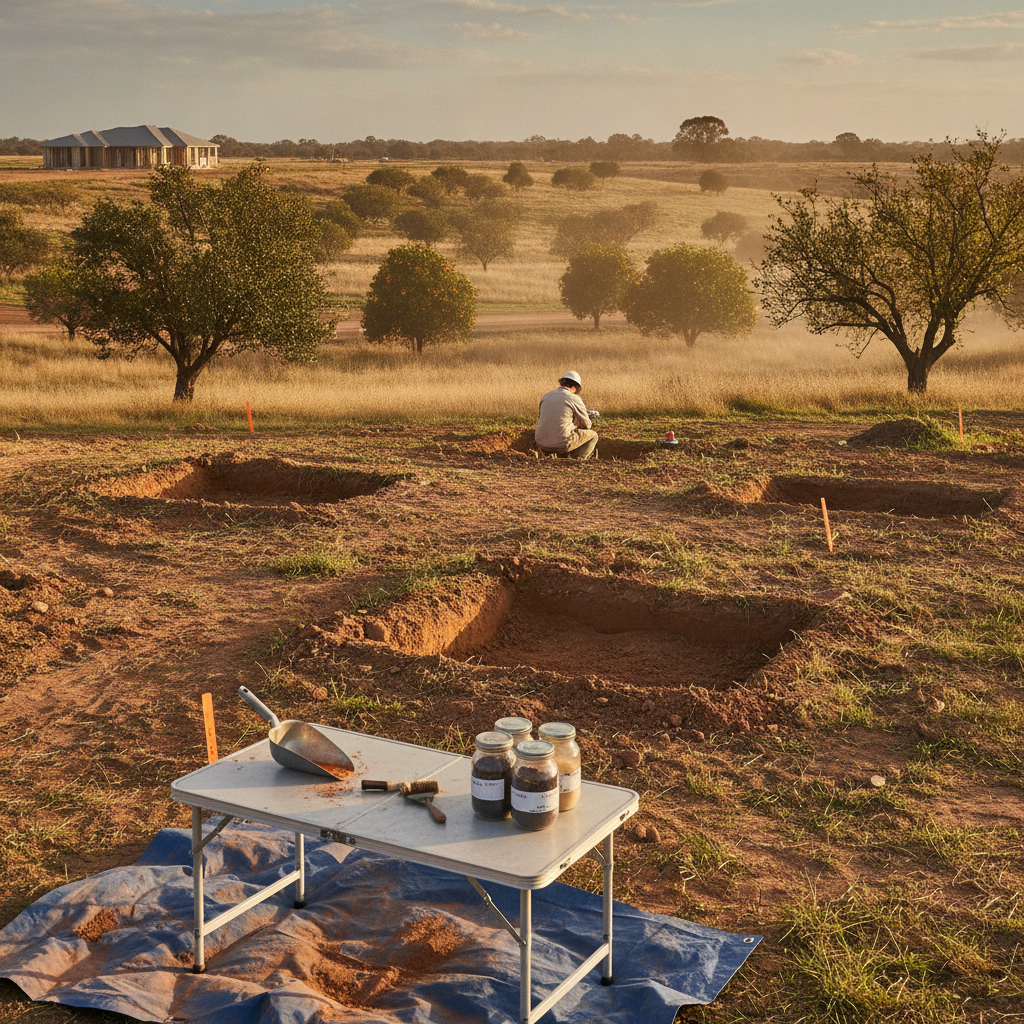
iEnvi completed a preliminary site investigation (PSI) and limited soil investigation for a proposed residential land division in northern Adelaide, South Australia. The work gave the developer a Tier 1 assessment of surface soil quality before subdivision and supported a planning lodgement on the basis that site contamination is unlikely to exist.
Why a PSI was needed for this land division
The parcel is a former almond orchard that had recently been cleared and sown to a cover crop. It sits within a Master Planned Township / Emerging Township Activity Centre setting under the Planning and Design Code. Orchard use is listed in Practice Direction 14 (PD 14) Schedule 1 as a Class 2 potentially contaminating activity. That history alone triggers a planning pathway that expects a PSI, even where the land has no known contamination listing.
Desktop checks against the SA EPA public register and a Lotsearch Enviro Pro report found no on-site contamination listings. Off-site environment protection orders, a petrol station and a recycling depot were all well removed from the site and were not considered a credible contamination pathway.
Scope of the investigation
- Desktop review of environmental setting and site history, including site identification through the SA Property and Planning Atlas (SAPPA) and a search of the SA EPA public register
- Review of an earlier PSI on the parent parcel, used as background history only
- Targeted (judgemental) surface soil sampling at eight locations, with field quality control samples
- NATA-accredited laboratory analysis for metals, total recoverable hydrocarbons (TRH), BTEXN, polycyclic aromatic hydrocarbons (PAH) and phenols across the program, plus selected analysis for volatile organic compounds (VOC), asbestos, organochlorine pesticides (OCP) and polychlorinated biphenyls (PCB) where the conceptual site model (CSM) called for it
- Comparison of results against Tier 1 residential criteria and a recommendation for planning lodgement
Soil results against residential criteria
Metals were the only analytes detected above the laboratory limit of reporting, and all were well below the National Environment Protection (Assessment of Site Contamination) Measure (NEPM) Health Investigation Level A (HIL A) for residential land. For example, the maximum arsenic concentration was 4.5 mg/kg against a criterion of 100 mg/kg. Organic compounds, OCPs, PCBs and asbestos were not detected. Quality control data were fit for Tier 1 screening.
On that evidence, the site was considered suitable for the proposed residential use without remediation. No further contamination investigation was recommended before the land division application was lodged with the PD 14 Schedule 2 declaration and certificate of title.
Practical takeaways for developers
- Former orchard land can still support a residential pathway where surface soils are clean and desktop evidence shows no credible contamination pathways.
- A PSI prepared for PD 14 lodgement is not the same as a Schedule 3 statement of site suitability. Match the report to what the planning authority is asking for.
- During construction, keep an unexpected finds protocol in place, stockpile any unusual material such as coal fragments or ash separately, and classify any soil before it leaves the site.
Related iEnvi services
Need a PSI or site contamination assessment for a land division in South Australia? Call 1300 043 684 or visit ienvi.com.au/contact/.
Related services for this project. iEnvi links delivered project work back to the service pathways clients use for similar sites — investigation, remediation, ecology and environmental management.
PSI services DSI services Contaminated land services Remediation services Talk to iEnvi