
What is low-flow groundwater sampling and when is it required in Australia?
Low-flow groundwater sampling (also called minimal-drawdown sampling) collects groundwater at flow rates typically below 500 mL/min, using a dedicated pump with its intake set at the middle of the screened interval of a monitoring bore. It is the preferred method on contaminated land investigations across Australia because it preserves in-situ water chemistry, minimises turbidity and produces representative samples of the mobile contaminant load. EPA Victoria Publication 669.1, the SA EPA groundwater sampling guidelines and PFAS NEMP 3.1 all endorse low-flow sampling as best practice for routine environmental monitoring.
Why low-flow groundwater sampling produces defensible data
Groundwater monitoring bores are expensive to install and maintain. Each sampling round generates analytical costs and feeds the decisions that follow: whether a site needs further investigation, whether a remediation system is working, or whether a site can be signed off for development. If the sampling method is wrong, the data are wrong, and decisions built on that data carry real financial and legal risk.
The traditional alternative, purging three to five bore volumes with a bailer or a high-rate submersible pump before collecting a sample, has largely fallen out of favour on contaminated land sites. High-volume purging draws water down from the saturated zone above the screen, mobilises fine sediment, oxygenates reduced groundwater and strips volatile organic compounds (VOCs) across the air-water interface. The result is a sample that does not represent what is actually moving through the aquifer toward a receptor.
Low-flow purging avoids each of these problems by drawing water gently from the screened interval at rates slow enough that drawdown stays minimal (typically less than 100 mm) and the geochemical conditions in the water column are preserved. For PFAS assessments, VOC investigations, dissolved metals and oxygen-sensitive parameters, that is the difference between defensible data and data that gets challenged at audit or review.
Equipment for low-flow groundwater sampling
Before arriving on site, confirm that the following equipment is available, calibrated and decontaminated:
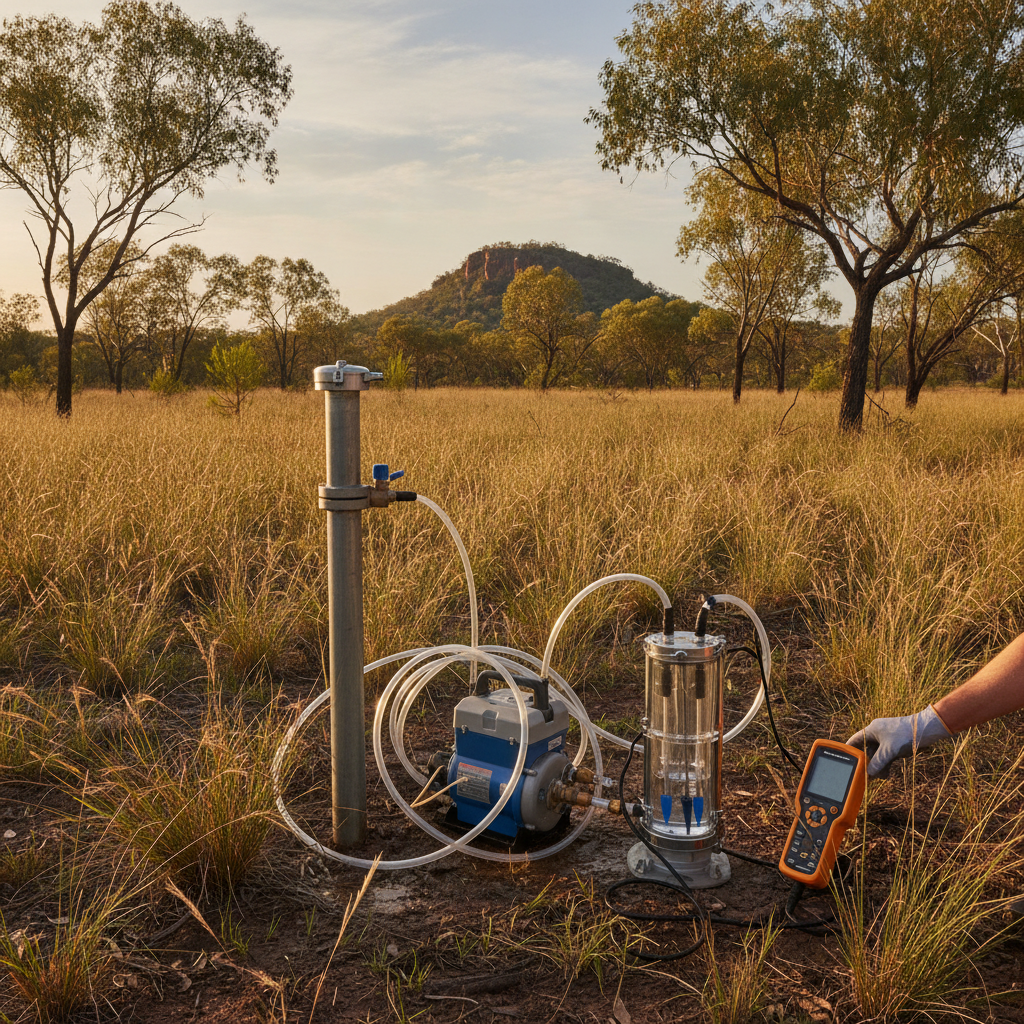
- Bladder pump or peristaltic pump: Bladder pumps (Solinst, QED and Geotech all make dedicated models) are preferred for volatile and semi-volatile compounds because they do not expose the sample to pump mechanisms or oxygen. Peristaltic pumps suit shallower water tables (generally less than 7 to 8 m of suction lift) and, fitted with HDPE tubing, are acceptable for shallow PFAS bores. Inertial foot-valve pumps such as the Waterra are useful for bore development and purging, but they agitate the water column and are not a low-flow method.
- Dedicated HDPE or polypropylene tubing: One set per bore, pre-labelled and stored in sealed bags to prevent cross-contamination. On PFAS sites, do not use PTFE or other fluoropolymer tubing: fluoropolymers can leach PFAS residues into the sample. A short silicone section in the peristaltic pump head is acceptable. Never share tubing between bores on a PFAS or solvent site.
- Flow-through cell: A sealed chamber connected in-line between the pump outlet and the sample vessel, allowing field meter probes to measure parameters without exposing the water to the atmosphere. This is non-negotiable for dissolved oxygen and ORP measurements.
- Calibrated multi-parameter field meter: Capable of measuring pH, electrical conductivity (EC), dissolved oxygen (DO), oxidation-reduction potential (ORP) and turbidity. Calibrate to manufacturer specifications before each field day.
- Flow controller or variable-speed drive: To set and hold the target flow rate. A stopwatch and graduated cylinder are a useful backup.
- Water level meter (electric tape or pressure transducer): To monitor drawdown during purging.
- Pre-labelled sample containers, cooler with ice, and chain of custody forms.
Step-by-step low-flow sampling procedure
Step 1: Bore inspection and water level measurement
Record the static water level (SWL) to the nearest millimetre using a decontaminated electric tape before disturbing the bore. Note the screen interval from the drilling log. Position the pump intake at the middle of the screened interval, or at the middle of the zone of interest where the screen spans multiple units, and keep it well clear of the bore base so settled sediment is not drawn into the sample.
Step 2: Equipment installation and flow rate setup
Lower the pump and tubing to the target depth, ensuring no kinking. Connect the flow-through cell in-line and insert the calibrated probes. Start the pump and set the flow rate between 100 mL/min and 500 mL/min. On highly permeable sands or gravels, up to 1 L/min may be acceptable if drawdown stays minimal. On low-permeability silts and clays, reduce the rate further, as low as 30 to 50 mL/min, so the bore does not dewater.
Measure and record the water level after two minutes of pumping. If drawdown exceeds 100 mm from the SWL, reduce the flow rate. Excessive drawdown means the bore is being purged faster than the aquifer can recharge it, which defeats the purpose of the low-flow method.
Step 3: Monitor stabilisation parameters
Record field parameters at least every three to five minutes throughout purging. Parameters are considered stable once three consecutive readings, taken at least three minutes apart, fall within the following ranges:
- pH: ± 0.1 units
- Electrical conductivity: ± 3%
- Dissolved oxygen: ± 10% (or ± 0.3 mg/L at low DO levels)
- ORP (Eh): ± 10 mV
- Turbidity: ± 10% and ideally below 10 NTU
- Temperature: ± 0.5°C
These thresholds are consistent with EPA Victoria Publication 669.1 and the SA EPA groundwater sampling guidelines. In practice, pH and EC stabilise first; DO and ORP can take longer, particularly in bores that have sat idle for extended periods. Do not start the clock until all parameters are trending consistently, and do not cherry-pick stable readings against unstable ones.
Record the volume of water purged. Low-flow sampling does not rely on purging a fixed number of bore volumes, but the purge volume is useful QA information and is routinely requested at audit.
Step 4: Sample collection
Once all parameters have stabilised, collect samples directly from the flow-through cell outlet or a dedicated sampling port, without disconnecting the cell or exposing the water to the atmosphere. Fill bottles in the order required by your laboratory: VOC vials first (no headspace, no bubbles), then metals, then general chemistry, then nutrients. Never rinse organic compound containers with sample water before filling.
Immediately cap and invert VOC vials to check for bubbles. If bubbles are present, discard and recollect. Record the field parameters at the time of collection as the final readings on the field data sheet.
Step 5: Sample labelling, preservation and chain of custody
Label each container with the bore ID, sample date and time, preservative (if any) and collector’s name. Photograph the labelled samples in the cooler as a QA record. Complete the chain of custody (COC) form immediately, cross-checking each bottle against the analytical request, and seal it in the cooler with tamper-evident tape.
Dispatch samples so they reach the laboratory well within method holding times. As a guide, VOCs in water preserved with hydrochloric acid have a holding time of around 14 days (shorter if unpreserved), and metals in acid-preserved bottles around six months, with mercury at 28 days. Confirm holding times with your laboratory when booking the analytical schedule, as they vary by method.
Step 6: Equipment removal and decontamination
Where dedicated equipment is left in situ between sampling rounds, cap and lock the bore casing. Where equipment is shared (not recommended on PFAS sites), decontaminate the pump, tubing and flow-through cell with a laboratory-grade detergent wash and distilled water rinse, adding a methanol rinse for organics, then a final distilled water rinse. Allow to air dry before storage.
Australian guidelines for low-flow groundwater sampling
Low-flow groundwater sampling is referenced or endorsed in several key Australian documents:
- ASC NEPM Schedule B2: The National Environment Protection (Assessment of Site Contamination) Measure, Schedule B2, is the national guideline on site characterisation. It frames how groundwater investigations are designed and expects sampling methods that deliver representative data.
- EPA Victoria Publication 669.1, Groundwater Sampling Guidelines: The primary Victorian reference, specifying stabilisation criteria, equipment requirements and documentation standards for monitoring bores on contaminated land assessments.
- SA EPA groundwater sampling guidelines: Align with the low-flow approach for licensed site monitoring and require a flow-through cell for sensitive parameters.
- PFAS NEMP 3.1 (June 2026): Reinforces low-flow sampling for PFAS site investigations, noting that high-volume purging can generate large volumes of PFAS-contaminated purge water requiring managed disposal.
- AS/NZS 5667.11:1998, Water Quality, Sampling: The Australian standard for groundwater sampling, providing overarching guidance on sampling design and technique.
Collect quality assurance samples at the rate set by your sampling and analysis quality plan. As a minimum, collect one field blank, one trip blank (for VOC sites) and one duplicate per sampling event, or as specified by the regulator or remedial action plan. Retain field meter calibration records with the field data and submit them with the laboratory report.
Low-flow groundwater sampling FAQs
Can I use a peristaltic pump for PFAS groundwater sampling?
Yes, where the water table is within suction lift. A peristaltic pump fitted with HDPE tubing is an accepted method for shallow PFAS bores, and a short silicone section in the pump head is acceptable. What matters is avoiding fluoropolymer materials: do not use PTFE or other fluoropolymer tubing, as these can leach PFAS residues into the sample. For deeper bores, use a dedicated bladder pump (Solinst, QED or Geotech) with HDPE tubing. Inertial foot-valve pumps are not a low-flow method and should not be used for PFAS sampling.
How long does low-flow purging take compared with high-volume purging?
It depends on the bore and the aquifer, but in practice low-flow purging usually takes 20 to 60 minutes per bore to reach parameter stabilisation. High-volume purging of three to five bore volumes is often faster in high-yielding bores, but slower in low-yielding bores that need to recover between purging phases. On programs with many bores, a common scenario on large industrial sites, the time difference per bore matters less than the improvement in data quality and the reduction in purge water disposal costs.
What do I do if parameters will not stabilise?
Persistent instability usually points to one of three causes: a blocked or partially collapsed screen restricting inflow, a water table too close to the pump intake causing intermittent drawdown, or a bore intersecting multiple water-bearing zones with different chemistries. Document the instability clearly in your field notes, reduce the flow rate to the minimum achievable, allow the bore to partially recover, and attempt a second purge. If stabilisation still cannot be achieved, record this on the COC form and in the data report; never fabricate stable readings. The laboratory data may still be useful but should be interpreted cautiously.
Low-flow groundwater sampling with iEnvi
iEnvi’s field teams carry out low-flow groundwater sampling on contaminated land sites across Queensland, New South Wales, Victoria, South Australia and Western Australia, using dedicated equipment and disciplined QA/QC. Our Certified Environmental Practitioners (CEnvP) design sampling programs that satisfy state EPA requirements and PFAS NEMP 3.1, with data quality suitable for regulatory audit and legal scrutiny on property transactions, remediation projects and compliance monitoring.
Whether you need a one-off sampling event, a long-term monitoring program, or an expert review of groundwater data collected by others, we bring the field discipline and reporting quality your project requires.
Contaminated land services | Groundwater and water services | Remediation services
Planning a monitoring round, or need your sampling methodology reviewed before an audit? Call iEnvi on 1300 043 684 or contact us online to scope a groundwater sampling program that holds up to scrutiny.
Need advice on this issue? iEnvi provides practical, senior-led environmental consulting across contaminated land, remediation, ecology and environmental risk.
Team credentials Contaminated land advice Remediation services Groundwater services Talk to iEnvi